
I, among many other Dallas residents, have signed up to speak at tomorrow’s City Council meeting, where it appears a final vote will be taken on whether to relocate our city government out of its current home at 1500 Marilla. At least, if the meeting happens. A lawsuit seeking delay has been filed late Monday, asking for a temporary injunction that would stop the meeting from taking place, though I don’t love the lawsuit’s chances.
Relocation from City Hall would free up the site for potentially new, catalytic uses, including a not-totally-out-of-the-question Mavericks arena.
Staying would involve some level of repair to the building, in an amount that is far from universally agreed upon. Since 2018, four independent studies have variously concluded the costs of needed repairs at around $150 million, $300 million, $324 million, and what was briefed to council last week, a range of $532 to $611 million depending on how you phase the repairs out over time.
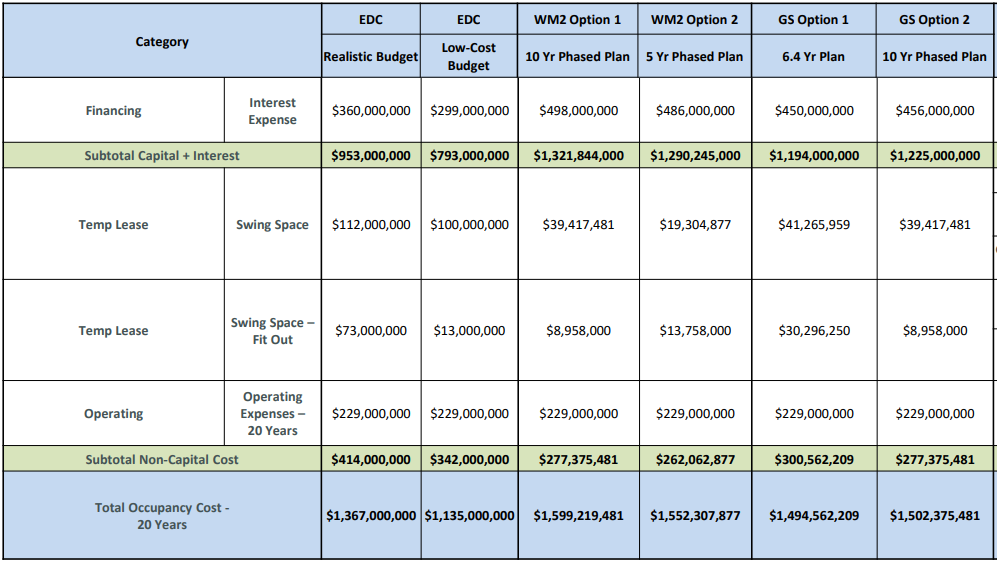
Those are just the repairs themselves, saying nothing of the added expense of financing the bill. With financing and all ancillary costs like moving or furniture added in, all of the studies we have in front of us today conclude the cost to stay at City Hall stretches into the billion-with-a-b range. Where I grew up, that’s a lot of money.
Tomorrow is going to be a long meeting. I have the distinct honor (you get put on the list in the order you signed up) of speaking one spot before legendary Dallas journalist and author Jim Schutze, and after several former mayors. It will be quite a who’s who crowd (and me).
Regardless of the outcome of this meeting, I have a few thoughts I want to put down on paper now, partially for posterity’s sake.
To start, there’s a good chance, at least looking at the statistics that Substack gives me, if you’ve read anything I’ve written, it’s the three-week series I did on City Hall in February. Why to demolish the building, what we should really expect it to cost (and cost of the alternatives), and the vision of Downtown Dallas you need for any of this to make sense. If you’re still on the fence about any of this or want a refresher, start there.
Those were the very first articles I wrote, and I had the benefit (or burden) of being really the only one publicly litigating the case for relocating those early couple months. A voice of one crying in the wilderness, if you will. “Save Dallas City Hall” had already begun to form as a rallying cry, but a coalition of us had not yet coalesced on the opposite side, a group I lovingly refer to as “Save Dallas From City Hall.”
I point this out, because even with hindsight, and even being early, I have great comfort in standing by everything I have said about City Hall.
When I started writing in February, people were objecting to the size of the $324 million repair estimate, or $1.1 billion total all-in budget with financing and relocation expenses. (People are still objecting to them, for what it’s worth.) The argument against these figures was they had been trumped up in order to justify the building’s demolition. (This is still largely the argument.) One variety of comment I saw often on social media was that the real cost would be little more than $150 million, or that they had a cousin that worked at City Hall and he said it would only be $100 million, something along those lines.
The latest estimate found the costs would be higher than the previous study, which mind you was done only in February, by nearly $300 million, with the all-in cost now at $1.6 billion. This increase came after they looked zone-by-zone and floor-by-floor through the building, and accounted for having the building occupied in part during all repair work. With every round of peer-review and independent analysis, the numbers keep getting bigger, not smaller.
Further, if you look outside of Dallas, as I detail more towards the end of today’s newsletter, you are hard pressed to find any large public building modernization projects that have cost much less than what is being proposed Downtown. In fact, many of these cases call into question whether the current estimates are high enough.
For example, the latest study estimated that HVAC upgrades at Dallas City Hall will cost $44 million, to replace or upgrade the original 1970s system. Boston City Hall, a brutalist-style office building of almost exactly the same square footage and age as our own, started pricing replacements for its original HVAC system late last year, and it expects to spend $93.6 million (page 5) to replace only the building’s air handlers, not including the chiller plant that actually cools the air. Examples like this offer little comfort for heading off on a modernization crusade of our own.
Second, I have been reflecting on what bothered me so greatly about the City Hall debate that I felt the need to publicly weigh in on it, at length, for weeks. I think I have put my finger on it, and it’s what still bothers me about this debate today. Preservation, specifically preserving buildings that are historic in a City’s life, is absolutely something we must weigh when making decisions.
It is not however, the end of the conversation.
When I hear or read the “Save City Hall” speeches and posts, I fail to find too much with which I disagree. The building has a design, an architect, and a role in Dallas’s public life that all make it noteworthy. If we tear it down, the world will have one fewer example of brutalist architecture, designed no less, by one of the world’s most awarded architects, I.M. Pei.
But what is that worth? A million dollars of taxpayer money? Sure. A hundred million? Eh. Maybe.
A billion?
At risk of repeating myself, decisions like this, any decision in running a city, are about tradeoffs. Every decision our elected leaders make is about which of two “good” things we will have less of: in this case, more historic preservation or more money available for roads, safety, and parks.
This is why I think the argument from the Save City Hall folks is never that renovating City Hall is a good use of taxpayer funds. Instead, the argument is almost the opposite, that it won’t really cost as much as we think. This downplays the long-term cost of preservation by simply wishing or pretending large buildings like this do not cost a lot of money to maintain, particularly when decades have gone by without the needed investments.
I have a problem with this. This is a politics that ignores tradeoffs. It is a disease that is not unique to Dallas and not unique to this one debate about a building, to be sure. Of course, preserving unique, historic buildings is a good thing. But what are we willing to sacrifice to do that? We are closing four libraries this year already. Please, into the microphone, pick which parks and libraries you’d close to renovate City Hall.
On my side, demolishing City Hall will not be free. Buying another building to move into, not free either. Fitting that building out with a new apparatus of government, again, it will all cost money. But how much money is what matters. Fort Worth just accomplished a City Hall move for $230 million, buying a vacant office building in its Downtown and turning it into a new seat of government. We know this works, and we know today what it costs with much greater certainty than a repair program that will hit unforeseen costs and obstacles.
We have to name what we’re willing to lose, what our proposed alternative costs, and who it will hurt. Until we do that, we don’t really have a plan, we only have a preference.
Third, and perhaps most importantly, I can’t help but wonder if the City Hall conversation is just the top part of a larger iceberg, the visible portion of deeper issues floating mostly below the surface. Simultaneously, we seem to be having, on at least four fronts, several civic conversations about why everything sucks right now, and each is inexorably related.
Do our ‘weak mayor’ and ‘14-1’ council systems create worse outcomes than alternative systems would, as argued in D Mag by former mayor Laura Miller?
What is Dallas’s role as the metropolitan core of the DFW Metroplex?
What responsibility does the city have to subsidize and retain professional sports teams within the city proper vs. in the suburbs?
What should the City do to encourage vitality and activity in our urban core, namely Downtown?
I couldn’t possibly get to all four of the questions this week, or even in one week. However, the wrapping up of the City Hall saga that launched this blog, assuming it wraps up tomorrow, may have just been the start of a longer conversation where demolishing City Hall is just one symptom.
I have a nagging suspicion about where exploring these issues is going to take me. I do think they are all related, or at least, in answering one, you will never avoid talking about the others.
What I want to tease you with today is what I am starting to call my “housing theory of everything” that explains both our declining preeminence in our eponymous Metroplex and why our financial decisions are increasingly constrained as a city. In the table below (the data stops at 2023 because that’s as far as we have the jobs data), Dallas over the prior decade continued to add jobs at an astonishing pace. Housing units and households, however, have far from kept up.
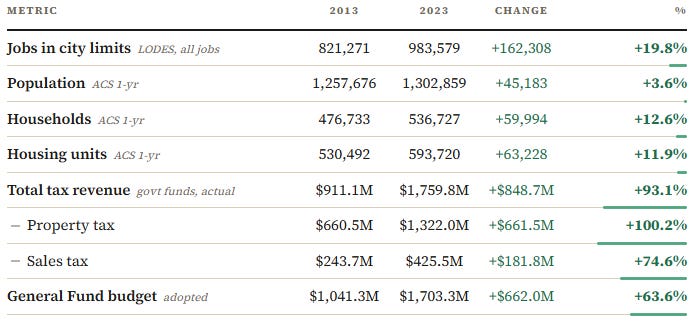
The problem with this, is that in Texas, jobs don’t pay taxes, property does. It does the city almost no good, from a pure tax revenue perspective, to have someone work in Dallas and live in Celina. Other than what their employer pays in property taxes on the office building (which have largely been declining in value since the Pandemic), or what we collect in sales tax when they eat lunch out, there is almost no revenue created from one extra job in Dallas, at least compared to one extra house in Dallas.
Over this period, the city added only four houses for every ten new jobs we created in Dallas proper. In a healthy housing market, or one that is not supply-constrained, you would expect to see that number be closer to seven new houses for every new ten jobs, based on national averages, or an average of 1.5 jobs for every household.
Interestingly, you may have noticed in the table, our population has not grown as fast as our number of households. Since every household, by definition, must have at least one person in it, this implies some other part of the population is actually declining. So, despite adding single-person households in the areas we’ve added more apartments like say Oak Lawn and Uptown, we are actually losing population in areas that previously held more people, largely families with children. The families, the parents at least, are largely still there. It’s the children who have grown up and moved.
I don’t think we’ll start to unravel all our current problems, how to revitalize Downtown, how to compete with the suburbs, how to pay for things residents say they want, like libraries, or even preserving City Hall, without having more people living here to pay for them.
We can only grow our population if we build the housing for people to live here in the first place. I’ve said before, population is an output, not an input. This isn’t “if you build it, they will come,” but rather “if you don’t build it, they can’t come.”
Celina, Princeton, Melissa, Anna, and Forney added as many people in a single year in 2025 as we added in a decade. At one point in 2024, there were more apartments under construction in one ZIP code of Collin County than all of Dallas proper.
I don’t know that building more housing will by itself solve every budget or financial problem that Dallas faces. I know it won’t. This may not be the only cure for everything sucking.
But I also don’t see which of our current problems it makes worse. I can’t imagine how having more people to shoulder the same tax burden, to fill up sports arenas, to use our libraries and our parks, or to once again clearly announce Dallas as the top dog in the Metroplex, could at all be a move in the wrong direction.
So, maybe we can work on that next.
love/hate/other to Kirk at onemansdallas@gmail.com
And now, for your moment of Zen, below is the speech I plan to give tomorrow.
Good morning, Mayor and Council.
My name is Kirk Presley. My wife and I live in District 6.
We will lose something when we tear down City Hall.
I want to say that plainly.
It is a noteworthy piece of Dallas architecture. It embodies an ambitious idea: that the City’s hopes and image could be shaped by concrete and glass.
But what we lose cannot be the end of the conversation.
Imagine if staff stood here today to propose a brand-new City Hall.
A famous architect. A unique design, something you wouldn’t choose for your own home, but distinctive, to be sure. It would sit on twenty acres of prime Downtown land.
Here’s the catch: a price tag of $1.6 billion over twenty years.
That is more than a thousand dollars per Dallas resident. Nearly three thousand per household.
Would you spend $3,000 of your family’s money that way?
Imagine the emails. Imagine what this council chamber would look like if you were asking taxpayers for $1.6 billion to build a new City Hall.
We will lose something when we tear down City Hall.
But we will gain something, too.
We will gain twenty acres of Downtown that can actually serve Dallas again.
We will gain the chance to see Downtown flourish as the crown jewel of the metroplex, not rot at its core.
We will gain over a billion dollars we will not spend restoring a building we would never choose to build today.
Some will say, Kirk, it will not really cost that much.
The Minnesota State Capitol. The United Nations in New York. The Utah State Capitol. San Francisco City Hall. Even, the Dallas County Records Building, three blocks from here.
Each of these buildings cost between $800 and $1,000 per square foot to modernize, adjusted for inflation.
That puts City Hall’s repair bill comfortably above the $500 million mark, before adding financing, moving, and operating costs.
We will lose something when we tear down City Hall.
But the question is not whether we will lose something.
The question is whether preservation at any price belongs on the backs of taxpayers. Of our children. Of our grandchildren.
I do not believe it does.
Thank you.

You might have only two minutes to deliver that speech. Hope you talk fast.
You put better into words, more than I can, an objective sense of reason about the issue. Thank you, sir!