
The last few weeks I have been circling the same question from different directions. What is a city for? What do we all owe each other for living in one?
Two weeks ago, I argued that living in a city means living close enough to other people for their lives to affect yours. That is the bargain, usually for the better. The schools and hospitals and parks and jobs do not arrive separately from the traffic, the noise, the apartment building, the stranger. A city is how ordinary people afford a life none of us could buy alone.
Before that, I promised that every political choice has a cost, and that the work of politics is not pretending otherwise, but being honest about who pays and why. Choices should hurt. If it does not hurt, we have not understood what we are giving up, or we are asking to give up nothing at all.
These two arguments collided at a microphone in City Hall a little over a week ago. That is where the collision most often happens, and it is one whose ripples are now reaching beyond the chamber, including a recall petition for a sitting member of the City Council.
The claim? No one is listening to our residents.
Listening
The Dallas City Council voted 9-5 on April 22 to approve a zoning change for three and a half acres of undeveloped land along Coombs Creek in North Oak Cliff. The change allowed about eighty homes (apartments, if you must) on a site previously zoned for about fifty homes, which would have meant more lot coverage and less protection for the floodplain. What the developer offered instead of straight multifamily zoning, was lot coverage capped at thirty percent, no short-term rentals, more parking spaces than the city would otherwise require, and a twenty-foot environmental setback from the creek.
Twenty-six speakers signed up to testify, most opposed. The hearing ran about two hours at the end of an already long council meeting. It was after 10:30 p.m. when the vote was finally taken.
Neighbors were not crazy for showing up. Eighty new homes on a dead-end street is not costless to the people who already live there. More people means more cars, more activity, more strangers, more moments that remind us of a city we share with a million other people.
During the meeting, Council Member Cara Mendelsohn, voting no, asked, “When are we going to start listening to our residents?”
The council had just spent the evening listening to its residents. People came to the microphone. They gave their names, their addresses, their worries, their reasons. They were heard.
What Mendelsohn meant by “listening” was something else. It is what most of us mean, if we are honest. She meant the council should have agreed with the residents she agreed with, and those residents should have been understood to speak for residents in general, who should have been understood to speak for The People, whose voice the council was elected to honor.
Each link in that chain is a small inaccuracy. Together they become a civic theology in which the people who show up become The People, and the act of their losing becomes proof that nobody listened.
The neighbors are not wrong to show up. They are doing exactly what the system is built to absorb. They are being listened to. The danger comes when their testimony is treated not as evidence to be weighed, but as sovereignty.
That is not what representative government is for.
Representative government exists because every private interest cannot be given final authority over the common life. Everyone gets a voice because everyone has dignity. No one gets a veto because, well, then everyone else does too.
We elect people to be tradeoff-weighing machines. That is their job. They listen to the people in the room, and then they are supposed to remember the people who are not in the room. The future tenant. The renter whose lease renews in August. The teacher who works in Dallas but cannot afford Dallas. The adult who grew up here and can no longer come home.
They are residents too, or they would be if we built them a place to live.
The costs of building are most visible to the people who live on a street. The costs of not building are scattered across people who do not yet know one another. The neighbor can point to traffic and say, “This will change my life.” The person priced out of Dallas cannot point to the apartment that was never built and say, “That would have been home.”
American political scientist Mancur Olson described this exact pattern in a famous 1965 book, The Logic of Collective Action, as “concentrated benefits and diffuse costs.” In this case, concentrated costs and diffuse benefits. A small organized group will fight hard for a benefit or against a burden that matters intensely to them. The larger public often will not organize because each individual share of benefit per person, per renter, is too small, too abstract, or too delayed.
Power is Power
The zoning case has the same geometry. On one side are the neighbors whose daily lives may change in understandable ways. On the other are the future neighbors who will call these apartments home. Behind them are Dallas’s hundreds of thousands of renting households whose rents are set by a market that responds, slowly and imperfectly but in the long run, to whether we build enough homes.
If the “unknown future neighbors” are too abstract for you, the City of Dallas conducts a city-wide citizen survey every year. The 2025 edition found that 46% of Dallas residents believed “access to affordable, quality housing” should be one of the city’s top priorities. First place, and it isn’t close. The 2024 and 2023 surveys said the same thing. Again and again, housing comes first as the top issue residents think the city should prioritize.


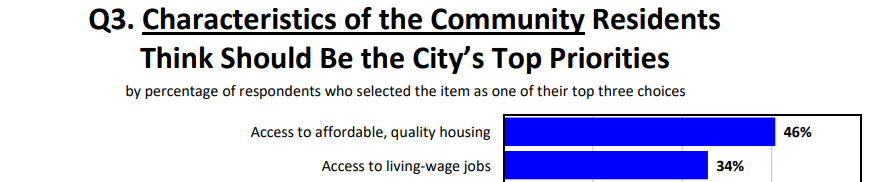
The hundreds of thousands of residents in this city for whom housing is a top priority were not at the microphone that night. That includes the majority of Dallas residents who are renters and see their rents going up every year, or who would live in the neighborhood they grew up in if they could afford it, or who are telling themselves Celina isn’t really that far away.
Here is what bothers me. It is not the anger. Anger is ordinary. It is not the self-interest. We all have interests. It is the laundering of self-interest through the language of democracy by equating the loudest voices with the ones most worth listening to. It is the conversion of “this imposes a cost on me” into “the city has no right to choose otherwise.”
The danger in local politics is that domination often arrives wearing the clothes of neighborliness. The thing being requested is still power: the power to decide that other people's need for housing matters less than one's own desire for things to stay as we imagine we like them.
Power is power. It does not become more noble when exercised by a neighborhood association instead of a corporation. A veto does not become more democratic because the people asking for it say “residents” a lot.
If you oppose eighty homes on your street, say so. If you believe the traffic, parking, drainage, or change are too much, make that argument. But then say the rest of it. Say that your preferred outcome means fewer homes. Say that it means fewer people can live near the jobs, parks, schools, and grandparents that make Dallas worth living in.
The tradeoffs do not automatically make you wrong. I only argue we all owe each other the obligation to name them.
Here’s my turn. This does not mean every project is good because someone might live there. I cannot tradeoff-launder my side to always be right. Not every idea that a real estate developer has ever had is a good one. Let me say that from personal experience.
Further, not every block of this city is an apartment complex that just doesn’t know it yet. Our neighborhoods should be places where people can make a life and stay long enough to know the dogs and the kids and the cracked sidewalks. That can include homes of more shapes and sizes, for more ages and stages. The list of options should always include single-family homes. What I am submitting is there is an option for “protecting the neighborhood” that is not never building anything in it ever again, but instead, building units that will serve younger families, downsizers, widows, or retirees better than the four-bedroom house.
The Recall
After the zoning vote, a campaign appeared online to recall Chad West, the council member in whose district the case was located. The first justification cited for the recall: “Failure to meaningfully listen to and respond to residents.”
As of this writing, recallchadwest.com is anonymous. (I get to criticize that now.) They are saying there are people who need to be listened to, but they just aren’t ready to specify whom. The domain name of the website is registered through a service that hides the name of the person who bought it. I reached out on April 28 to the listed contact email on the website, but no one got back to me.
The speakers at the zoning hearing, to their credit, accepted the cost of being identified. They came to the microphone, gave their addresses, and stood by their preferences in front of their neighbors.
The unnamed organizers of the recall have not done the same. They want the moral weight of what their website labels “grassroots organizing” without the burden of belonging to a community in public. Where the rhetoric of “We the People” is turned up the loudest, the names of those people are absent.
West was re-elected less than twelve months ago with 59% of the vote. He was re-elected on a public record that included workforce housing and zoning reform. This vote was completely consistent with that record.
Elections are how residents are listened to. Public hearings matter, but they are not a replacement for the voting booth. The people who returned West to office are residents too. Representative democracy works because our officials have to face all of us, at regular intervals, and we get to decide together how good of a job they did at listening.
A veto
The angry neighbor is so close to being right. He is right that his street matters. He is right that people who live on a street facing change are owed a voice.
But that thinking allows us to make a fatal move. We treat the fact that a concern is valid as proof that it should be decisive. We mistake injury for authority. We mistake being heard for being obeyed.
That is the line I am asking all of us to do the hard work of drawing.
A city is the place where your good and my good have to survive contact with each other. Our desire for quiet is legitimate. Another person’s need for a home is also. Our fear of change is human. Another family’s hope to make a better life here is too. Politics is the hard work of weighing those realities without pretending any of them vanish because they are inconvenient to our side.
A veto is not just a “no” to a project. It is a “no” to the city as a shared undertaking. It says the present resident counts, the future resident does not. The visible neighbor counts, the absent neighbor does not. The person with a microphone counts, the person priced out before they ever got one does not.
This line of thinking reduces a city into a customer service department. It bothers me every time I see the city use the new motto, “Service First” (recently expedited to “Service First, Now!”). I understand what it means. The pothole should get fixed. The trash should get picked up. Fine.
We are not customers. We are not consumers of products made by a corporation called Dallas.
We are citizens.
That is a reciprocal relationship. It means the city owes us something, and it also means we owe something back. It means that on some days, the city will ask more of us than it gives us. Patience, or inconvenience, or willingness to live near people we did not personally invite.
That is not the burden of living in a city. That is the point.
love/hate/other to Kirk at: onemansdallas@gmail.com

This is pretty typical for city politics. American politics has struggled from the founding with what the framers called the "mob" or the tyranny of the majority. With the financial incentive of your single family home being our biggest, most valuable asset, then vociferous opposition to anything that reduces the value of this asset is baked in. It plays out every single day across this nation. The paradox is these homeowners are planning to sell the valuable asset of their homes to fund our downsizing in their old age. Then, they won't be able to find a smaller unit in their old neighborhood.
One way a smart city could balance the needs of the property value partisans and the need for more affordable housing is to set the standard that the developer make a case for how its development will enhance or be neutral as to the property values in the neighborhood. I believe such a thing can be done. Business can conform to the people's needs and still do its project. Nobody ever seems to ask it to do that though.
A fact which developers could use is that as these single family homes soar in market value, young families with children can't live there. This causes the school district to decline in enrollment and funding - especially as over 65 exemptions kick in. When the school district declines, guess what? Home values decline. A smart developer could also play up how nice their apartment will be for future retireees.
Good leadership at City Hall would think of the long-term viability of the City. It might listen, analyaze and synthesize each project by throwing the good of the City into the mix. But, it usually does not. City councils usually just wait for the mob to show up at council meetings and then react by placating it. In smaller cities, everyone in city hall usually has a day job. This limits the "vision thing" for them.
These are fair points about listening versus leading. But when there is a continued pattern, influenced by boards strategic board appointments, as well as the elected with an agenda,... that treats residents as adversaries, we get to this point. Pepper Square was proposed to the city and area to be 12 stories… So of course residents were up in arms about that in their single family neighborhoods below. The reality is that it will be 4 now after all the financing has come through. Why put residents through the ringer when it's just not necessary? The council person did not even feign "representing " her constituents, at a time when the project, was apparently not well planned. Leadership means guiding, ..not ruling one way or the other.