
Last week in Part I of this series, we took a look at the history of zoning: how zoning became the default for building the modern American city, how at its onset it was questionably unconstitutional, and how its reach has crept far beyond health and safety issues, becoming a catch-all for the regulation of daily life.
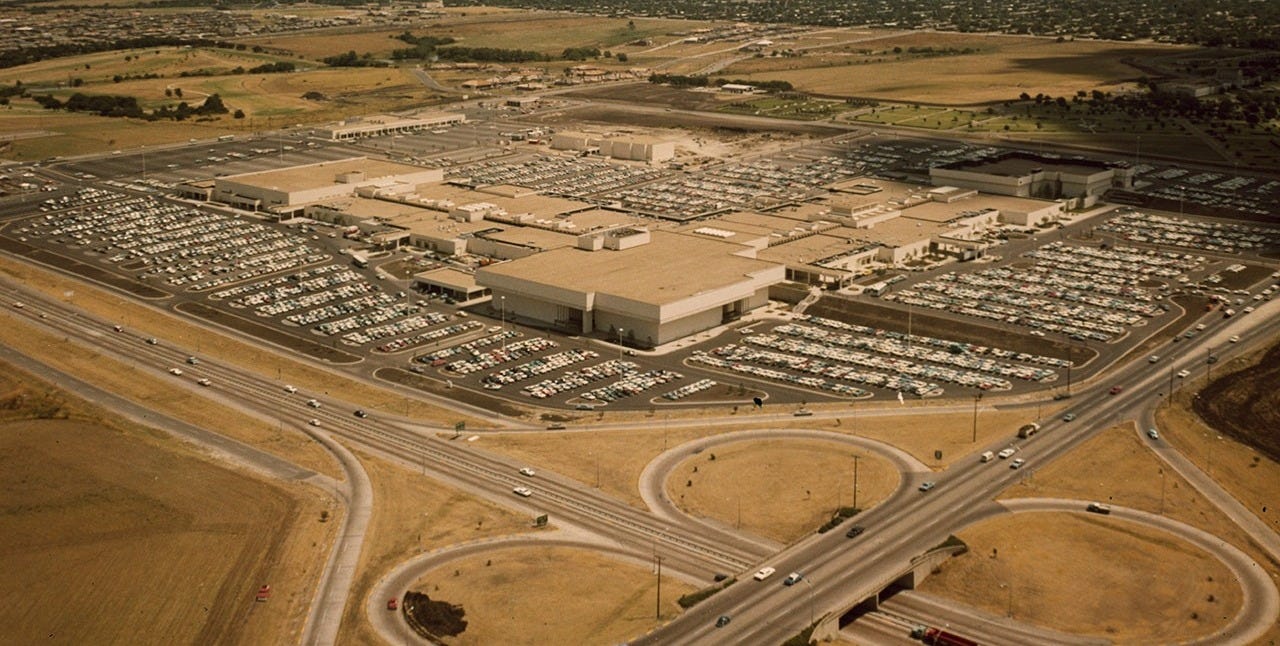
Today we are going to keep it strictly local. As a city, we are about to embark on a full rewrite of our city’s development code, which has only been comprehensively updated one time since 1965. That means parts of our zoning code are exactly as old as NorthPark Mall, and for reminders, here’s what Dallas looked like at that time.
About 16% of that 1965 code still persists word for word today, the largest revisions coming in 1987. Most of the rest, about 78%, comes from that Reagan-era update. However, our single-family districts, the type of zoning that covers close to 65% of the city and about 86% of where we allow housing, have hardly changed in the ways that matter since the 1960s. These zoning districts, which in their own words, set aside some of the city for “estates” and other parts for “moderate value” housing, have escaped major revisions. There were seven districts in 1965. There are seven of them now.
All seven districts were and are built atop the same two essential commandments. The first: thou shalt not build more than one home on a lot. The second: thou shalt not build a house on a lot that is any smaller than a minimum size we picked in 1965. Those two rules, in conjunction, gave us the Dallas we know today. One lot means one house, not two, or four, and the size of those lots has a minimum, which would differ depending on which neighborhood or part of town you were in. The districts themselves are named after that minimum size: in R-7.5 we require a house to be built on 7,500 square feet of land, in R-16 it is 16,000, and in R-1ac it is a full acre.
Those two commandments seem like they might be laws of nature, or handed to us on a mountaintop. It’s hard not to think of a neighborhood as a place with mostly houses that don’t touch each other. But, they’re just rules on a piece of paper someone in Dallas wrote down sixty years ago. All kinds of people in all places and times have gotten by just fine without rules like this: big cities on the East Coast, Europe, or even here in Dallas for most of our own first century.
With the upcoming zoning rewrite, we are all collectively about to decide whether or not we want to keep these two rules. Up until this point, I don’t think we have ever stopped to ask what they are for, what they cost, or why we have cleaved to them for so long. Answering that means going back even further than 1965, into Dallas’s own long and weird history with zoning, which is both oddly well-documented and even more oddly, well, racist.
In 1916, Dallas became the first city in Texas to segregate housing by race via city ordinance, reserving separate blocks for White and Black residents. We lifted that ordinance directly from Louisville, KY, which had passed a nearly identical law two years earlier. Both ordinances began with the stated goal that segregating housing would “prevent conflict and ill-feeling between the white and colored races.” A year later, in Buchanan v. Warley, the U.S. Supreme Court unanimously struck down the similar ordinance in Louisville.
Dallas did not take the hint. In 1924, we passed a second ordinance, this one making it a crime to break a private agreement that provided for segregation. In other words, Dallas could enforce segregation as long as it was contained in private agreements, such as deed restrictions, and not through a public ordinance. When my wife and I bought our first house, the packet of paperwork from the title company showed, in fact, our street had once had such a deed restriction governing it. If you live in Dallas, especially in a pre-war neighborhood, and are a big enough nerd to have read your house’s title work, there’s a good chance you would have seen the same.
The Liberty Annex Corporation, a residential developer with homes to sell and twenty or more Black families wanting to buy them, sued the city over this ordinance. In court, Dallas maintained that the police power, exercised “in the interest of public peace and the general welfare,” still authorized the city to enforce residential segregation. As we discussed last week, that is the same “police power” Justice Sutherland had upheld in Euclid three years earlier as permitting the general idea of zoning, but applied now to races instead of warehouses. The court flatly rejected Dallas’s argument in June 1929, holding that ordinances “segregating whites and blacks, based on the color line,” were unconstitutional and unenforceable, and struck down Dallas’s law.
Seventy-four days later, Dallas adopted the city’s first comprehensive zoning ordinance.
The new ordinance did not classify people, nor housing, as white or Black. It didn’t need to. It was facially completely race-neutral. It instead added the requirement that houses come with minimum quantities of land, in an amount that differed from zone to zone. On the high end, homes required 6,000 square feet of land, and in some districts, it could be as low as 375. Land isn’t free. So, a house with more land is a more expensive house. Require 6,000 square feet under every house on a street and you have effectively set the lowest price at which a house can be built. Allow the smaller, more dense housing only far away in another zone, and you’ve created a pretty good fallback without de jure segregation
The ordinance offers no health or safety justification for why some neighborhoods would be just fine with a family housed every 375 square feet, and why some neighborhoods, for their “general welfare,” would receive only houses built on at least 6,000 square feet of land. I note, the city didn’t yet think to go so far as to separate what it called “apartment houses” and “dwellings,” which consisted of up to two units, in most areas of the city. As long as you had enough land, you could build anything you wanted to: apartments, or duplexes and detached houses.
In 1943 the city hired Harland Bartholomew, a consultant who wrote zoning plans for cities across the country. What he noticed about Dallas, in his resulting report, was how “mixed” it was. Uses were “badly intermingled.” Some neighborhoods were labeled as “blighted” due to their “proximity to negro development.” To his horror, duplexes were scattered so widely that he could find very few single-family areas without one, and even apartments were turning up in the same neighborhoods.
It is a description of a city where you could potentially find cheap housing and expensive housing on the same street. To a mid-century city planner like Bartholomew, that was a defect. He proposed giving duplexes and apartments their own limited districts and reserving far more of the city for single-family houses alone.
The city passed new ordinances based on the Bartholomew Plan in 1947 and 1951. In between, in 1950, Dallas hired its first full-time planning director, Marvin Springer, hiring him straight out of Bartholomew’s firm where he had been chief planner. Springer pushed the city to annex land aggressively, and it did. Dallas went from about 50 square miles in 1945 to 198 by the end of 1955. All of that new land needed zoning, and Springer, worried that the growth had outdated the code, set about devising a new one.
A draft of Springer’s proposed ordinance went to public hearings in late 1962, and in March of 1965 the City Council passed it as Ordinance No. 10962, the code from which many key parts still persist today.
That ordinance greatly boosted the amount of land required per house. Under the new ordinance, the default zoning would be 7,500 foot lots, or R-7.5, for all new residential development. Recall that in 1929, even the most restrictive district still allowed a home every 6,000 square feet. The R-7.5 classification still to this day covers 67% of our single family neighborhoods and at a total of 96 square miles, an area larger than the entire City of Plano.
So, picture with me that it is 1965. It would be four more years until the first section of LBJ opened to motorists. No one had yet walked on the Moon. The population of Plano at the time was less than 4,000 people.
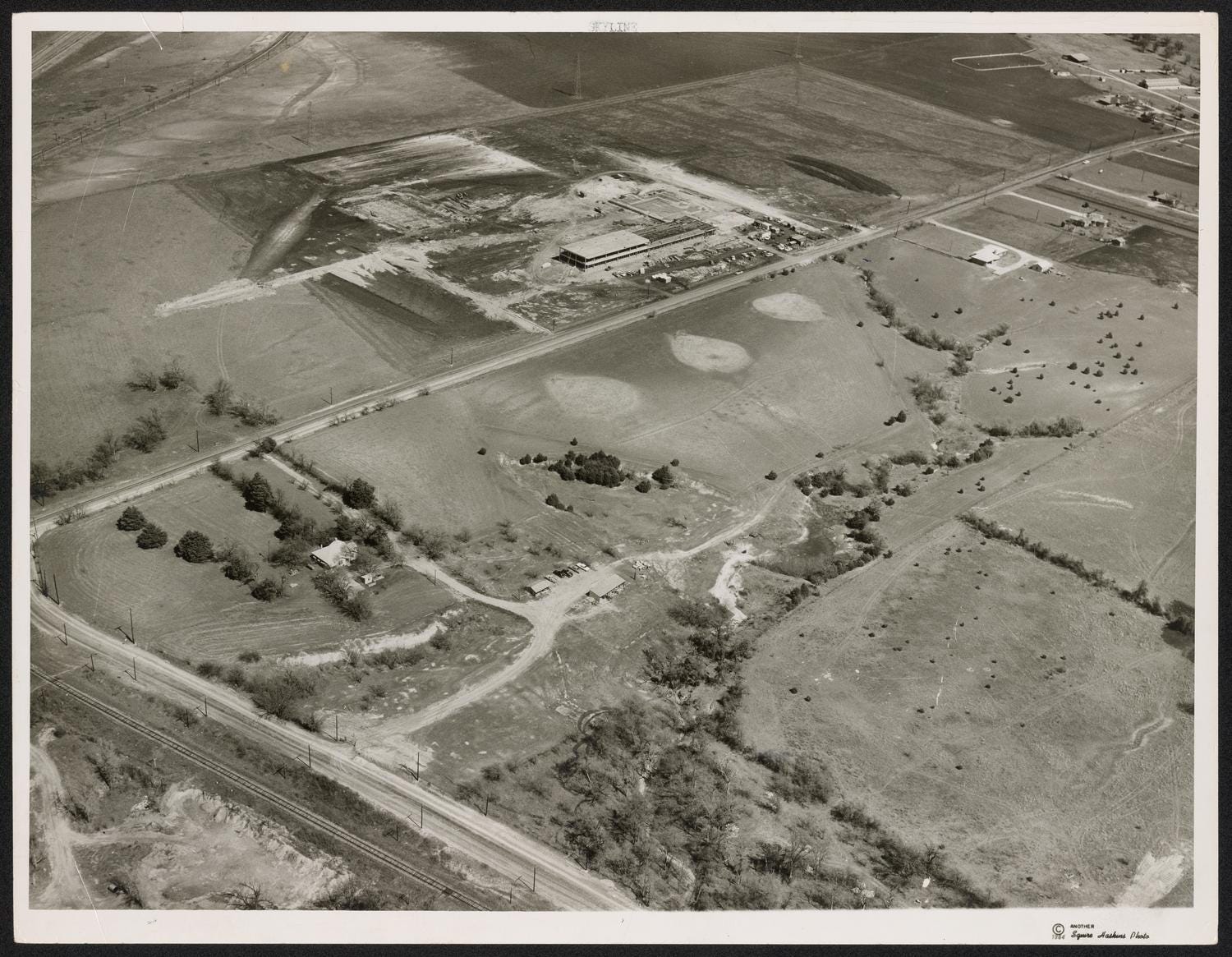
At the time, Dallas was building over 50,000 single family homes per decade. Considering roughly half the homes we build today are just replacing one other home, Dallas was building five times more houses than we build today, and adjusting per capita, ten times more.
That is the Dallas for which our current zoning code was largely written. It was a city that could not possibly have imagined it would have ever run out of places to put houses, fed by an endless supply of annexable land. We had no worries that drawing up a map that capped the number of houses per street, or put a floor on the size of every lot, would ever have consequences that came home to roost.
You already know how this story ends. In fact, we’ve known how this story ended for at least two decades. In 2006 the City Council adopted forwardDallas!, its first comprehensive land-use plan. By the time that report and plan were made, the open land and annexations of 1965 were long gone. “Dallas must move beyond its heavy reliance on vacant land,” the report said bluntly at the time.
Unfortunately, we did not, and the numbers all show it. Dallas is the slowest major city in Texas at building new housing, largely because we have not taken steps such as permitting new smaller townhomes, like Houston did in 1998 when it allowed 1,400 square foot lots in many areas, or Austin has done more recently, allowing up to three homes on a lot in large parts of the city. Our rents and home prices have increased the most of any large city in Texas since 2015, while we have correspondingly grown our housing stock the least over the last decade, only growing it 8%.
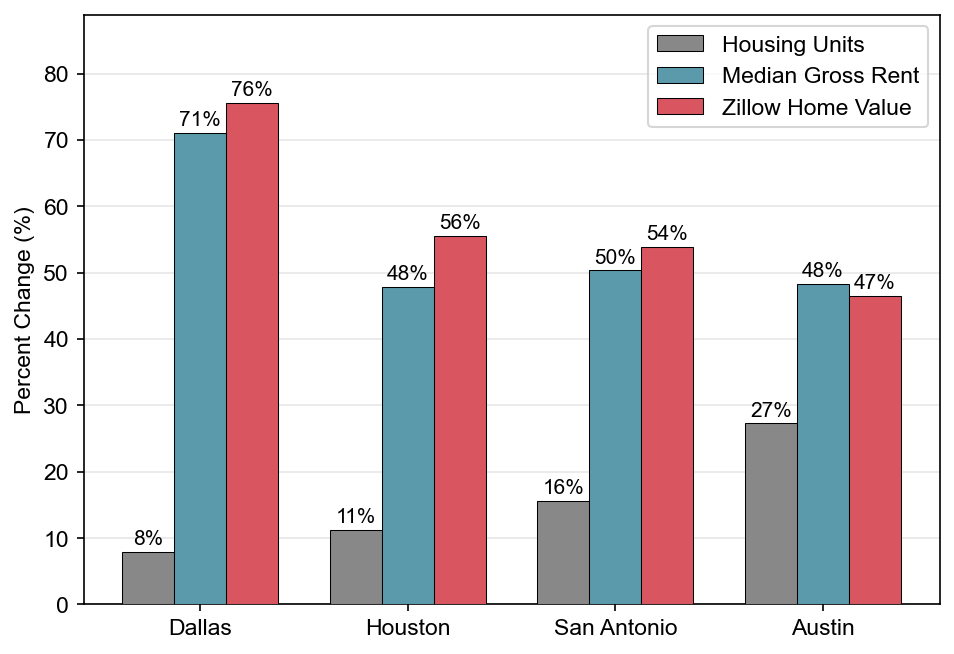
Our failure to build more housing, now that the City has finally grown out to its borders, is a direct result of clinging to those two commandments, which keep our planning and zoning stuck in an era where land was still available and vacant in every direction.
Take R-16 zoning, which is used overwhelmingly in North Dallas and specifically in Preston Hollow. It requires a lot of at least 16,000 square feet and allows one detached house on it. Per data from the Dallas County Appraisal District, land in the city’s R-16 districts is valued at roughly $2 million an acre, or about $46 a square foot. Do the math, and the zoning code is effectively requiring $750,000 dollars of dirt underneath every house before anyone pours a foundation, frames a wall, or buys a refrigerator.
In R-1ac, the one-acre district found mostly in Old Preston Hollow, the same math comes to a little over $2 million, before you’ve even built the house. I feel like I might be picking on Preston Hollow here, but it’s the only neighborhood that received what the City called “estate” zoning, and so it makes for the most extreme examples.
Look, the City doesn’t owe everyone a house in Preston Hollow. We shouldn’t even pretend, as I’ve argued in the past, that when we do add housing in Preston Hollow, it might or needs to be “affordable” in any real sense of the word. That’s not the point.
There can still be neighborhoods with housing for rich people. However, that is not an excuse for our zoning code to exclude everyone except the richest people in these neighborhoods. The millionaires who want a one acre lot can have it! But, ask what you are expecting the city to protect you from by not allowing anything but that around you. The same standard applies in our R-7.5 areas: why can’t a duplex or an ADU can’t fit next door?
Remember where we ended up last week: zoning is at its most defensible when the city is regulating health and safety. We already have the city’s answer on what is safe. We allow 5,000 square foot lots happily in other areas of the city. As a health and safety rule, it makes no sense to have seven different minimum lot sizes across the city. It can only make sense if you see it as a floor on what it costs to live in each part of town.
I didn’t choose either of the two examples last week, parking spaces at bars or college students living together, by accident. In May of 2025 the Dallas City Council voted fourteen to one to scrap most of our minimum parking ratios. Then a few weeks later, the Texas Legislature, R’s and D’s voting together, passed Senate Bill 1567 and told university towns like College Station that they could no longer arbitrarily cap household occupancy by counting how many of their residents share a last name. Neither city, to the best of our knowledge, has slid into the sea. The sky has not fallen.
These rules are not the fifth law of thermodynamics. We wrote them, so we can unwrite them, and the morning after, the city is still standing.
None of that means bulldozing zoning, becoming Houston, and letting the steel foundry or the hog slaughtering plant open behind the kindergarten. To paraphrase Justice Sutherland, pigs will stay out of the parlors.
It means moving the burden of proof.
Today, zoning rules are presumed innocent, and anyone who wants to build has to prove himself, hearing by hearing, vote by vote, as some hostile invader. Flip it. With the rewrite, we have a once in a generation opportunity here, and our first since 1987. When Dallas publishes the new zoning code, make the old rules justify themselves, and ask what the rules are really getting us. Ask what they are costing us too. We are on the path to becoming the most expensive big city in Texas.
Our zoning code is totally ours to choose, and we should treat it like a choice. We don’t. We are merciless when we deliberate the budgets and the costs of everything else our city does. A convention center has to promise jobs and a return on investment. Even parks or schools get measured in economic development and increased tax base. The reason is not civic virtue.
The reason is those things have an obvious line item in a budget. That is an easier thing to argue about than the city that we could have built and did not. The tradeoffs of zoning never appear labeled on any budget, and a budget is seemingly the only thing this city knows how to fight about anymore.
There is a cost to what we do not build, but it is invisible, perhaps by design. It is the house that never got built and the family that gave up and moved to Celina where the smaller home on a 3,000-foot lot got built. It is the renter wondering why her rent has gone up 71% in the last decade. It is the neighborhood that your kids grew up in and can’t afford to move back to.
It’s time to agree on whether that cost is worth it.
love/hate/other to Kirk P. at onemansdallas@gmail.com