
Dinner-table politics is usually a metaphor. I always try to write as if I were explaining things to a slightly unsympathetic relative when politics comes up at Thanksgiving. In my case a few weekends ago, it was not a metaphor, and came with steaks I grilled, mint juleps (it was the day of the Kentucky Derby, after all), and a mother-in-law who knew a question was eventually going to be asked.
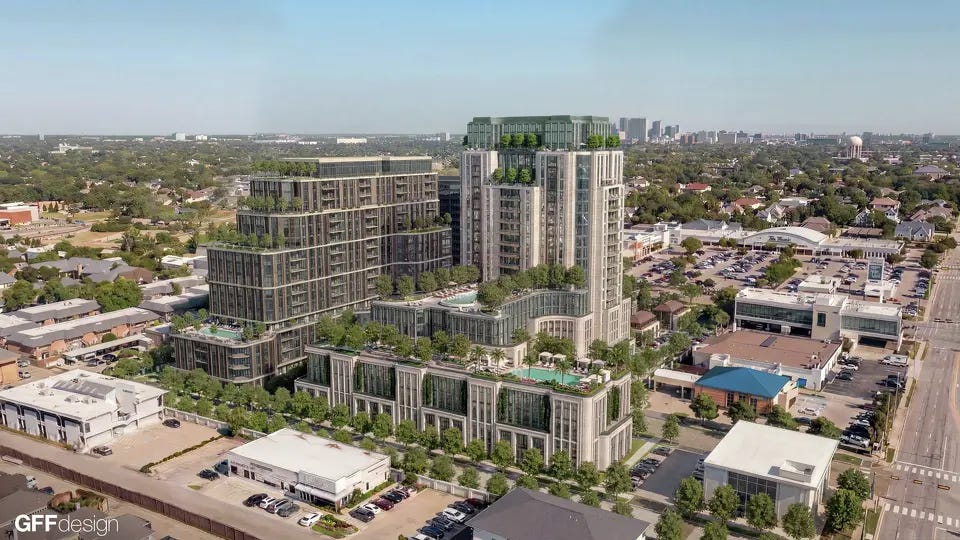
That week, she signed the petition against the proposed zoning change at Preston and Royal, the one that would allow a 240-foot, 19-story hotel-and-condo tower and a 210-foot, 18-story multifamily apartment building at one of the busiest commercial corners in North Dallas. Current zoning allows 54 feet.
The opposition website, Preserve Preston Hollow, warns that the project would turn a “well-planned neighborhood into something similar to Houston.” This is a wonderful sentence, as it treats Houston less like a city and more like a communicable disease. It is a more honest self-admission of the Dallas psyche than I could ever hope to write. I digress.
My mother-in-law has lived around that intersection for almost forty years. She knew I knew she signed the petition. I knew she knew I knew. When it finally came up, everyone at the table had the look people get when a family conversation nears a man’s most boring hobby: writing about local politics.
She winced when I brought it up. Not dramatically. Just enough to say she had hoped she might make it through dinner without a cross-examination.
I told her I was not going to shame her. (I mostly meant it.)
Why did you sign it? I asked.
Her friends had asked her to.
That was the first answer and also the most human one. People sign petitions because their friends ask them to. People oppose zoning cases because someone they trust tells them a thing is bad. Most of the time politics is someone handing you a clipboard.
What bothered you about the building?
She gave the answer everyone gives.
It’s too tall.
Too tall. It has the advantage of sounding objective while meaning almost nothing. Too tall for what? Too tall compared with? Too tall from where? The phrase has done a great deal of work in council chambers, neighborhood meetings, and anxious Nextdoor posts without ever having to defend itself.
The tallest proposed tower is 240 feet. Current zoning allows 54. That sounds tall because it is tall. You do not have to be an architect or the last living disciple of Jane Jacobs to understand that either building is taller than a North Dallas ranch house.
The question is whether that settles anything. How tall is too tall?
What, exactly, is the injury caused by height? Not traffic, noise, or a building pressed against your fence. Those are complaints we can adjudicate. But height by itself.
Seeing the building? A city is not harmed by being visible to itself. If the cost imposed by a tower is that a person standing a quarter-mile away can see it in the distance, then the objection is not really about harm. That is about preference. Preferences are allowed. They just should not automatically become law.
It would not even be the tallest building in Preston Hollow. That record belongs to Preston Tower, the 316-foot condominium tower behind the pink wall on Northwest Highway. The building has been part of the North Dallas landscape since the 1960s. Does anyone think the value of houses in Preston Hollow, Dallas’s most expensive neighborhood, has suffered from people seeing this building sometimes?
Lastly, visibility, and really above all, trees, matter here enormously. 240 feet is tall, but if the cost of tall buildings is sometimes seeing them, how often you will actually see them and from where must be studied. This weekend, I drove around Preston Hollow, looking at where you could actually see the 316-foot Preston Tower. As close as two streets away from the building, a single tree in someone’s backyard, barely taller than the house it sits behind, blocks sight of the entire building from this perspective.
Tall does not always mean visible. This is equally true for “privacy” as a related concern with height. If you can’t see the building, it can’t see you either.
None of this makes 240 feet short. It does however make the apocalyptic version of the argument harder to sustain.
After a pause, she returned, but what about the traffic?
Preston Road has traffic on it all day, and the building will certainly not make that problem disappear.
The site’s existing ‘community retail’ zoning is the City’s highest-intensity zoning for traffic. Apartments produce less traffic than grocery stores, but don’t just take my word for it. An average sized grocery store will generate 2,000 to 2,400 trips per day, per the Institute of Transportation Engineers. Apartments produce 3.31 daily trips per dwelling unit, per the same source. A three-hundred-unit complex (specifically here, one hundred condos and two hundred rental units) would generate just under 1,000 trips per day. Less than one-half of what a grocery store alone would add to this corner, not to speak of the other six or eight businesses one would build in the strip mall around it. If traffic were your only concern with this development, you should be for it, not against it.
But here’s the real catch. The traffic at the intersection of Preston and Royal right now is not generated by people who live at the intersection of Preston and Royal, because nobody lives at the intersection of Preston and Royal. There are no houses here. It is generated by people driving to there from the surrounding neighborhoods to use shops at the corner.
Some of the people who would in the future live at Preston and Royal are people who would otherwise have had to drive there from a little farther away. A household suspended in the air above a corner with two grocery stores is not automatically creating new congestion. Instead, it could allow someone who forgot cilantro to take an elevator instead of an Escalade to go and grab it. That’s actually a trip saved, if the person would have otherwise hopped in their car from Tibbs or Azalea.
The traffic argument, that apartments actually mean shorter trips and fewer cars than if the corner had only retail zoning, was less convincing to my mother-in-law, as it often is. I have ordered many traffic studies for concerned neighbors over the years. Their reading of said traffic study usually results in more disagreement, not less. We moved on.
The next question came between bites of steak, and it is fair: why here? It just doesn’t fit.
“Why don’t you build it at Valley View?” is another version you would often see online. (Sure, we can also build one at Valley View. It sounds like the Mavericks have that covered.) I’m not against it, I’m just against it being here.
The existence of other places where new infill development could go is not an argument against also building here.
By any honest description, Preston and Royal is the part of Preston Hollow that is not houses. It has never been houses. It is where the houses do their errands.
Preston and Royal is not a ranch house. It is six lanes of traffic, a Tom Thumb, a Central Market, Royal China, dry cleaners, parking lots, curb cuts, and a whole lot of strip retail doing its fluorescent duty. This is not some leafy residential block being jolted awake by commerce. This is where the neighborhood goes to buy shrimp, prescriptions, birthday cards, and emergency dinner rolls.
So when my mother-in-law says the tower does not fit, the real question is: fit what? Does it have to fit the houses half-a-mile or a mile away on her block? Or does it get to fit the commercial corner on which it actually sits?
Those are not the same standard. This development is not bordering a single family home, full stop. If a commercial corner must follow the scale of “nearby” single-family homes, then it cannot really become anything except the residential neighborhood’s useful little servant: low, spread out, asphalt-covered, and deferential. None of Dallas can, when we start redefining “next to” to mean near.
But seriously, why here? I’ll tell you. Preston and Royal is absolutely one of the places in North Dallas where this kind of building makes sense. It is already commercial. It is already on major arterials. It is where surrounding households come for commercial activity, buying groceries, and eating dumplings.
It is being proposed at a corner that already functions as a neighborhood’s little downtown, lacking only the one thing downtowns usually have: people living there.
I asked: Remember when Katie and I looked for our first house, you asked us why we weren’t looking in Preston Hollow?
Sure I do, she recalls, you both laughed at the question.
My in-laws bought their house in 1989. In today’s dollars, adjusting for only inflation, but not the strange alchemy of North Texas housing prices, they would have paid only $388,000. A starter home in Celina goes for more today. The lot, the house my wife grew up in, sold in December for well over one million. The builder has plans to demolish the house and put up a three or four million dollar spec home there.
One of the things you hear in conversations about projects like this is that the neighborhood has a character in need of protection. That is not a silly thing to care about. Neighborhoods do have character. Streets have memory. People are not wrong to notice when the place they knew begins to disappear.
Character can be a slippery word. If character means the 1950s ranch houses filled with families and young children my mother-in-law remembers, including families buying their very first home like her, then the neighborhood is already losing it one teardown and one empty nest at a time.
The median household in each of the four census tracts around Preston and Royal today contains only two people, according to the 2024 Census ACS data. The median age across them is 50 years old, including children. The average house has 3.82 bedrooms, and the most common household size, two married adults, is presumably only sleeping in one of them. When you drive around the neighborhood on a Saturday like I did this weekend, you would be hard pressed to find more eighth birthday parties than estate sales.
The people who would live in the proposed building are not invaders from a hostile province. These will be apartments for rich people. I did not tell my mother-in-law, nor would I tell you, reader, that these apartments or condos would be affordable, because they will not be. None of this will be affordable housing by any useful definition of the phrase.
But affordability is not the only housing question. A building like this gives people who already belong to the neighborhood a way to stay without staying in a single-family house forever. It gives empty nesters, widows, divorced people, older couples, or adults moving closer to mom a place to move without leaving their grocery store, doctors, friends, and routines. We have the added benefit of those houses then becoming available to someone else, the next family that looked like my in-laws when they first moved in.
None of this makes a high-rise tower charity. It makes it succession planning.
The strange thing about talking politics with family at dinner is that when you think you are making a point about zoning, you are also finding out whether your politics can survive the people they are actually about. You are putting your ideas on trial in the only courtroom that really scares you.
It is easy to write about upset neighbors as if they are interest groups with lawns, in a newsletter I send to strangers. It is harder when one of them is sitting across from you, eating the steak you grilled, asking a perfectly normal question about the place she has lived for forty years. If I cannot explain this to my mother-in-law, about the neighborhood she actually lives in, then I have not earned the right to explain it to anyone else.
It would be clean and satisfying to tell my mother-in-law that the tower is for the next version of her and her husband in 1989. Young, no kids, just getting started in life. Affordable-ish, upper-middle class at least. That would be the easier and more emotional argument: it would allow her to imagine that my wife and I might be able to afford Preston and Royal today too, at the same age her parents once did if the city only just allowed more housing.
That’s not really true. That door has already closed. This is Dallas’s most expensive neighborhood, and that’s not going to change, especially with an New York investment bank or two relocating here every month.
There are still other doors a neighborhood can leave open. A place for someone’s mother to downsize without leaving her friends. A place for an adult child to live near a sick parent. A place for people whose lives no longer fit a single-family house but whose lives still belong, in every real way, to the neighborhood. The right question is not whether this building makes Preston Hollow affordable. It will not.
The question is whether ‘too tall’ is a real cost compared with the cost of a neighborhood that made room for one generation, then left those very same people the choice of aging in a mostly empty single-family home or leaving the neighborhood.
The question we all get to decide our answer to is whether Preston and Royal is willing to be a neighborhood people can move within, or only a neighborhood people move out of.
And that is not a question about height.
This building is tall. We can all stop pretending that was ever in dispute.
The Dallas City Plan Commission (CPC) is expected to hear this zoning case later this week on Thursday June 25, where it will be voted on by CPC before going to a full City Council vote this summer, presumably after the council’s summer recess in July.
love/hate/other to Kirk at onemansdallas@gmail.com
If I were developing this property, I would be very pleased to see the opposition sign reading: "No Skyscraper Rezoning". By common definition, a skyscraper is a minimum of 100 meters - 328 feet - taller than the 325 initially proposed. I imagine the developer underwrote to a high rise structure (240 feet) to begin with so they can present their proposed zoning changes as playing ball with the neighborhood while still getting approval. By no sense of the word is 240 foot a skyscraper - the oppositions rhetoric soon becomes meaningless.
As a lifelong visitor to the center, I hope this development get's approved - the center can really benefit from the high density housing. It was a solid argument that you make on traffic being a non-issue - I would guess that traffic is the root of the opposition.