

There is no such thing as a single-family neighborhood.
At the very least, it’s an oxymoron, like jumbo shrimp or educational television. A neighborhood with only a single family in it lacks any, well, neighbors. It isn’t really a neighborhood at all until the second family moves in.
Of course, I know what people mean when they use that phrase. Perhaps I am being overly pedantic or needlessly contrarian. When people speak of a single family neighborhood, they are referring to residential areas made up of mostly homes that do not touch each other, where one address, one lot, neatly corresponds to one driveway, one picket fence, and one last name.
But, is any of that ever what made a neighborhood worth living in? Did your Fourth of July parade, your trick-or-treating, or your Cowboys watch party ever benefit in any way from the homes on your street having not touched each other?
I ask because we are all about to hear a great deal in Dallas about protecting single-family neighborhoods. On November 5, the city published the first draft of its new development code, the first full re-write of our zoning since the 1980s. The initial “discussion” draft, which will be revised over the next twelve months with a targeted adoption for later next year, runs 414 pages. Among a great many other things, it would end a distinction our zoning has made since at least 1965. In our residential zoning districts, one lot would be able to hold two homes, by right, with the city essentially no longer making a distinction between whether one structure is one home or two. So, duplexes.
Not everyone is taking the suggestion well. I have been reading Facebook over the weekend (which if you have the means: I must recommend against). One viral post with over a hundred re-shares announced, in capital letters, that “DALLAS IS MOVING TO DESTROY SINGLE-FAMILY NEIGHBORHOODS CITYWIDE.” Comments under posts like it promise the re-write is the work of “real estate devil princes,” that “Houstonification has begun,” or that this is proof that “the city wants to kill itself.” Veteran Dallas journalist and now Facebook frequent-flyer Jim Schutze described it in a post as “violence to existing residential neighborhoods.” Comment after comment uses a similar framing of violence, destruction, and with neighborhoods as something in need of protection.
So when people say we need to protect single-family homes and neighborhoods, I would ask, “from what?”
From homes? From neighbors?
Neighborhoods are worth protecting, but it’s worth being specific about what we are protecting them from. Think about the best street you have ever lived on in your entire life. Write down what exactly made it that. My guess is the list is mostly people: the parades, the parties, the family with slightly older kids who could babysit, the elderly neighbor who knew exactly whose dog had gotten out, or the guy who owned the ladder or chainsaw that everybody borrowed after a wind storm.
I doubt anything in the city’s development code made the list.
Now go back down the list and ask which of them a duplex would have robbed you of. Would another front door have ruined Halloween? Would the neighborhood babysitters have suffered from an excess of customers? Would the dad with the chainsaw have minded one more person owing him a favor?
Maybe architecture made your list, the cute bungalows, prairie or craftsman homes on an old street. But the city’s zoning code doesn’t protect those today either. Only if you live in a historic district (which most of us do not) does either the old zoning code or the new draft one have any answer at all for keeping architectural styles fixed over time.
It’s worth being specific about exactly what is being proposed here. Under the draft code re-write, a house, whether it contains one unit or two, can be no taller nor sit any closer to the sidewalk than the other houses you could build on the street where it is added. In fact, the re-write has even more new protections describing where a house’s garage, roof, or windows must be located, compared to the (non-existent) rules we have today. This addresses the problem of the boxy, roofless houses with huge garage doors looming over the street: the kind of new single-family house you are most likely to see built on a residential street in Dallas today, a symptom of our current rules, and something that no one in Dallas much cares for either. Instead of size, all a duplex can add to a street is a second address or a unit number, plus the one additional family that calls it home. You could call this the “more houses, but prettier ones” compromise.
There’s another thing people mean when they say “protecting,” and I don’t think they mean a way of life, but a form of financial protection. People have an idea that lower-value housing creates lower-value parts of town. They see duplexes and multi-unit housing as something that brings blight or transience, and that it is something “imposed on” a neighborhood. We don’t have to think very hard about how land use has been practiced in Dallas for most of the last hundred years to see that this way of thinking overlooks the rather large hand we had in arranging things that way.
We used residential and detached-housing zoning to create parts of town that were more expensive on purpose, as well as the opposite, cheaper by design. So, it’s no surprise that neighborhoods with duplexes or apartments are less affluent than neighborhoods with only large-lot, detached housing, because well, that was the point. Since 1943, the city has explicitly controlled housing affordability through density. We now plan to do exactly that, but with the goal of making housing more affordable more places, not less.
So in that regard, this isn’t a new idea at all, we are just considering flipping the lever the other direction on a very well understood policy. Affordability was and always has been the very purpose of residential land use regulation. I grant then that incumbent homeowners are not wrong to notice that a system designed to benefit them will get a little less benefit-y.
There’s a history here. As I wrote about in October, in 1943 the city hired a consultant, Harland Bartholomew, who in his housing report was horrified to find duplexes scattered so widely that he could find very few single-family areas without one. The ordinances we passed on his advice gave duplexes and apartments their own limited districts and reserved the rest of the land for detached houses alone. At the time, here’s what he said about duplexes in Dallas:
Second, there has been an unusually widespread and scattered development of two-family homes. There are only a very few single-family areas on the outskirts that are free from the intrusion of duplexes. There are duplexes in all 58 census tracts. There is hardly a single block completely occupied by this use. Instead, the general pattern is of two or three to the block, the remainder of the block being devoted to single-family homes.
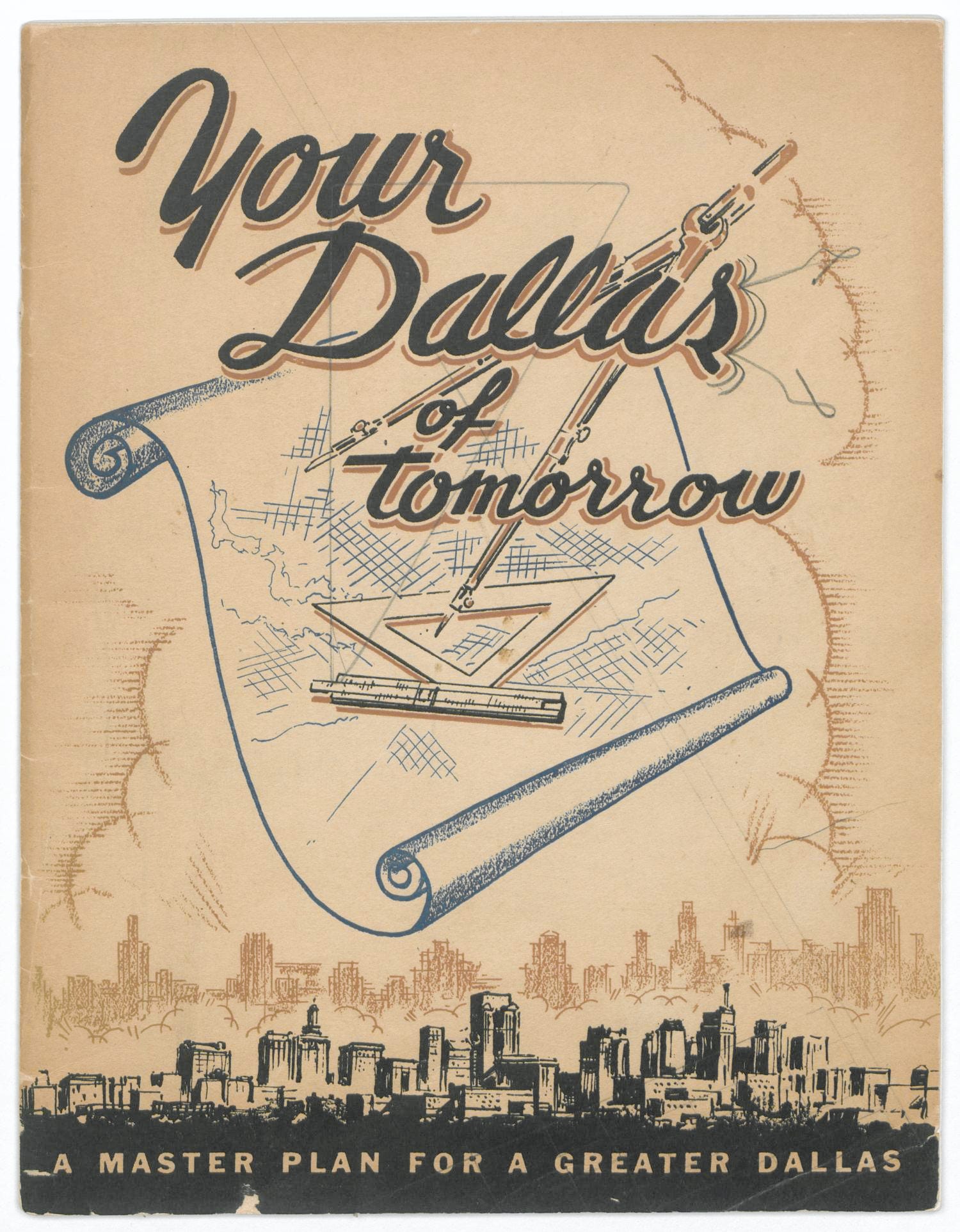
It’s worth noting what this history demonstrates. For nearly a hundred years, Dallas had gotten by just fine with every street playing home to the occasional duplex, “two or three to the block.” We hired a fancy consultant from St. Louis to tell us what was wrong with this, the “intrusions” we were allowing. But, two-unit houses were simply a normal part of how our city grew for decades, and still exist to this day in many of our most established and desirable neighborhoods. I kid you not: even the first home in Dallas, John Neely Bryan’s cabin (the one Downtown today is a replica), was built so it had two separate living areas that shared one roof.
So, I think we should allow duplexes, and the first reason is the plainest one. It’s not that weird. Parts of town people adore living in, Old East Dallas, my neighborhood Elm Thicket, and heck while we’re at it, large swaths of the Park Cities, allow duplexes, have for decades, and in many cases, these homes are every bit part of the very neighborhood character we are so focused on protecting.
Second, what we are talking about adding is not hostile invaders from a foreign province, such as Fort Worth. We’re talking about adding more housing options for the kind of people who would want to live in your neighborhood anyways, but for whom the large lot, or the large three or four bedroom house is not an attractive or affordable option. Not every household in this city needs, or can pay for, four bedrooms and a yard, and our housing code ought to fit the people who want to live here today, not sixty years ago. This means younger families moving into the neighborhood as they are getting started in life, and also older neighbors staying in their neighborhoods longer, as they can downsize but stay on the same street.
The third reason is the one I started with: it is the people that make a neighborhood in the first place. Every neighbor you now value was, at some point, a stranger who moved in. So were you. You did not know beforehand which stranger would turn out to be a lifelong friend. More homes on a street means more chances at that. The one ingredient no neighborhood can ever do without is neighbors.
But there is another reason to do this, and it has less to do with borrowing flour, trick-or-treating, or backyard cookouts.
One thing I’ve written about in the past is the idea of policies being “regressive”, which means they place a larger burden on people with lower incomes. Gasoline taxes are an example, where people all roughly drive their cars the same mileage more or less during the month. Texas’s flat twenty-cent tax on a gallon of gasoline is a much larger share of someone’s income when they make $30,000 compared to when they make $300,000.
Land use policy, zoning, can be regressive too. Policies that make the only kind of housing you can build in most parts of the city large, detached homes on separated lots, and restrict multi-unit housing to less than 8% of the city’s total land, and 14% of where we allow housing, are about as regressive a policy as you can imagine. These rules favor the statistically wealthiest people, homeowners, at the expense of renters, who I would remind you are a majority of Dallas residents, and further, have every bit as much reason to want and deserve a quiet street, a good school, or good neighbors. About 23% of renters in the City of Dallas spend over fifty percent of their pre-tax total income on rent. Further, for people in Dallas who make below the median income, a full 56.6% are housing-cost burdened1. This compares to people who make above the median income, where the incidence of being cost-burdened is ninety percent less, at only 6.5%. Our existing housing policy and our approach to zoning most hurts the people who can least afford housing.
We do not usually write rules this way on purpose. For example, the federal income tax brackets ask more of the people who have more. Whatever you think of the specific tax rates, almost no one argues it should run in the other direction. Our zoning code runs in that other direction. The housing that is most able to serve people with lower incomes, smaller units, smaller lots, and even apartments, is the most restricted kind, while 86% of the land where we allow housing allows only the most expensive, least affordable kind, stapling a large lot onto every detached home.
A progressive land use policy would not have to redistribute anything, or hand out checks to anyone. It would only need to stop requiring the most expensive kind of home on nearly all the land in the city. It would let a household buy as much housing as it actually needs and no more: half a lot, a unit over a garage, one side of a shared wall. The people with the most to spend can still have their one-acre lot.
In all these conversations, we give the current rules a dignity I do not think they have earned.
We call them protections. We talk about them as if they were the natural state of a neighborhood, and as if anyone who wants to change them is a destroyer, a hostile invader, or a “prince of evil” or something. I think we have it backwards. A rule that distinguishes a building not by its size, but only by the number of families living in it, is the thing that needs explaining.
Yes, change is change. But keeping the rules is a decision too, and we make it every year we leave them alone. It is a decision, a choice, to have a zoning policy that asks the most of the people who have the least. A policy like that makes Dallas a worse place to be poor, which just makes it a worse place to be. And, the costs do not stop at the wallet of the family that cannot find or afford a home. They trickle down to everyone else who depends on a teacher, a nurse, or a line cook, as we all depend on that person’s finding a place to live, and we are all worse off when they move to Celina.
It’s time we remember a neighborhood is the people in it. Not the buildings.
There is no such thing as a single-family neighborhood. There are only neighborhoods, and the good ones make room for more than a single family.
love/hate/other to Kirk P. at onemansdallas@gmail.com
The federal definition of cost burdened is that a renter or homeowner spends more than 30% of their pre-tax income on rent, utilities, insurance, and/or a mortgage. For a family living on $80,000, they have $2,000 a month to spend on housing without being “cost burdened” per this statistic.