
Part 2 of 2.
Last week, we looked at the surface-level questions about Fair Park. Who should run it? What kind of shape is it in? Those are the conversations we most often have about our largest park, the most scrutinized 277 acres in Dallas. They do not get at the deeper question.
What is Fair Park for?
Here is my working theory. The test is simple.
Fair Park should be a place where you can take a seven-year-old for the day and never worry about running out of free or nearly-free things to do. A place where you can wander from a museum to a playground to a fountain to an aquarium without constantly running into gates, asphalt, more parking lots, or feeling that the place does not belong to the public.
This is not a radical standard. Versions of it exist all across this country in cities that are richer or poorer than Dallas. Forest Park in St. Louis, Balboa Park in San Diego, Grant Park in Chicago. Great public places, when they work, are the physical infrastructure of a shared civic life. They ask nothing of you. There is nothing transactional about your time there, other than to leave the place as nice as you found it. Further, they are where we socialize the next generation. Fair Park should be a place where, on an ordinary day, the seven-year-old learns and knows what it feels like to belong in Dallas’s shared public life.
That description sounds soft until you notice how rare the experience has become. American life has been quietly privatizing for fifty years. Childhood especially. The world some of us half-remember was different. Bikes ridden out of sight from adults we knew. Pickup basketball. Wandering as an activity. That world has retreated almost entirely behind screens, liability waivers, and weekends scheduled into fine grids of things that cost money. A city in which every encounter is a transaction has stopped being a city in the fullest sense.
Great public places do not depend on constant novelty. They only need a base condition of usefulness. You can go because the weather is good. You can go because the kids need to run around. You can go because you are broke and the city still owes you somewhere beautiful.
Fair Park is not yet that kind of place. The reason it is not yet has less to do with what is inside the grounds than with what runs around them.
Walk past Fair Park sometime.
What you are walking along is not a street. It is half a street. A street is a thing with buildings on both sides. The fence around Fair Park is one long border with life on one side and an empty 277-acre mostly-parking lot on the other. The blocks of South Dallas that abut Fair Park’s perimeter have been heroically doing the impossible work of being a neighborhood next to a non-neighbor since at least 1936.
The fence is the first and largest problem at Fair Park. We will not put “the park” back in Fair Park until it looks like a place that is open to the public.
We get the park-and-neighborhood relationship wrong a lot. Backwards, even. This is not a new problem; it is identified in one of the first chapters of Jane Jacobs’s The Death and Life of Great American Cities as one of urban planning’s original sins. Parks do not make great neighborhoods. Neighborhoods bestow usefulness upon working parks. Parks are not an end unto themselves. They are a pre-requisite, a context, in which public life can happen, but they are no guarantee that it will.
Further, giant fenced parks adjacent to residential neighborhoods, really a giant fenced anything, can actually become destructive to what surrounds them. Again, Jacobs called this concept a border vacuum: a long impermeable edge that pulls activity out of the blocks beside it. Hospitals, college campuses, 277-acre fences. No one opens a shop or a restaurant that faces a fence. You instead open a McDonald’s that most people experience from its drive-thru.
Get past the fence, and you’re still walking another 2,000-odd feet through hot concrete parking lots until you make it to the children’s aquarium, the Discovery Gardens, or any attraction buried within Fair Park. The parking lots serve as yet another barrier behind the fence and communicate clearly that this place is for people who drive in once a year, not people who could enjoy it on a Tuesday.
The new Community Park, approved by City Council in February, is the city’s first attempt at a correction. It is 10.5 acres of green space on land that is currently parking spaces. Good. Build it. Build it beautifully and generously and unapologetically. Then remember that it is being built on the wrong side of the fence.
Many of the walks inside Fair Park are over a mile round-trip, and every path to the new Community Park has zero shade. Where the fence stands today and everywhere inside it, we could instead ring the campus with one continuous shaded path of trees and grass, connecting the DART stations, the Community Park, and the museums. (This is my radical plan, plant trees in a park.) We can even call it a highway, since we love building those.
Next, Fair Park has too many vacant buildings, and they are hard to fill. An ideal tenant has to want an old protected, historic building, with the City of Dallas as their landlord, and a calendar greatly disrupted each fall by the State Fair. It’s a tough sell. It’s no accident the Perot Museum’s predecessor, The Museum of Nature and Science, now sits in Uptown on private land today. The fix is to stop treating every empty space as needing a permanent tenant and instead start treating them as venues: spaces for the trade shows, summer camps, school programs, and seasonal events that already work elsewhere in this city.
The easy argument to make, the one that I have just allowed myself to slip into, is that we should build a park so well programmed and so beautiful that people will drive from all over the Metroplex and all over Dallas to experience it. It would be easier to build the will and the philanthropic support to make Fair Park a much nicer place if it were something people drive to from richer parts of the city. That may still be the winning political argument.
It cannot be the point.
The base level of usefulness for Fair Park has to start with the people that live closest to it. Otherwise, we are just building Six Flags.
Once we invert the “parks help neighborhoods” fallacy, we start to clearly see that anything good for South Dallas is good for Fair Park. Not all things good for Fair Park are good for South Dallas. In fact, many of them are not.
Renovating the Cotton Bowl into a venue that can hold more 50,000-person concerts means more noise, more bumper-to-bumper traffic, more late nights for Fair Park’s neighbors. Adding shade, playgrounds, splashpads, and ordinary civic life that the children who live in the neighborhood would actually use is the kind of change that should come first.
The Dallas Observer ran a good piece last week on the City’s latest plan for fixing the latest plans for fixing Fair Park. Park Director John Jenkins described recent Cotton Bowl renovations as the first step toward “another revenue stream.” The city is in early stages of planning a hotel in the middle of Fair Park, north of Dos Equis Pavilion. The hotel plan briefed to Council on April 6 promises that lease revenue from the hotel could “mostly or fully fund all park and facility maintenance and operations.”
Under state law, a hotel is one of the only commercial buildings you can build on parkland. The city is reaching for a hotel not because it is an obvious answer to a question about Fair Park or South Dallas. They are arriving at the conclusion Fair Park needs a hotel because it is one of the only ways for anyone to make money off of Fair Park, the city included. They are so preoccupied thinking of if they could do something, they have given no thought to whether they should. (I call this Jurassic Park syndrome.)
Regardless of the merits of the hotel, the conversation leaves us with the recurring standard where most Fair Park conversations end today. Fair Park must figure out how to pay for itself.
We do not ask roads to pay for themselves. We do not ask libraries to be self-sustaining. We do not ask the fire department to break even. Public infrastructure is something a city builds because it is worth having.
We already created a new revenue stream for Fair Park, barely four years ago. Prop A, from the November 2022 election, created a local 2% tax on hotel stays, of which 20% goes to Fair Park. That stream is around $4 or 5 million per year. In debt terms, meaning how much money can the city borrow against that tax revenue, it supports roughly $50 million in project financing.
We borrowed against this 2% tax already in 2023, which was only enough to pay for a third of the $140 million Cotton Bowl renovations.
Dallas has not forgotten how to spend public money on public things. Recent major capital commitments for parks and event spaces, going back to the 2017 Bond package, total roughly $897 million. About $707 million went to non-Fair Park parks and venues. Even of the slice that went to Fair Park, the Cotton Bowl received $140 million. Fair Park, excluding the Cotton Bowl, received just $50 million, only 6% of all major park capital funding over the last decade.
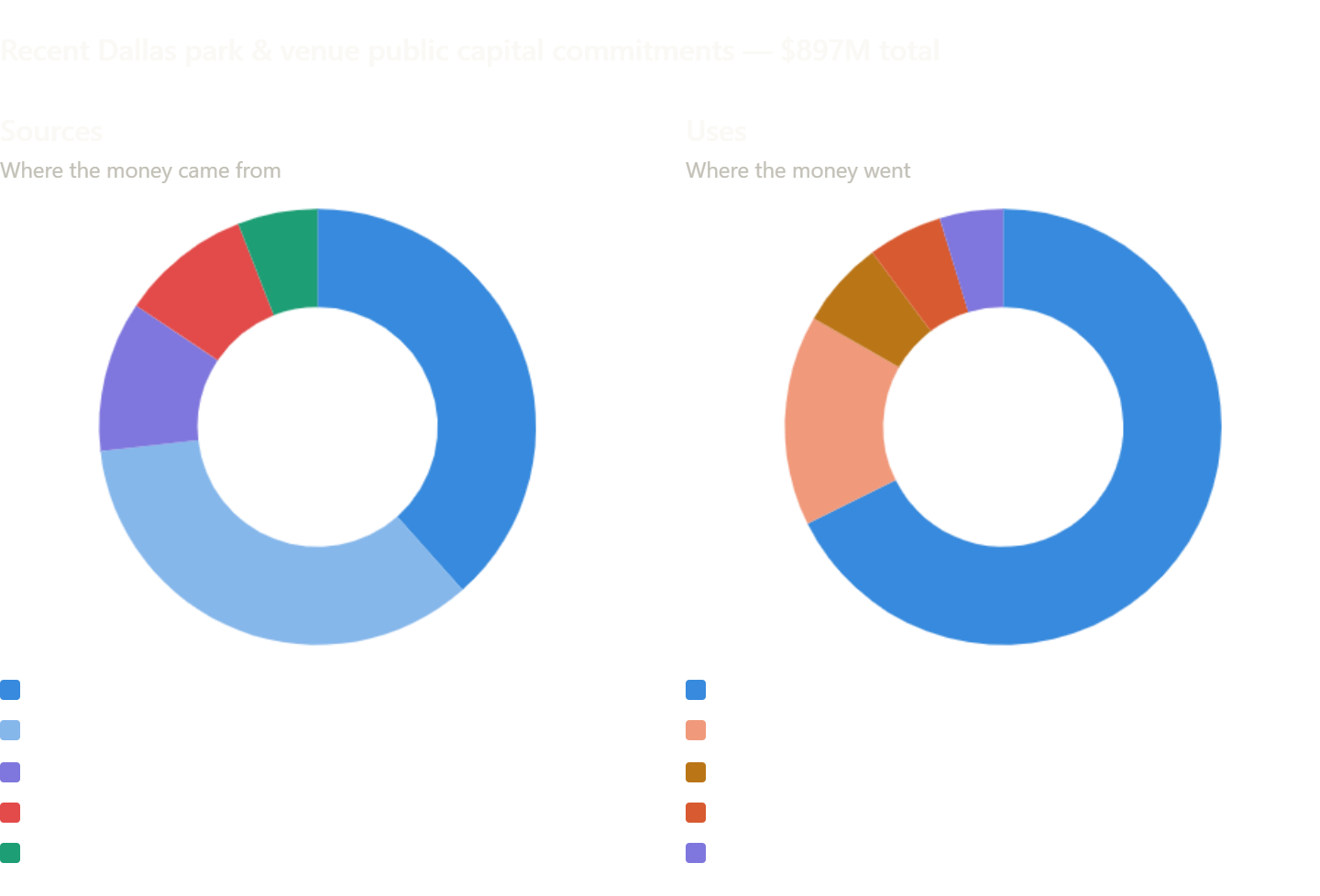
The point is not that every dollar on that chart should have been spent on Fair Park. The point is simpler. When Dallas wants to spend public money on public projects, we find a way. When we had money for Fair Park, the Cotton Bowl got the first bite, and it ate the whole turkey leg. The rest of Fair Park is now being told to find a business model.
We are preparing to spend billions, three billion to be precise, rebuilding the convention center. Whatever its merits, it is a building for dentists from Ohio to visit for three days and leave with dorky lanyards. We have not lost the ability to spend big on projects. We have only lost the ability, the will, or the confidence to spend big on ourselves.
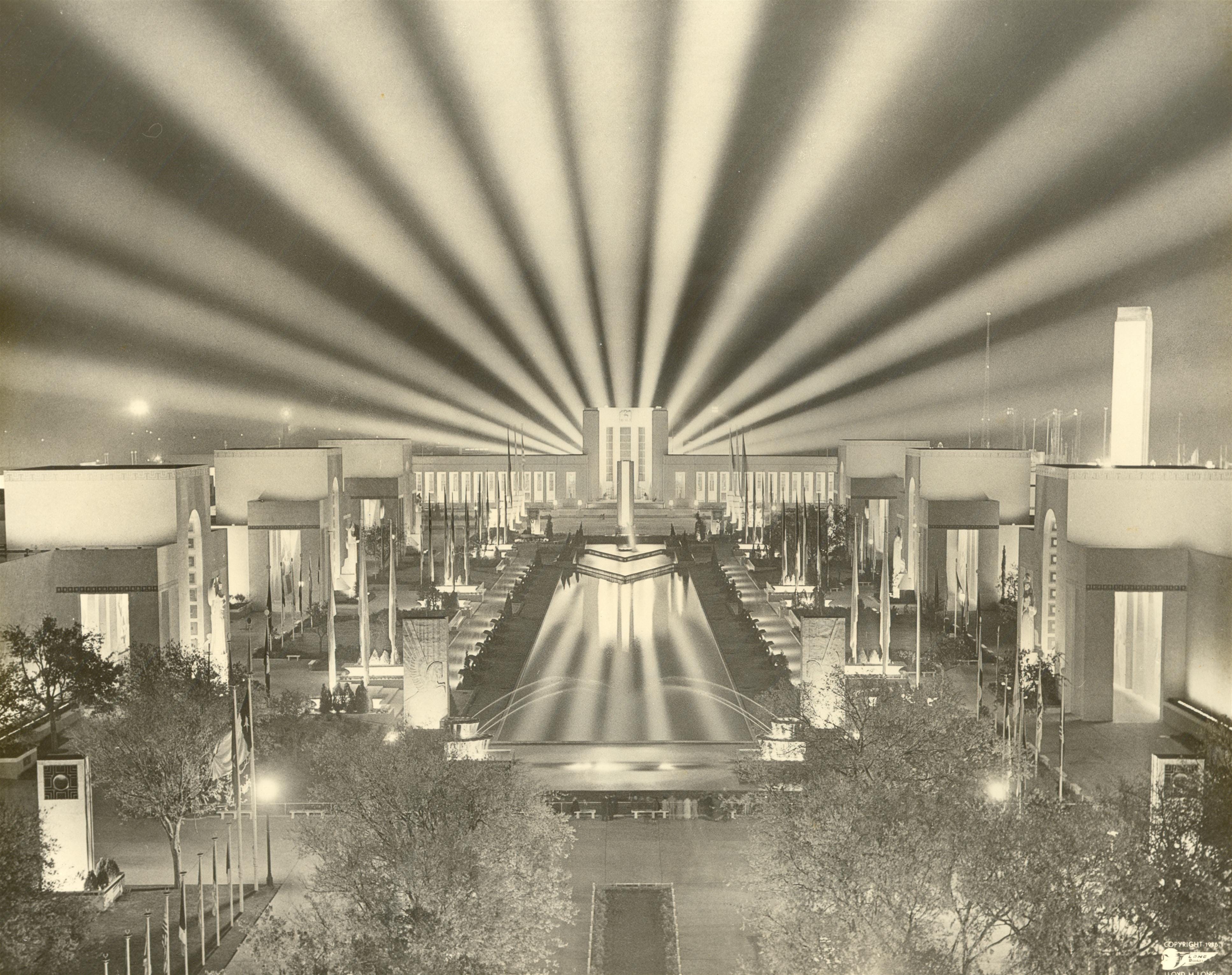
In 2036, Texas turns 200. The Fair Park we know from the Centennial turns 100. This is our civic deadline. The rest of the state, maybe the rest of the country, is going to grade our book report.
It is honestly already a little late to start caring about it. Dallas is running out of time to decide that the 2036 bicentennial is the moment that Fair Park fully reenters civic life.
The Centennial Exposition was built with almost absurd confidence, bordering on arrogance. Not every status quo that generation maintained deserves celebration. The 1936 exposition reflected the exclusions of its time, and the neighborhoods around Fair Park paid the price for ambitions that were not shared. Nostalgia gets dishonest quickly here.
The work, however, is to recover the courage without repeating the cruelty.
Fair Park is a mirror. Holding it up, you see Dallas. The ugly parts and the history. What used to be. What could be.
Do we believe children, specifically children from South Dallas, deserve somewhere beautiful to spend a Saturday? Do we believe the buildings we inherited from a people more confident, more arrogant, and more ambitious than us are obligations rather than liabilities?
Do we believe a future Dallas should be able to look back and say the people of 2026 were capable of building something generous, durable, and free?
What do we owe Dallas? What do we owe ourselves?
We owe ourselves at least one place in this city that feels like it belongs to everybody. A place where a child from South Dallas and a lawyer from Lakewood and maybe even a tourist from Houston can go and instinctively understand the same thing: this city built something beautiful for people who may never be able to repay it.
That is what great public spaces are. They are acts of civic generosity. We inherited one at Fair Park. We owe the next generation a better one.
love/hate/other to Kirk at onemansdallas@gmail.com
Programming note: I will be off next week for summer break. See you in June!
Good article. I agree! Government provides the infrastructure so business can flourish. Government does not owe business the exact things it desires to maximize profits. As government converts citizens' taxes into the things which benefit their pursuits of happiness, business may very well benefit. But, a very pernicious idea has crept into government. That is that business trumps the people. Fair Park is a very good example.
I will also note that fancy, wealthy neighborhoods do see to get the nice amenities and the Fair Park neighborhood is looked at with skepticism and a demand that it "give back" with income for the city. Hmm.....
With so much acreage, it would be nice to create a lazy river with swimming areas that more resembled swimming in the river. I guess I'm reflecting on Sewell Park in San Marcos. That along with a restoration of nature or its reasonable facsimile would provide untold value to the citizens of Fair Park. The respite of nature and a chance to relax the mind can make for better citizens. Kids with the freedom to enjoy themselves as themselves tend to not have as many social problems.