
Part 1 of 2
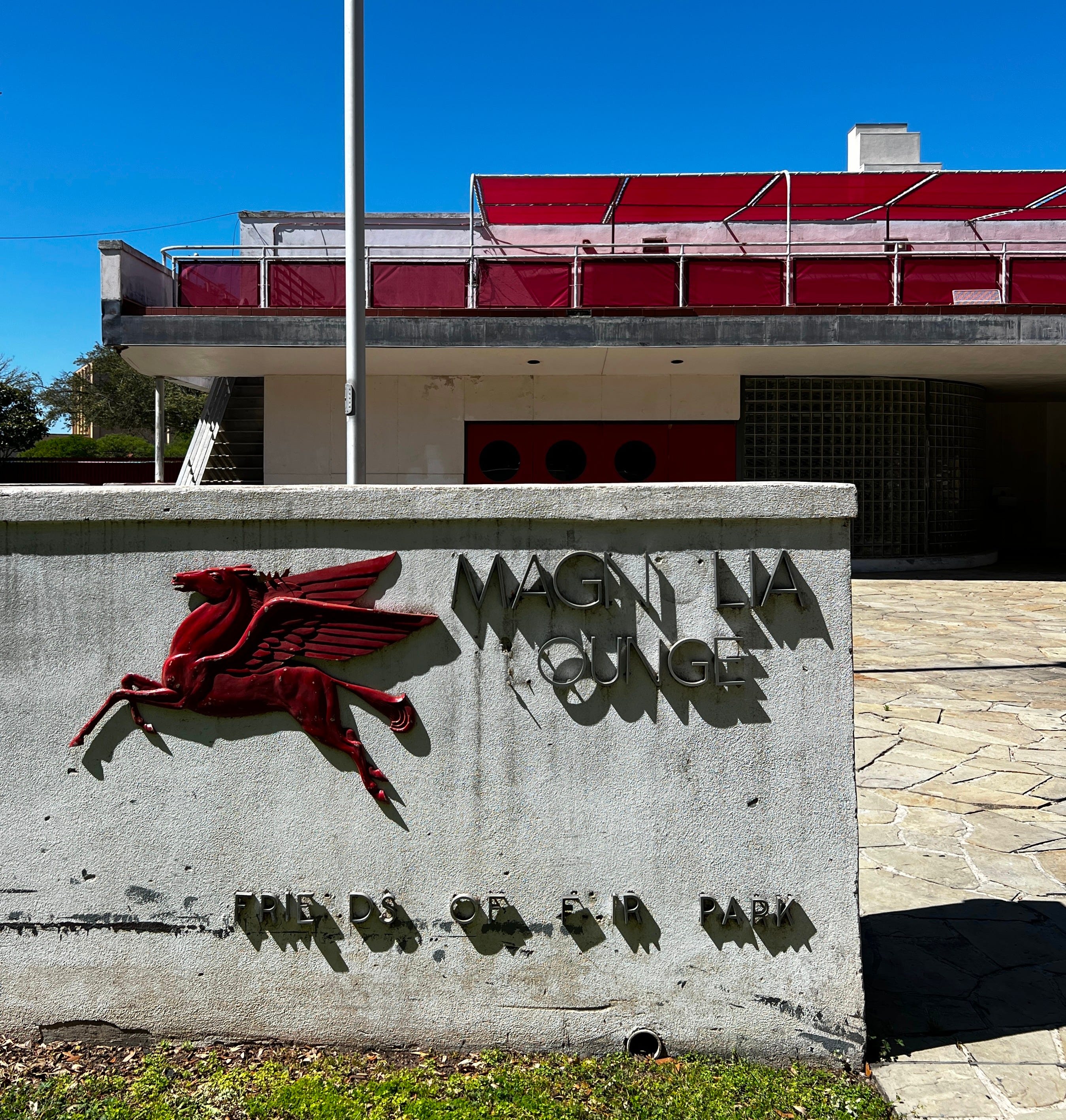
I went to Fair Park a few weeks ago to volunteer at an event, and on the walk in I started tallying signs of life.
The Music Hall had a Broadway matinee. The crowd shuffling toward the doors looked less like the cosmopolitan theater types at the Winspear Opera House and more like the Methodists arriving for church. The men had on their nice khakis. I parked in the wrong location and ended up walking past the Children’s Aquarium. It was a weekend of spring break, and you could tell. The line outside the door announced itself before I reached it: sticky kids, grateful parents who had decided two air-conditioned hours were worth the price of admission. Somewhere else, signage for some sort of job fair or workforce training event was drawing a crowd of mainly young Black men. They stood out among the gray-haired Methodists.
A Big Tex-sized hole stood at the heart of all of it. He hibernates in winter and spring and summer.
Fair Park was not roaring. It was not transformed, but it was not in need of “saving” or any of the other dramatic words it would be tempting to write. It was in the loosest but still important sense, working.
It looked like Dallas.
Anyone who has been on these grounds in late September knows what this place sounds like with the volume turned up. Big Tex booms a ‘HOWDY, FOLKS’ every some-odd minutes. The SkyWay creaks overhead. The smell of corny dogs, turkey legs, beer, and, when you are downwind, livestock comes from every direction at once. The Auto Show fills the Centennial Building and the more-aptly named Automobile Building. Two or two-and-a-half million people pass through over twenty-four days.
I love it. In doses. I have eaten the corny dogs, spent too much money on coupons, and taken perhaps my favorite picture of my wife, then girlfriend, looking back and laughing on the Swings as the sun sets. The State Fair is loud, excessive, sentimental, strange, and glorious. For twenty-four days a year, nobody has to ask what Fair Park is for.
The State Fair answers the question by drowning it out. For three and a half weeks, Fair Park has purpose, ritual, money, motion, and smell.
The trouble begins when the fair leaves. Fair Park is not barren those months. In fact, just as many visitors will go to Fair Park over the other eleven months as will go to the State Fair, on days like the Saturday morning I found myself there last.
But on the other 341 days, Fair Park becomes a civic problem again: a collection of public buildings, parking lots, private contracts, deferred maintenance, parking lots, racial inequity, periodic scandals, parking lots, and more than a few broken promises spread across 277 acres.
To understand Fair Park in March, you have to understand three versions of it at once. There is the hundred-year story, in which an old fairground became one of the great civic stages of the Texas Centennial. There is the ten-year story, in which Dallas tried to solve Fair Park by changing who ran it. Then there is the one-year story, in which the latest structure failed and the city took back day-to-day control.
Start with the long history. The State Fair predates the Fair Park we recognize today. According to the Texas State Historical Association’s Texas Handbook, the city acquired the fairgrounds from the original State Fair’s board of directors in 1904, beating out offers that would have seen it become a new residential addition to the City. The old private fair association had fallen on hard times after the state banned wagering on horse races. The City took the land from the State Fair but agreed to keep letting them use the fairgrounds and agreed to assume their debts. For decades, it ran on a simple arrangement. The city owned the property and treated it more or less as a park. The State Fair and its board occupied and operated the grounds each fall.
The physical Fair Park we have today, the one that looms large in the Dallas imagination, was made in 1936.
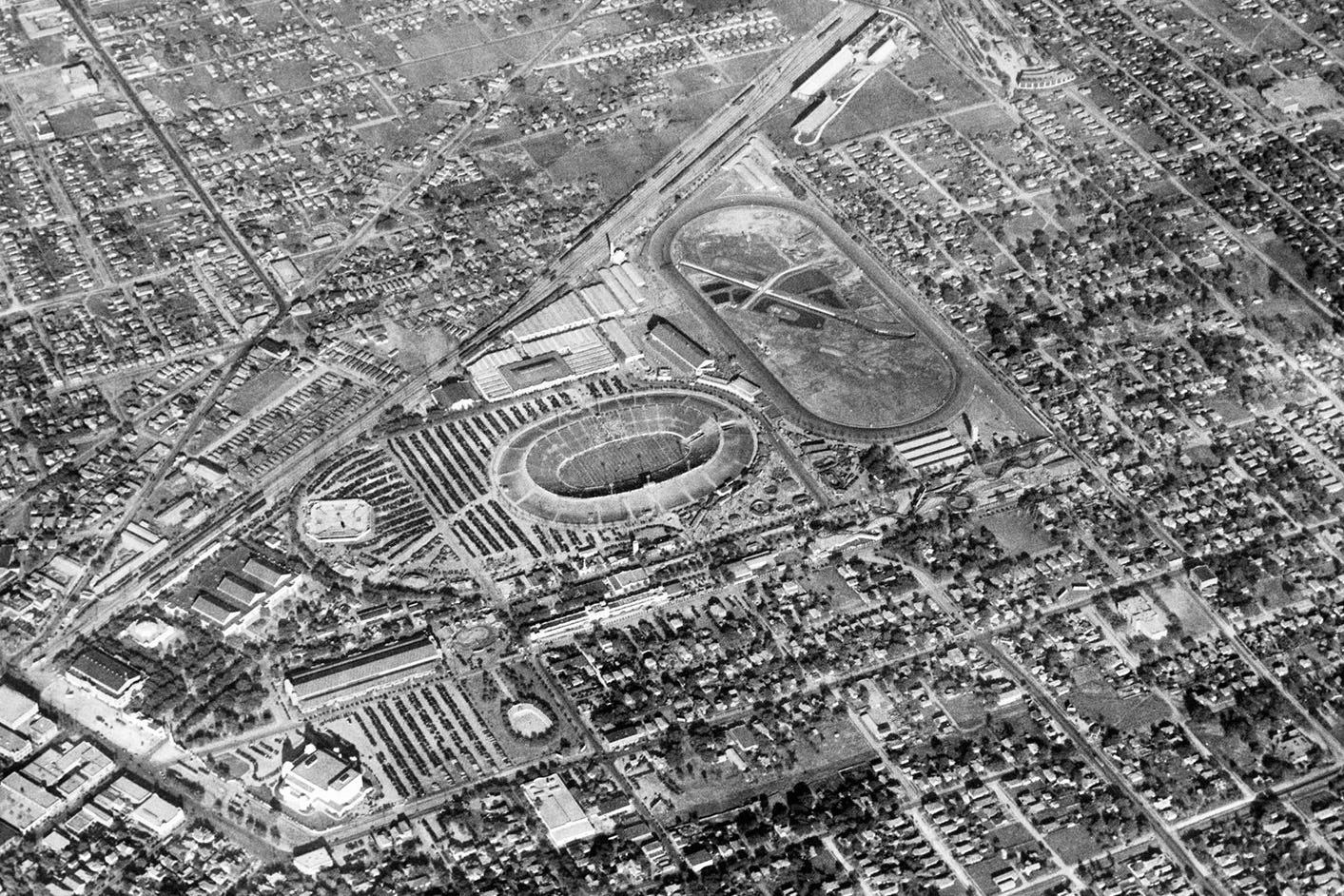
That year, Dallas hosted the Texas Centennial Exposition, and the old State Fair grounds were remade into an exposition city. It was Texas’s hundredth birthday, but Dallas built it like a world’s fair: in plaster, concrete, murals, fountains, sculpture, neon, and ceremony. Twelve million people came through the exhibitions of 1936 and 1937, roughly two times the entire population of Texas at the time.
San Antonio had the Alamo. Houston had San Jacinto. Dallas had the weakest claim on the history of Texan independence of all the cities vying to host the Centennial but the strongest civic machine. Again turning to the Texas Handbook, our Boosters put up a total of $8 million of their own money (worth $200 million today) and outmuscled cities where Santa Anna or Davy Crockett had actually been.
The result is the Fair Park we know: the Hall of State, the Esplanade, the Tower Building, the murals, the sculpture, and the facades. A temporary exposition gave Dallas its most permanent public prize.1
This is the first complication. Fair Park is not simply a park that has fallen on hard times. It is an exposition ground that outlived its exposition. Its buildings were designed to astonish crowds in 1936, no thought for what they could be doing on a Saturday morning in 2026.
For decades, Dallas got by without a working theory of what to do with this temple to New Deal architecture. The old bargain was the State Fair returned every fall and gave the place its annual reason for being. The rest of the year, some aging buildings held events, the Cotton Bowl hosted a football game or two, it saw children on field trips to the Science Place (which closed after the Perot Museum opened in 2012) while some spaces sat empty, and much of the acreage sat as unused surface parking.
By the 2010s, that bargain no longer looked like stewardship. Mayor Mike Rawlings convened a Blue Ribbon Task Force (not just any kind of task force) in 2014 to say what generations of Dallasites already knew: Fair Park was underused, undermaintained, and overdue for a new future. The Task Force recommended a public-private partnership with power to control the revitalization of Fair Park, including its relationship with the State Fair.
That last phrase was the radioactive part. It treated the State Fair not as the immovable object around which every other idea needed to bend, but as one tenant in Fair Park’s larger civic future. It was like escaping the gravity of a supermassive black hole. Proposals that emerged to shrink the footprint or the number of days before and after the Fair reserved for set-up were short lived.
Rawlings turned to chief DART visionary and former Hunt Oil CEO Walt Humann to build a private foundation that could take over day-to-day operations and raise the level of ambition, following the path taken by both the Dallas Zoo and the Arboretum.
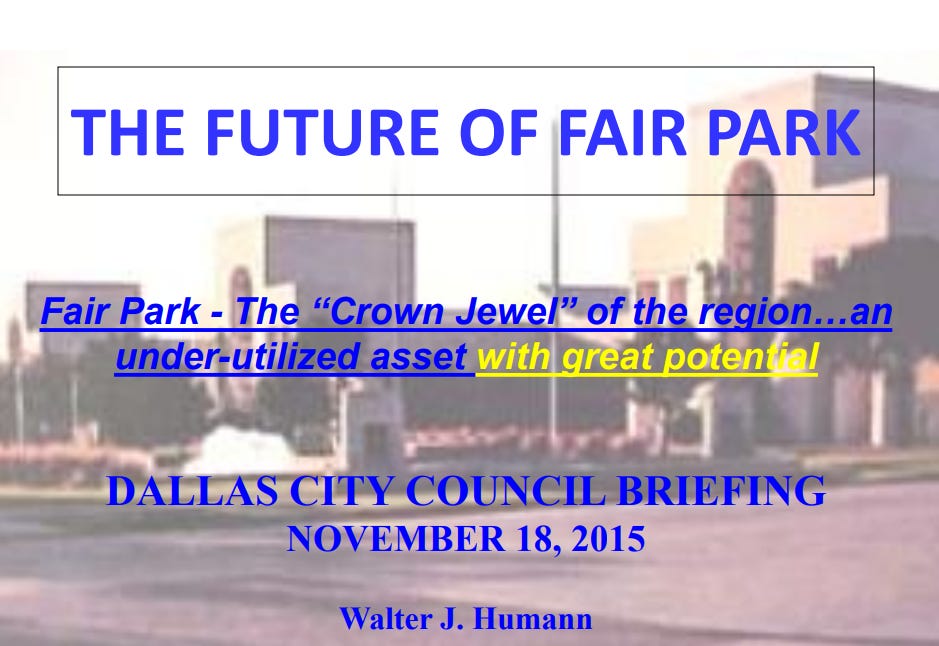
Humann's plan reached the Park Board in 2016, which entailed forming the “Fair Park Texas Foundation” to which the City would hand over operations of Fair Park. The city attorney later ruled (no doubt with some prodding by the plan’s detractors) that handing operations to Humann’s new foundation without public bidding would violate state law. The 2018 RFP that followed still required the operator to be a nonprofit. It produced Fair Park First: another new local nonprofit partnered with a for-profit venue operator Spectra, who ran convention centers and professional sports arenas around the country, later acquired by the Oak View Group.
The dream was familiar: keep the public asset public, summon private-sector competence, launder it with nonprofit virtue, and hope the resulting creature could do what City Hall had not. Spectra’s bid immediately saved the City around $10 million per year compared to what we spent running the place ourselves. The council chamber burst into applause when the contract was approved, per the Morning News.
The arrangement had structural problems from the start. Fair Park First was brand new and had no money, other than what Spectra would pay for. Its first executive director reported to the nonprofit board on paper, while also being paid by Spectra. Fair Park First was a contractual middle man between Spectra and the City of Dallas itself, preventing direct accountability from City Council or the Park Board for the performance or condition of Fair Park. For several years, the place ran anyway, until 2024 audit findings found $5.7 million in private donor funds had been allegedly misspent on operations and other disallowed uses.
Finally in 2025 the City brought Fair Park operations back inside Park and Recreation and terminated the Spectra (now OVG360) contract. Fair Park First, the nonprofit, is still in the picture as a conservancy to raise and steward private philanthropy.
That is the “one year” story, but it still points back to the old question. Dallas had never decided what Fair Park really was, so we kept experimenting instead with who should have the keys.
The model Dallas is reaching for now has a successful American example in Forest Park Forever, the nonprofit conservancy founded in 1986 to support Forest Park in St. Louis. Like Fair Park, Forest Park is a centrally-located civic asset that once hosted a World’s Fair. It hosts the zoo, the Muny Theatre, the Saint Louis Art Museum, and is the kind of place you can take a seven-year-old for the day and never worry about running out of free or nearly-free things to do. The city owns and operates the park, while the conservancy’s role is in raising private money, supporting planning, funding capital projects, and giving donors a durable civic vehicle that lasts longer than an election cycle for stewardship.
It is not hard to see why Dallas would find that attractive. The comparison clarifies the problem more than it solves it. Forest Park is mostly a park. There is more grass than concrete, and it’s not particularly close. Fair Park is not a park, at least not in the ordinary sense.
Fair Park is a fairground, a historic exposition, a landlord, a parking reservoir, and a neighborhood wound. It is a lot of things, but a park is not one of them. Every major plan for Fair Park over the last generation has circled some version of the same aphoristic phrase: “Put the ‘Park’ back in Fair Park.” It sounds obvious, which is one reason Dallas keeps repeating it. The phrase may also be a diagnostic error. Fair Park was never simply a park that was short on grass. It was a fairground that became a Centennial Exposition ground that became an inheritance and a problem no single model could solve.
We are working on that.
On February 25, 2026, the City Council unanimously approved a $40 million development agreement with Fair Park First for a new 10.5-acre “Community Park” inside Fair Park’s eastern boundary, where the largest parking lots now sit. Funding is roughly 90 percent raised. Groundbreaking is targeted for August 2026, after the FIFA World Cup Fanfest is hosted here. It is a step in the direction of putting the “Park” back in Fair Park.
The Community Park is, among other things, a moral make-good to the residents of South Dallas. As catalogued most recently by Zac Crain for D Magazine in “The Fair Park Lie”, in 1968, the city cleared nearly 300 Black-owned homes to expand Fair Park’s parking lots.2 Residents fought eminent domain offers they regarded as grossly unfair. At one 1969 meeting, civil rights leader J.B. Jackson pointed out that land belonging to Councilman Abe Meyer had been appraised at $4.17 per square foot, while Black-owned land on the same block had been appraised at 75 cents.
The promise of a park is not new. Throughout the 1968 takings, Park Director L.B. Houston assured the public the new acreage would include preserved trees, picnic areas, a lighted playground, basketball courts, and maybe enough room for a baseball diamond. He spoke of “getting away from concrete.”
It became 4,000 parking spaces, same as it is today.
Fair Park First will oversee the development of the Community Park on behalf of the city, aiming to open by late 2027 on a timeline dictated by some of its federal funding. It will be a test and tone-setting exercise for Fair Park First, now without the private-sector operator Spectra at its side.
The new arrangement may solve a custody problem. It gives Park and Recreation the keys, Fair Park First a narrower philanthropic role, and the long-awaited Community Park a path to construction. Still, custody is not a replacement for purpose. The temptation is to answer purpose with use: more events, more programming, more grass. The deeper question is whether Dallas still believes our shared public life deserves a monumental home.
The 1936 question was how Dallas could show itself off for Texas and the country. Last decade’s question was who should run the place. Last year’s question was how to recover from another failed structure.
The next question is harder.
What is Fair Park for?
That is the question for next week.
I could cite at length here the 1940 book The WPA Dallas Guide and History, reprinted in 1992 by the Dallas Public Library and UNT’s publishing wing. Used copies of it float around at Half-Priced Books or online. It is the perfect time capsule for not only the history of the first hundred years of Dallas, but more importantly, how Dallas saw Dallas. The extent to which things haven’t changed is shocking.
The Accommodation, by Jim Schutze also recounts this story, serving as a climax of sorts in the book. See chapters 28-30.
I firmly believe that if Fair Park was actually put in the hands of Humann, he and Anderson would have settled their differences and worked to make a better Fair Park. Both their hearts were into it. But the city saw fit to hand it to a Philadelphia company, so here we are...
This was a great piece. My whole life, I've read about plans for Fair Park and then watched them all fizzle out just in time for a new plan. I wonder if part of the reason for this is because we don't have a good answer to the "what is Fair Park for" question.
Part of trying to answer this question is reckoning with what it used to be. After the expositions of 1936 and 1937, the south side of the park was designed as a civic center. Around the lagoon was a natural history museum, a museum of fine arts, an aquarium, a science museum, and a garden.
Over time, Dallas chose to move those institutions out of Fair Park. Instead of investing in what could have been a great cultural center, we slowly extracted everything out of it.
That's part of the problem today: the institutions that were birthed in Fair Park still exist. They just exist somewhere else. That purpose for Fair Park is fulfilled elsewhere.
We need a vision for the space that's more than just having it be better utilized year round. That is what so many of the recent plans distill down to. Find tenants for the buildings. Book more concerts. Book more festivals. This connects back to your "Theory of a City" post. These plans all take the form of: "We have a world class space, it should be a bigger asset."
Much to think about. I look forward to your next post.