
It is 2046.
You are driving east on the new bridge over the Trinity into Downtown Dallas. AT&T left for Plano seventeen years ago. The Discovery District closed not long after. Neiman Marcus is gone. Brides buy their dresses at Northpark. The Dallas Mavericks are in Irving, in a taxpayer financed-arena surrounded by an entertainment district that is, by all accounts, pretty nice if you enjoy driving to things. The Dallas Stars play in Plano. The American Airlines Center has been torn down. The site is now a new mixed-use development with a fading “Y’all Street” banner (a real thing that real adults called it) that no one has bothered to take down. The project is about 60 percent leased, which developer Jack Matthews calls “stabilizing.”
City Hall, in this version of events, got its renovation. The council voted to stay in 2026, called a bond election early, and began a phased-repair program that was projected to take five years and cost $800 million after the second independent review brought the number down. Eight years and $1.1 billion later, the building was finally modernized. The roof no longer leaked. The generators worked. Seven of the blocks around City Hall and the convention center are still surface parking lots.
The convention center opened on time in 2029. It is widely considered a top six convention center in North America. Conventions come. Attendees stay in the hotels. They climb in Waymos to go back to the recently-added Terminal H at DFW Airport. The deck park over I-30 was built and it is lovely. It connects Downtown to the Cedars in a way that, on paper, should have catalyzed development on both sides.
Downtown Dallas, in this version of 2046, is not a disaster.
It is something worse. It is fine.
It is a place that functions during business hours, holds events on schedule, and has a residential population that grew just enough to not be embarrassing, but not nearly enough to feel like a neighborhood.
Nothing in this scenario went wrong. That is the thing that should scare us. Every project was completed. The convention center was built. City Hall was repaired. The deck park was funded. Individual decisions, each defensible on its own terms, made by separate committees on separate timelines. The problem is that nobody ever asked them to add up to the same thing.
I have spent three weeks on City Hall. The building, the numbers. I stand by all of it.
However. (There is always a however.) I am going to do what I said I wouldn’t do, and what I told you shouldn’t do either. I am going to combine the City Hall question and the arena one. Because perhaps, the City Hall question was never the question. It was the question you had to answer first, but why tear down a building to do nothing with the 15 acres you just made available? It means we can finally ask the question I have been circling for three weeks.
What is Downtown for?
Tearing down City Hall only makes sense if you have a vision for Downtown to be on a path other than the one it is currently on. The urgency and speed at which we are making that decision only make sense if Downtown is at an inflection point. If you have not been paying attention, it is. At best, Downtown is on its way to becoming Dallas's largest opportunity cost. At worst, it becomes nothing at all.
The Ghost of Downtown Past
Downtown Dallas is in many respects, not unique. American downtowns look the way they do because of two forces, applied in sequence. The first was proximity. Before the automobile, people clustered because they had no choice. Narrow streets and tall buildings were a function of feet, not policy. The courthouse, the city hall, the department store, and the theater anchored every downtown in America for two centuries, not because someone planned it that way, but because everything had to be close to everything else.
The second force was the office. Postwar, the car and the suburb solved the proximity problem, but offices still needed to cluster. You cannot run a law firm from a ranch in Celina. Downtowns survived the suburban exodus not as neighborhoods but as commuter destinations, places you drove to in the morning and left at five. (We are still recovering from the highways they built to allow this.) For decades, it was enough. The restaurants served lunch. The city collected property taxes on towers full of desks. Nobody asked whether Downtown was a place people wanted to be, because it was a place people had to be, eight hours a day, five days a week.
The constant across both eras was that Downtown is centrally located. That has not changed. What has changed is what it makes sense to put there. Not offices, or at least not only offices. We know what COVID did, and we can only guess at what AI does after. However, the same things still benefit from being in the center of a metro area of eight million people: the seat of government, civic and cultural institutions, convention and entertainment facilities, and dare I say, arenas. Above all of it and around all of it, we will need people. The pre-war downtown was a place you walked to because you had no car. The postwar downtown was a place you drove to because you had no choice. The post-COVID downtown, if we build it right, is a place you live in because you want to.
The Ghost of Downtown Present
As I am sure you are aware, Downtown’s largest employer AT&T has announced they are leaving for Plano, taking with them six thousand employees. We were told they left because they wanted a “horizontal campus.” However, emails between AT&T CEO John Stankey and City Manager Kim Tolbert, first publicized by DMN just last night, tell a different story. Stankey’s trouble, in his own (corporate) words, was that “my concerns transcend the immediate issues and moment and extend to the ongoing and cyclical nature of our challenges with effective/sustained governance of the City and the inter-relationship of other issues and components to deliver a healthy business environment and neighborhood.” Sheesh. I can only imagine how much the consultants got paid for that sentence. I could have written it in two words — We're out. “Challenges with effective/sustained governance” is this week’s candidate for new city motto.
According to DMN, AT&T’s RFP for a new HQ that followed did not include a single site in Dallas. They were not shopping for a campus. They were leaving. When half your workforce can work from a kitchen table in Frisco, the only reason to keep 6,000 people in a single downtown tower is that Downtown offers something Frisco does not. Right now, it does not.
What Downtown still offers is the densest, most highly taxed acreage in the city, which is why cutting it out like our appendix is not an option. Downtowns all across the country are outliving their past purposes, but that is no excuse to treat it like a centrally-located vestigial organ. The question is whether we can build a new purpose before it reaches a point of no return.
The State of Play
If your image of Downtown is one from say 2021, it is out of date. Many more people live in Downtown than did ten years ago. The pandemic-era spike in unsheltered homelessness, which was a national phenomenon Dallas handled about as well as anyone (which is to say, not great), has in part subsided, especially in the tourism-heavy parts of Downtown. Whether that holds past the city’s extraordinary efforts ahead of the 2026 FIFA World Cup (or to save AT&T) is a fair question. Regardless, the Downtown you are picturing is probably worse than the one that is actually there. It is still not great.
Downtown Dallas has a residential population of roughly 13,000. For scale: that is only a bit higher than the population of The Village, the apartment complex at Greenville and Lovers where you may have lived in your twenties. The entire central business district of the ninth-largest city in America has fewer residents than fit inside the route of the Dallas St. Patrick’s Day 5K Race.
Downtown sits on just under nine hundred acres of land. It is less than half of one percent of the city’s land. By my math, it contributes over 4 percent of all property tax revenue, property taxes being a majority of Dallas’s revenue. It contributes closer to 8 percent of commercial property taxes, the ones that are not assessed on regular homeowners and which swing hard with things like homestead exemption reform and are generally speaking a regressive tax. Downtown provides over ten times more tax value per acre than the rest of the city, a higher value per acre than even the tony Park Cities.
That ratio is falling. For some real world examples, Comerica Tower has lost 11 percent of its assessed value since 2010. Bank of America Plaza (“the Pickle”) has lost 1 percent over the same period. Similarly-aged buildings just across the highway park in Uptown, The Crescent and 1845 Woodall Rodgers, have gained 156 and 204 percent over the same period. Downtown merchant sales volumes (on which we collect sales tax) fell from $1.35 billion in 2017 to 2019 to $850 million in 2021 to 2024, a thirty-seven percent drop that can only be written off due to the pandemic in part. This is not a Dallas problem. Dallas is booming. This is a Downtown problem.
Dallas needs density to maintain its tax base. The city is landlocked. The revenue has to come from building more value on the acres we already have. Even better if it comes from increasing the value of a building that was already built. If you have been to a zoning meeting anywhere for anything ever, you already know how this conversation goes.
I will not prejudice anyone by saying the angry neighbors are wrong. (They generally are). I am saying that if you do not want density in your neighborhood, you should be very excited about density being built Downtown. Downtown is perhaps the one place in Dallas where you can add twenty thousand new residential units and there will be no one to show up and complain.
Letting Downtown decline is not the fiscally conservative position. It is the opposite. It is watching the most productive, centrally-located acreage in the city lose value while the capital moves north, and deciding not to do anything about it because the intervention looks expensive in a press release. Yes, the intervention is expensive. Doing nothing will cost us more.
What the Arena Does
The tax base does not recover without residents. Not convention attendees. Not office workers who leave at five. Residents. Tens of thousands of them (or more). Enough that the streets have foot traffic at all hours, that retail can survive on neighborhood demand rather than event spillover, that “public safety” becomes a consequence of population density rather than a euphemism in Downtown’s BCG consulting report.
Convention centers do not build neighborhoods, because conventions are temporary. Parks do not build neighborhoods, because parks without people are just grass. An arena is busy 40 or 50 nights a year, which is better than a convention center but worse than a grocery store. What an arena does, if it is planned correctly, is give a developer a reason to build the housing that builds the neighborhood. The arena is not the point. The twenty-thousand apartments around the arena are the point.
San Diego already proved this. In the late 1990s, East Village was 130 blocks of warehouses, vacant lots, and social services. Roughly 70 percent of the land was empty. The city and the Padres agreed to build Petco Park there in 2004 as the catalyst of a 26-block master-planned district. The final tab was $474 million (not inflation adjusted). The city paid $301 million, mostly through hotel-tax bonds (how we financed the AAC around the same time). The Padres and private developers covered the rest, including almost all of the cost overruns.
Within ten years, the 26 blocks around the ballpark had added roughly 14,000 new housing units and 15,000 residents. The population today, twenty years on, is north of 40,000. Employment barely moved. In the decade after Petco Park opened, the area added 29 jobs. Not 29,000. Twenty-nine. The ballpark built a neighborhood.
I am using San Diego as the model. Not because it all went perfect. It did not. California eventually canceled state funding that meant local taxpayers footed more of the bill than expected. Homelessness there is still an “issue.” I am using it because San Diego’s East Village was 130 blocks of nothing in 1998, and today 40,000 people live there. People live there on Tuesday mornings. The restaurants are open because the residents are there, not because the Padres are playing. The ballpark is one building among many. The ratio is the point.
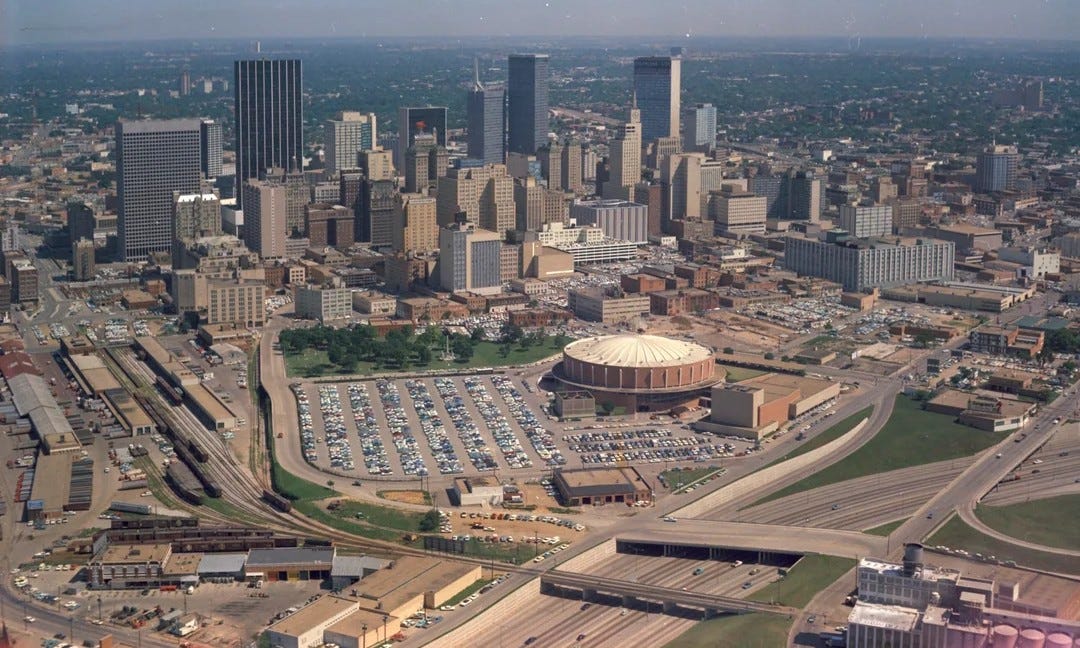
Victory Park was supposed to do what Petco Park did. Everyone in Dallas already knows how that went. The financial crisis hit. The condos sat empty. The arena worked. Everything around it did not, for well over a decade. Victory Park eventually filled in. It took twenty years to get a grocery store. However, Victory Park was never large enough in the first place, only 75 acres compared to 900 total downtown. It is a few blocks of apartments next to an arena.
Victory Park paid a price we can all now learn from. First, it was planned as a luxury destination, not as a neighborhood. Second, it was priced for a population that did not exist, instead of priced to create one. Any deal for a new arena that does not include residential density and a lot more of it, is Victory Park again. We have already run that experiment. Every version of this story that works has to end the same way. More people living Downtown. A lot more than could ever fit in Victory.
Who Pays
I spent almost a month now on the City Hall numbers. I owe you the same work on the arena.
The last five NBA arenas built in America cost between $524 million and $2 billion. Two were privately financed by mega-billionaires who wrote the check themselves. Dallas will not get that deal. (We should ask.) San Antonio is the next team to break ground on a new stadium, with a $1.3 billion dollar budget and $800 million of that being publicly funded. The budget in Dallas will start with a ‘B’.
We should expect the arena deal, whether it happens at Valley View or Downtown, has a largely publicly-funded component, paid for by our hotel occupancy taxes. Once again, San Antonio is the model. We can use a mechanism under state law called a PFZ, Project Finance Zone, which re-directs a portion of the state’s share of hotel taxes away from Austin and to specific local projects. We have already used it on the new convention center next door, and we would redraw the zone to include the arena. I cannot help but note here, we are going to be slicing the pie pretty thin to add another billion dollar pledge to the $2.2 billion in hotel-tax debt already funding the convention center.
I do not know whether the city will use hotel-tax revenue, tap into general obligation bonds, the land value at 1500 Marilla, private contribution, or some combination to finance an arena. Those are answers for questions that have not been asked yet. However, the same standard I applied to City Hall applies here. Show the numbers, make the math work, and pick who ultimately pays if the projections are wrong. If someone proposes a billion dollar project without mentioning who pays for it, the answer is usually: you.
2046, the Other Version
It is 2046 again, but different.
The convention center has been open for seventeen years. It is full most weeks. Attendees walk out the front doors and into a neighborhood. A neighborhood with a breakfast place on the corner of Marilla and Ervay that has been there eleven years because the owner lives six blocks away and her regulars live closer. The deck park connects the convention center to the Cedars, and both sides of I-30 have the kind of mid-rise residential density that makes a park feel like a park and not a green buffer between two parking lots.
City Hall was demolished in 2030. The city bought AT&T’s old campus, right as they moved to Plano. The 15 acres at 1500 Marilla became the center of a master-planned neighborhood district. There is an arena. The Dallas Mavericks play in it. We hosted NBA All Star Weekend in it twice. It is one building among many. The arena is busy 40 or 50 nights a year. The neighborhood is busy every night. The taco shop across from the park is busy at lunch on a Wednesday, which is perhaps the only measure of a neighborhood that has ever mattered.
Downtown Dallas has a residential population of 40,000. That is still modest by the standards of a major American city, but it is triple the 2026 number. The streets are not empty at 9 p.m. The restaurants are open for dinner. There is a grocery store. The tax base contributes nearly one-tenth of the City’s annual revenue, despite being only three percent of the city’s (growing again) population.
Nothing in this version of 2046 required any technology that does not exist. It required no unprecedented public expenditure. The only thing this version required that the other version did not was a decision. Downtowns aren’t just places people work any more. This is a neighborhood. Build it like one.
The version of 2046 I want to build toward still has losses. We lose a Pei building. We lose the civic plaza. The people who love that building are protecting something real, and I will not pretend otherwise.
I want to be honest about what the demolition argument actually is, because I have been making it for three weeks. I said separate the questions. The financial case is necessary but not sufficient. The argument is not about maintenance costs. It is not about the Adelsons. It is that Downtown is losing the tax base, the employers, and the foot traffic that justify its property values, and that 15 acres in the right location with the right plan might be the best chance to reverse that trajectory. That is the bet. It is not a small one.
What we are trying to win is a Downtown that works, that has people in it. The kind of place where you walk to dinner and pass other people who are also walking to dinner and nobody has to commission a study about whether the street feels safe because the answer is obvious.
The measure of whether we got it right is not whether the arena gets built. It is whether twenty-thousand more people live downtown fifteen years after it opens. That may be the only version of 2046 we can afford to choose.
love/hate/other to: onemansdallas@gmail.com
Thank you for this well thought out and written piece.
The first place to begin is to acknowledge the downtown of our past will not be the downtown of our future. The catalyst, the purpose, of a CBD is no longer there: business. Yes, there will continue to be commercial uses however the idea of congregation of daytime employment in vertical office buildings is not there going forward. This is due to both WFH, from the impact of AI, and finally the reality of business district nodes spread all around the metropolitan area. More will come.
The Dallas downtown of the future can be a viable area based on culture and entertainment , with residential as its main use, instead of the CBD. That does not preclude the current City Hall continuing as our City Hall, in fact it reinforces that use. The buildings that contained office workers converted to residential.The KBH Convention Center providing a stream of customers, the Maverick's Arena located directly east and adjacent with City Hall right where it sits. The new Dallas downtown merges with Cedars and Deep Ellum with the highways submerged that currently divides them.
1500 Marilla could easily be written into the Convention Center Master Plan without voter referendum. Chad west noted on WFAA with Jason Whitely that CH is CONNECTED to CC via a tunnel. And Bazaldua noted that CH underground parking was funded by the convention center funds when CH was built.
This puts 1500 Marilla under the Brimer Bill without having a voter referendum, as I see it:
Utilizing the Brimer Bill (Chapter 334 of the Texas Local Government Code) to replace Dallas City Hall with an arena/hotel/civic museum... whatever, and a surrounding entertainment district is projected by proponents and economists to be a massive catalyst for economic development, potentially transforming a $1 billion liability into a $10 billion economic engine.
### Revenue Generation and Tax Base Transformation
Replacing a municipal building with an arena and surrounding private development would fundamentally change the fiscal status of the 15-acre Marilla Street site:
* **Property Tax Rolls:** As a government-owned facility, City Hall currently pays no property taxes; a leased arena and mixed-use district would ass to the tax revenue.
* **New Revenue Streams:** An activated district would generate sustained sales and hotel occupancy taxes (HOT) that the current "concrete bunker" cannot.
* Avoiding the "Spite-Fix":The city currently faces a modernization bill for the existing structure between $906 million and $1.14 billion over the next 20 years. Relocating and redeveloping allows the city to avoid this capital drain while leveraging the private sector to fund the new district.
The "Anchor" Development Model
Proponents argue that unlike isolated "Island" stadiums, an integrated "Anchor" stadium model catalyzes year-round economic activity:
* Total Investment:Developer Ray Washburne and others project that a $2 billion arena district could attract as much as $10 billion in total macroeconomic investment to the southern side of downtown by 2031.
* Local Success Story: The Victory Park/American Airlines Center case study serves as a local precedent. That district generates approximately $1 billion annually in cash flow, supports 11,000 permanent jobs, and produces $26 million in local taxes annually.
*Office Market Stabilization: Relocating municipal operations into one of downtown’s vacant office towers (where the vacancy rate is 27.2%) would help stabilize a struggling commercial real estate core by taking approximately 500,000 square feet of "dead" space** off the market.
### Re-Stitching the Urban Fabric
The economic development extends beyond the immediate site to the surrounding neighborhoods:
* Realizing the 360 Plan:The current City Hall site is described as a "functional dead zone" that severs downtown from southern neighborhoods. A new district would "re-stitch" downtown to The Cedars and Southern Dallas.
* Synergy with Infrastructure: This development would synergize with the $3.7 billion Convention Center expansion and TxDOT's plans to lower I-345 and reconstruct the I-30 "Canyon," creating a contiguous flow of pedestrian and commercial energy.
In summary, the transition is viewed by many city leaders and developers as a strategic move to trade a functionally obsolete structure for a high-intensity economic anchor that would define the city's trajectory for decades.