
The conversation about Dallas City Hall is already headed in predictable directions. Questions of whether we build a shiny new City Hall or fix the old one. Others squabble over preserving a Brutalist masterpiece by famed architect I.M. Pei. Many have already skipped ahead to whether the site should be handed to the Dallas Mavericks for a new arena. Everyone has an opinion. Nobody wants to say the quiet part out loud.
It’s tempting to think that the right question to ask is: “How did we get here in the first place?” That, however, may be the only question not worth dwelling on. Dallas made a series of choices, year after year, budget after budget, to skip planned maintenance and pay for it later. It’s later.
The right question is much simpler and far more uncomfortable: What do you do when there are no good options?
Dallas City Hall is a 49-year-old building where nearly every major part of the building is past its useful life. Water leaks through the facilities so badly that someone installed a gutter system inside the building to catch it. The building’s air conditioning is so old it relies on refrigerant now banned by the EPA for causing holes in the ozone layer. In the floors, walls, ceilings, insulation and pipes, there is asbestos in nearly every place the engineers looked (and likely too in the places they didn’t) which will make any repair program much more slow and costly. The total bill to stay at City Hall now starts at $906 million and in all likelihood, would eventually climb past a billion.
Unfortunately, the tab is so large that it has opened the door to messier questions about who benefits from what comes next.
Where We Are
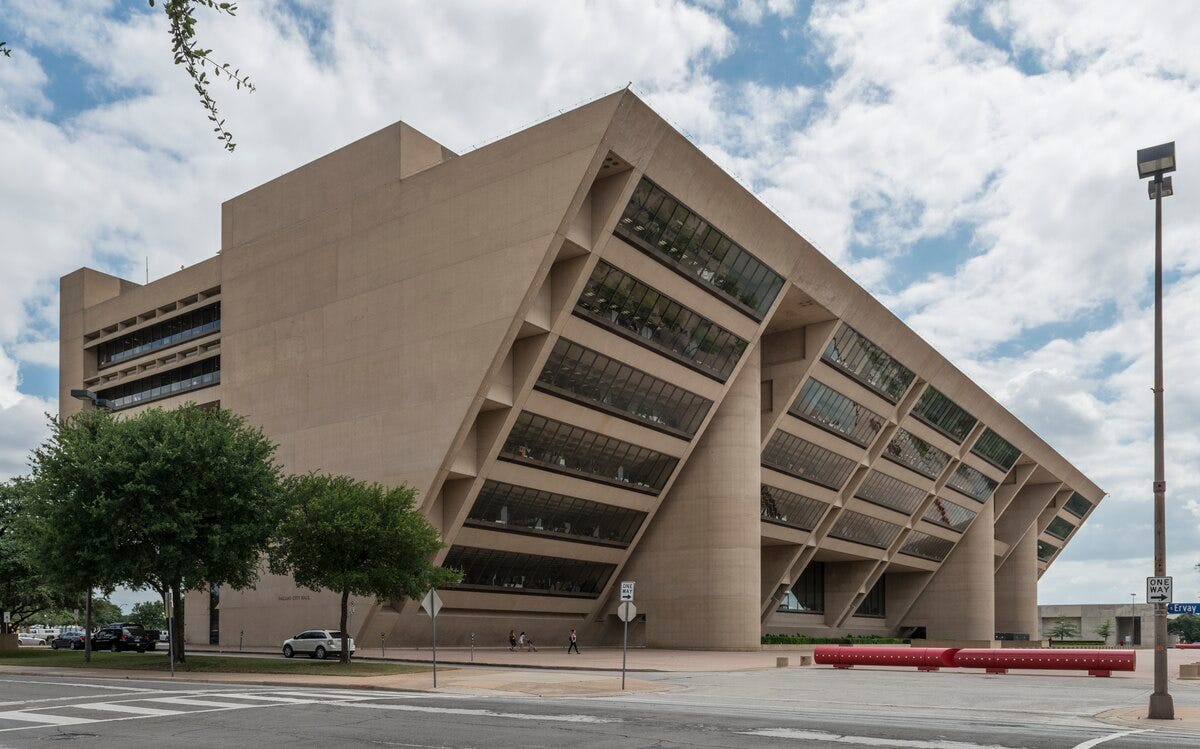
If you’re reading this, you’ll already know our City Hall is designed by famed architect I.M. Pei (also of Fountain Place fame), championed by Mayor Erik Jonsson (also of Central Library fame), and was built in an era in which Dallas was by all accounts struggling to move on from being the place where they killed JFK (also of Airport fame). Dallas City Hall opened in 1978. It is, by most accounts, a significant piece of civic architecture. The Brutalist style it embodies made the building a natural stand-in for the headquarters of the evil OmniCorp in 1987’s Robocop, despite the film’s being set in Detroit. It is also, by every engineering account available, a building where nearly everything that can wear out has worn out.
According to the Facility Condition Assessment from AECOM, nearly every major system in City Hall has exceeded its useful life. The roof has a standard useful life of 25 years. City Hall’s roof is 29 years old. The HVAC systems have a standard life of 20 to 30 years. Like the building itself, they are 49. The emergency power generation system has a standard life of 20 to 25 years. Again, parts of it are 49.
Here is the closest I got to being angry in writing this piece (though I’m not mad, I’m just disappointed). The city actually designed a replacement for the emergency generator system. The engineering was done. The plans were drawn. Then the city paused implementation and moved the funding to something else. The old, undersized generators are still running. They are powering the building that houses Dallas PD dispatch, 911 call operations, and even the city’s Emergency Operations Center.
Read that again. The systems keeping the lights on for Dallas’s Emergency Operations Center are running on generators the city itself determined needed to be replaced, then chose not to replace.
This is the pattern. The presentation from Assistant City Manager Donzell Gipson to the Finance Committee on February 23, 2026, includes a line that I can only imagine will be in the running for our new city motto: “The majority of repairs done to date have been reactive to system failures.”
We don’t fix things when they wear out. We fix things when they break. The difference between those two philosophies, compounded over 49 years, is the difference between a manageable annual budget and a $329 million repair bill.
That’s just the repair number. Keep reading.
Why We Can’t Have Nice Things
The number you will (may) hear most often is $329 million. That is the estimated cost for corrective repairs to City Hall’s building systems and infrastructure. It is a large number. It is also deeply misleading, because it assumes conditions that do not exist.
The $329 million estimate assumes the building is unoccupied during construction. You cannot rewire the electrical system, tear out and replace all the HVAC equipment, strip the roof, rehabilitate the parking garage structure, and abate asbestos throughout a building while nearly 2,000 city employees are working inside it. AECOM’s assessment says “in-place” renovation is not recommended due to increased construction cost, extended timelines, operational disruptions, and environmental considerations.
The full report breaks down the true costs of repair in a 20-year table, and it is worth walking through every line because each one represents a cost that was created by pretending an earlier cost didn't exist.
Start with corrective repairs: $329 million. That covers restoring the building systems to functional condition. It does not include modernizing anything. It does not include reconfiguring the space. It does not include new technology. Just getting the pipes, wires, chillers, generators, roof, windows, fire suppression, and structure back to working order.
Next, you have to actually make the building usable again after those repairs. Interior buildout runs around $100 million. Furniture, fixtures, and equipment: $20 to $45 million. Technology: $15 to $31 million. ADA compliance upgrades: $33 million. Soft costs and moving: $20 million. Contingency: $23 to $28 million. Call it roughly $165 million at the low end to make City Hall move-in ready after $329 million in repairs.
But remember, nobody can be in the building while this work happens. So you need to lease temporary space for five years. The lease itself runs $100 to $112 million. Fitting out that temporary space costs another (wide-ranging) $13 to $73 million.
Because the city does not have $329 million (plus everything else) in cash sitting around, it will need to finance the project through bonds, as we do for most large city expenditures. Interest expense over 20 years: $299 to $360 million. Layer on 20 years of what the engineers estimate the go-forward operating expenses will be to stay in City Hall, and you have yet another $277 million.
Add it up. The total costs to remain in City Hall until around its seventieth birthday range from $1.1 to $1.4 billion.
Also, the $329 million corrective repair estimate does not include cost contingency. It’s a government job. Things will cost more and take longer than we think. The real number will be higher. We just don’t yet know how much.
Let’s Talk About the Building
Before we get to the arena question, we should talk honestly about what we are being asked to save.
I have been to Dallas City Hall dozens of times. City Council meetings. City Plan Commission hearings. Meetings with staff in the offices upstairs. I can tell you from direct, repeated, personal experience that the building is miserable to navigate and miserable to access.
If you have never been, picture this. You are a Dallas resident. Maybe you need to attend a public hearing regarding a zoning case on your street. Maybe you need to deal with a permit or pay a water bill in person. You drive to a giant concrete structure off Young Street that looks, from the outside, less like a civic building and more like a nuclear power plant. You enter a building whose layout is at best, color-coded. “Ah, you took the green elevator. You need to go back down and take the red elevator to this floor,” a helpful staffer may tell you. You try to find the right floor, the right wing, the right office. Getting around is confusing. The space has been piecemealed and reconfigured over decades into something that the city’s own consultants describe politely as “challenges related to wayfinding and security.” Less politely: nobody can find anything and the building fights you the whole way.
I could wax poetic about how a City Hall is supposed to be the physical expression of the relationship between a city and its people. The ability for the public to come and be heard or be served. I even mostly believe it. Dallas City Hall is a literal concrete bunker. It communicates the opposite of every one of those values. The inverted pyramid looms over dark, castle-like columns at exactly the place where a civic building should feel most welcoming. The plaza is a soulless concrete expanse, with its heat bordering on hostile in the summer months. It competes for the title of most deadly public space in a downtown that already boasts the site of a presidential assassination.
Now, about I.M. Pei.
I am told I.M. Pei was one of the greatest architects of the 20th century. The Louvre Pyramid. The East Building of the National Gallery. The Bank of China Tower. These are places I have not been to, but see on his Wikipedia page. His body of work locally includes the Meyerson Symphony Center, Fountain Place, Energy Square and One Dallas Center. However, quoting former councilman Philip Kingston, every architect, no matter how brilliant, eventually has a worst building. Dallas City Hall might be his.
The preservation argument leans heavily on the Pei name. Yes, that name carries real weight. We should still be honest about what we are preserving. We are not preserving the Louvre Pyramid. We are preserving a brutalist office building from the 1970s that the architect himself admitted was, “perhaps stronger than I would have liked; it's got more strength than finesse".
There is a conversation to be had about historic preservation. That conversation has to include whether the Pei name alone justifies spending over a billion dollars preserving a building from which Dallas does not derive a billion dollars worth of value. We should not confuse architectural celebrity with architectural success. A building can be designed by a famous architect and still be bad at its job. Both of those things can be true at the same time. That is what a tradeoff looks like.
So if not renovation, then what?
The most prominent public plan for the City Hall site involves demolishing the building and making way for a new Dallas Mavericks arena. Their current home, American Airlines Center, opened in only 2001, but the Mavericks’ ownership has been making the case for a new stadium, even to the point of litigation with current AAC roommates, Dallas Stars. The City Hall site, adjacent to the new (and old) Convention Center at the south end of downtown, is no doubt 15 acres of attractive real estate.
People hate this idea.
The Mavericks are now owned by the casino-magnate Adelson family, who are the single largest financial supporters of Donald Trump’s presidential campaigns. Further, they are major spenders in Texas politics due to our state’s long prohibition on casino gambling, having spent over $10 million so far this year (yes, it’s February) to back candidates in Texas House and Senate primary races. And even if you can look past all that, they’re still the family that traded future hall of famer Luka Doncic for (checks notes) Max Christie, Marvin Bagley III, and Khris Middleton.
In a city that voted overwhelmingly for the other guy girl, this all matters to people. Perhaps the Luka component above all. You have a privately-owned NBA franchise asking for public cooperation from a people that are not feeling especially cooperative. The Adelsons are looking to cash in on sympathy they have not banked. It creates an unavoidable dynamic where a billion-dollar public decision looks, to a significant portion of the electorate, like it primarily benefits politically questionable (at best) billionaires who couldn’t possibly need any more money.
So, the political frame becomes: tear down I.M. Pei’s building so that Trump-supporting billionaires and the other wealthy real estate developers in downtown can profit from the land your tax dollars paid for. That is a hard sell, and everyone involved knows it. The Robocop comparison is too on the nose at this point, that this building once served as the fictional headquarters of a corporation scheming to demolish a city for private real estate development is now, in real life, potentially being demolished so that real estate and casino billionaires can develop the land. I digress.
Tradeoffs
The building is failing regardless of whether anyone wants to build an arena on the site. The $329 million repair bill exists whether the Mavericks are involved or not. The leaking garage, the corroded piping, the asbestos, the generators running on borrowed time. All of that is true independent of any arena proposal. If the Adelson family sold the team tomorrow or moved to Irving, Dallas would still have a City Hall that costs over a billion dollars to renovate and occupy for the next 20 years.
The arena question is a question about what happens to the land after City Hall moves. It is not, or should not be, the question that determines whether City Hall moves. Those are two separate decisions, and conflating them is how we end up making the next billion-dollar choice for the wrong reasons.
Should the city negotiate hard on the terms of any arena deal? Obviously. Should public land generate substantial public benefit? Absolutely. Should the politics of who owns the Mavericks determine whether Dallas spends a billion dollars renovating a failing building? There is not a more expensive way to make a point.
The danger here is that (legitimate) anger at the arena deal’s primary beneficiaries becomes the reason Dallas talks itself into pouring a billion dollars into a building that doesn’t work, never really worked for the public, and will cost more to fix than to just leave. That we would spite-fix City Hall. This is not the progressive outcome.
The people who would pay for it are not the Adelsons. It is us, the Dallas taxpayers.
We do not get to pick an option that has no downside. There is no version of this where nobody benefits who we wish wouldn’t, and nothing is lost that we wish we could keep. That is what it means to have no good options. The question is which bad option we can live with, and whether we can be honest about what each one actually costs.
Where Do We Go From Here
The commercial real estate market in Downtown Dallas right now is, for a tenant the size of the City of Dallas, very favorable. Multiple office properties Downtown (somewhat famously) have more than 500,000 square feet of excess space, enough to consolidate city facilities that are currently scattered across separate leased and owned buildings. The preliminary financial analysis found that moving to an existing office building (or buying it) is by far the least costly option. (I note, this is a move that the City of Fort Worth has recently very successfully employed itself to take a large vacant office building out of the market. Run, don’t walk, to see their new City Hall if you haven’t been.)
This crossroads also offers a chance to rethink how Dallas delivers city services. The city could consolidate the building permit center, currently in Oak Cliff, into the main campus, relocate 911 and Emergency Dispatch to a purpose-built, hardened facility (instead of a leaking building running on de-funded generators), and in the process, free up surplus properties like the Oak Cliff Municipal Center. For once, the city could occupy a building that is actually designed to welcome the people it serves. A City Hall with natural light, floors and elevators that make sense, ground-floor access, and maybe even less water intrusion.
The City should look hard at buying or leasing new space Downtown. Other cities have done it well, notably our neighbor to the west. Further, it kills two birds with one stone and takes at least some vacant office space off the market, at a time when it seems like Downtown is at a turning point, if not a full-on crisis. There are serious benefits to leasing vs. owning that should be considered for a City which has a penchant to underspend on maintenance.
The Choice
The question we are all asking, “how did we get here?,” is perhaps the easier one to answer. The harder question is, what are we going to learn from this? Worse, are we going to learn from this at all?
None of it works if the governance does not change. If Dallas leases or buys a building and then runs the same pay-as-you-go playbook for another 30 years, we will be right back here. Different address, same billion-dollar conversation. The disease is not the building on Marilla Street. The disease is a politics that ignores tradeoffs. That cuts maintenance whenever something more urgent (or more politically attractive) comes along. Every time a council votes to lower property taxes while the building they sit in crumbles around them, they are making a choice that has a cost. The cost is just quiet enough to ignore until it isn’t.
There are only around 500,000 households in the City of Dallas. We let this problem build up to the point it will take $2,000 or $3,000 from every family in the City to fix.
The real question for Dallas is not “new building or old building.” It is not “Pei or no Pei.” It is not even “arena or no arena.” Those are all downstream questions, and treating any one of them as the whole debate is how we avoid the harder conversation.
The upstream question is whether we are willing to fund the maintenance of whatever we choose next. Are we willing to start accepting tradeoffs? Because the billion-dollar bill at City Hall is not a surprise. It is the entirely predictable result of treating a building the way we treated it, every year, for 49 years. The only surprise is that anyone is surprised.
There is a real case Dallas City Hall should go. Not because the Mavericks want the land. Not because Brutalism is ugly. Because the building has failed, the math to fix it doesn’t work, and the money it would take to renovate it would be better spent on almost anything else. The arena question, the Pei question, the political question. Those all matter. But none of them change the number.
There are no good options. There are only honest ones and dishonest ones. The honest ones require us to name what we are gaining and what we are giving up, who benefits and who pays, and to make the choice with our eyes open. The dishonest ones let us pretend that someone else will pick up the tab, or that we can have it all if we just fight hard enough for our side.
Dallas, the next building is only as good as the budget. Whatever we build, buy, or lease. Whatever happens to the land on Marilla Street.
Are we ready to actually take care of it this time? Are we ready to have nice things?
love/hate/other to: onemansdallas@gmail.com
Kirk this may be one of the most well thought out arguments I’ve read in a very long time. When you are ready to run for Mayor, I’m ready to support you.
Pictures of this building were in my art history textbooks in the 00's. I've never been under the impression that it's a minor work of Pei's at all, even on an international scope. My read is people have been using his name only for shorthand, as these debates are often brief, and that in art conversations usually the artist's name, if they are significant to history, is the first descriptor of the work. The equivalent of something like this today doesn't exist and could not be made. I don't think there is a clear answer given the fragility of the building, but I do think it would be a considerably consequential thing to tear down, and I wonder if it would garner a whole new inauspicious and infamous legacy for Dallas were we to destroy it- especially given that it was built in more optimistic and prosperous times.