
A week ago, I made a fairly direct claim that Dallas should tear down City Hall and look to rent or buy an existing office building in Downtown.
The reactions I received to last week’s post, I think, are broadly reflective of the overall discourse about City Hall. People aren’t really talking about the arena. People are very worried however that a group of actors within the City is intentionally putting such a high price tag on City Hall to make it seem like staying is out of the question. Critics say reactions like mine are far too trusting of the “official narrative.”

Should we take the City’s numbers at face value? Is the $329 million corrective repair estimate or the $1.1 to $1.4 billion all-in figure trumped-up in order to make demolition look like the only rational option? Further, is the reason for that not incompetence or conservatism on the part of the engineers, but something worse? Should we all be worried that the fix is in?
In this version of the story, the City Manager and her staff, the Economic Development Corporation, the consulting firms they hired, and some unknown outside actors are all working toward a predetermined outcome: sentence City Hall to death by demolition, clear the site, and hand it to the Adelsons for a new arena. A majority of City Council is either in on it, or falling for it hook, line, and sinker.
That is a serious claim. And serious claims carry a burden of proof. Burdens that both sides would benefit from shouldering a little more than they have to date (myself included.)
What the Criticism Actually Says
I count four strains of skeptics.
One group points to a 2018 AECOM study that evaluated City Hall conditions from 2016 data. That study estimated about $19 million in repairs and $93 million in replacements. If the building needed $93 million eight years ago, how does it need $329 million now? There are partial explanations (narrower scope in 2018, inflation, multiple systems crossing end-of-life in the same window), but it’s a fair point. Count it.
A second group focuses on process. Council Member Adam Bazaldua called the EDC’s report a “justification memo” rather than a neutral assessment. Council Member Cara Mendelsohn said the report was “one-sided, predetermined and agenda-driven.” Bazaldua asked Linda McMahon, the EDC president, directly whether they had engaged any consultants who would not stand to benefit from a sale of 1500 Marilla Street. Her answer: “Not that I’m aware of.”
That is not a good answer. Two for two.
A third group focuses on the various assumptions baked into the billion-dollar figure. The report assumes the building must be fully vacated for five years, purportedly due to the quantity of asbestos that will be disturbed during renovations. It includes fitting out the temporary, five-year office space at a cost of up to $73 million, a move I can only describe as lighting money on fire. Critics point out the EDC also attributes $134 million in furniture, technology, ADA and moving costs entirely to the ‘stay’ scenario, as if moving into a different building somehow avoids needing desks and wheelchair ramps. Hat trick.
A fourth group landed late last week: Sixteen Former AIA Dallas Presidents (for the record, I am furious they swiped the title of my forthcoming sequel to Twelve Angry Men) released a ten-page slide deck calling the EDC’s projections “not credible.”
The deck gets many of the above points right: the shared-cost misallocation, the absence of a phased-repair alternative, and also a point no one else has raised. The Finance Committee has already voted to relocate emergency services from City Hall to a new purpose-built facility at $200 to $250 million. The EDC’s $211 million in core systems costs appears to assume those services stay in the basement. If the city is double-counting emergency systems that it already plans to move, that alone could knock tens of millions off the $329 million. Grand slam. (The deck also states the EDC failed to consider the City could apply for state and federal historic tax credits to pay for up to 45% of the renovations. I have to throw a penalty flag here. These funds are only available to private, income-producing buildings according to the Texas Historic Commission’s FAQs. They are 16 architects, not 16 tax attorneys after all.)
All of these are fair points. They are collectively more than enough to say: the city has not met its burden of proof on the billion-dollar number. But even taken together, they are not enough to meet a very different burden, which is the claim that the numbers were fabricated. Very few of these criticisms engage specifically with the findings of the report (the roof, the generators), but rather with the process, the assumptions, and the incentives of its authors. The gap between “these estimates have problems” and “this was a coordinated lie” is enormous, and right now the public conversation is collapsing the two. Sorry to be the discourse police.
What $329 Million Actually Gets Us
Before we get to the conspiracy claim, we should ask whether the $329 million number is even unusual. Even people who don’t buy the conspiracy still struggle with its size.
The original construction cost of Dallas City Hall, completed in 1978, was about $70 million. In 2026 dollars, this is roughly $350 million. The proposed corrective repair bill, before interiors or relocation, is a comparable number to what it cost to build City Hall in the first place. That by itself is not evidence of fraud. It is however a measure of how much damage 49 years of deferred maintenance can do.
In Austin, the Texas State Capitol underwent a comprehensive restoration and underground extension completed in 1995 for about $200 million. In 2026 dollars, roughly $430 million. That project restored the entire 360,000-square-foot historic building (new plumbing, electrical, HVAC, fire safety, full interior restoration to its 1888 appearance) and built a 667,000-square-foot underground extension. The Capitol restoration ran about $586 per square foot on just the historic building, not counting the additions. Dallas City Hall’s corrective repairs come in at about $439 per square foot.
Bethany Erickson at D Magazine contributed another example even closer to home. The Dallas County Records Building, actually three buildings constructed in 1915, 1928, and 1955, was renovated for $200 million, completed in 2022. In 2026 dollars, roughly $224 million, or about $784 per square foot for 286,000 square feet. That renovation is complete and those buildings are in use. There were higher per-square-foot costs than City Hall’s repairs, on buildings a fraction of the size, and nobody called it a conspiracy.
Erickson also makes the Notre Dame comparison, and it’s a fair one. (The one in Paris, not the one with a football team.) Notre Dame, 860 years old, devastated by fire, essentially rebuilt for about $760 million, although restoration work is ongoing. A near-total reconstruction of one of the most important buildings in Western civilization, using methods that included medieval carpentry and stonemasonry. It still cost less than the all-in, twenty-year figure being quoted for a brutalist office building from 1978.
If I haven’t exhausted you, there is the Federal Reserve in D.C. Its two buildings from the 1930s are currently undergoing a full renovation at a projected cost of $2.5 billion. That is roughly $2,273 per square foot. It is, by most accounts, an extraordinary boondoggle. The cost drivers? Asbestos, lead, historic preservation, blast-resistant windows, DHS-grade security, contaminated soil, and a sinkhole. Several of these sound familiar. City Hall’s corrective repairs, at $439 per square foot, look modest by comparison.

The Comparison the City Never Made
The EDC report’s most damaging mistake is not something it got wrong. It is something it never attempted.
If you are going to tell a city council and 1.3 million residents that it will cost a billion dollars to stay in our own building, you owe us a comparison. Not a vague gesture to “favorable conditions and cost-effective relocation solutions,” which is the language the report actually uses. A real comparison. Same time horizon. Same cost categories. Same financing assumptions. Our sixteen former AIA presidents point this out as well.
The city didn’t do that. So I did.
First, I built a 20-year financial model comparing three scenarios on apples-to-apples terms: stay and renovate, buy an existing office building, or sign a long-term lease. All three use the same assumptions: square footage, the same employee count, and the same financing rates. All three include the same $134 million in shared costs (furniture, technology, ADA compliance, moving, contingency) because we can assume some version of those costs exist regardless of which building you’re in.
Second, I remind you they only get to a billion dollars by drawing the analysis out over 20 years. It’s fair to say we’ve shifted the goalposts by conflating what it costs to “fix” City Hall with what it costs to “occupy” City Hall. Regardless, a dollar in 2046 is worth less than a dollar today. I accounted for the timing of the costs spread out over 20 years as well, by taking the net present value under each scenario.
The full model, with every assumption sourced, is published alongside this piece. (I know what you’re thinking. No, I do not have anything better to do.) Here is what it shows, using mid-range estimates throughout.
Stay and renovate costs approximately $1.19 billion over 20 years. That is largely in line with the City’s figure, though I get there with higher financing costs, less a credit for the residual value of the City Hall land.
Buy an existing downtown office building costs approximately $536 million over 20 years. The city owns the building free and clear at the end of the bond term.
Sign a long-term lease costs approximately $642 million over 20 years. At the end of year 20, the city owns nothing and faces a renewal at whatever the market demands.
On a net present value basis at a 5% discount rate: staying costs $855 million, buying costs $511 million, leasing costs $536 million. Buying saves $345 million in today’s dollars. Even the lease saves $319 million versus staying.
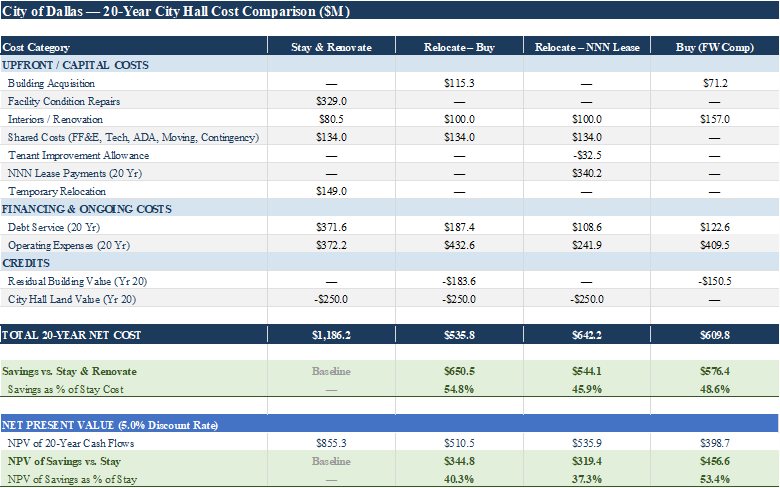

We don’t have to guess about whether this kind of move works for a Texas city, because Fort Worth just did it. Fort Worth purchased the former Pier 1 Imports headquarters, a 400,000-square-foot Class A office tower, for $71.2 million. They spent $157.0 million renovating it into a new City Hall, including a purpose-built council chambers addition. Total project cost: $226.5 million, which includes a $50 million overrun. Even with the overrun, that is $553 per square foot for a fully renovated, move-in-ready, seat of government. When I run Fort Worth's actual costs through the same 20-year model that adds interest and operating costs, the total comes to $610 million. Still $576 million cheaper than staying in City Hall.
The assumptions in the model could be wrong. The purchase price could be higher. The fit-out could run over. Interest rates could rise. But the gap is so large that the assumptions would need to be very wrong, in the same direction, on every line item, for staying to beat moving. The margin is not close.
The Conspiracy Claim
I understand why people want to believe the fix is in. Dallas has a seemingly well-earned reputation for deals that get cut in private and justified in public. The Trinity toll road. The convention center hotel. When a new project shows up with a big shiny price tag, a billionaire family waiting in the wings, and a rushed public process, the pattern recognition kicks in before the report even gets read.
“Everyone that I don’t like is lying” is not an argument. And right now, that alone is doing a lot of the work.
The conspiracy claim sounds small when people say it out loud. "The numbers are cooked." Follow it one step further and it gets very big very fast. It means AECOM fabricated findings. It means the engineers who inspected the roof, the generators, the HVAC, the plumbing either lied or were told to lie. It means the EDC, the City Manager, and the facilities staff are coordinating a fraud across dozens of departments and companies. Dallas already has a conspiracy that happened downtown. We do not need to manufacture another one. If the proof exists, it is probably sitting now in someone's inbox. (I’ll even sign your petition to release the Washburne Files.)
The City’s report deserves the scrutiny it is getting. They have not yet met their burden of proof. But the critics on the other side are falling well short as well. Old public buildings cost a lot of money to maintain. They are not pointing to a specific finding of the engineers and showing it to be false. They are, in my humble opinion, working backward from a conclusion either that the building must be saved at any price or about the Adelsons. That is not skepticism. That is self-justifying belief. And it lets you skip the hard, boring work of actually engaging with what dozens of firms and engineers found when they inspected the building.
Where This Leaves Us
The conspiracy theory is not the biggest danger here. The biggest danger is that we use skepticism about the numbers as an excuse to do nothing. Calls for a second opinion, a second report are growing. They may be headed off by the fact that Mayor Johnson has called for a vote on the issue this week.
Dallas has been doing nothing about City Hall for 49 years. Every bond cycle, City Hall gets pushed to the next one. In 2012, the bond program set aside $400 million for city facilities. Flood control, streets, and economic development took priority. In 2017, the bond included $7 million for City Hall. Seven. In 2024, $61 million was initially requested, then $28 million was advanced and later reallocated to other things. They didn’t upsize the emergency backup generators in 2025 after designing and setting aside funds for them.
This is the pattern. It is always the pattern. The building needs work, the money gets moved, and the bill gets bigger. We study the study that updates the prior study.
Whether the real corrective repair number is ultimately $100 million, $200 million or $329 million, it is a lot of money. Relocating is still cheaper in every scenario tested, by a wide margin. Even if the renovation estimate comes down 25% or 50%, the gap between staying and buying still runs into the hundreds of millions. The question is not whether we can afford to move. It is whether we can afford not to.
Separate the questions. Whether to stay in City Hall is a question about the building, its condition, and the cost to fix it. What to do with the land afterward is a separate question about the future of Downtown, public benefit, and whether the Adelsons deserve a new stadium. You can believe the building should go and also believe the arena deal stinks. You can believe the numbers are fat and also believe the building is failing. That is just what governance looks like when there are no clean answers.
Ironically, and maybe this is the worst part of all of this — both sides can be right. The skeptics can be correct that the City has inflated the total in order to justify tearing down City Hall. The City can still be right that it’s the best option. The numbers can be wrong without the answer being wrong.
Is there a conspiracy to tear down City Hall? Sure. Maybe. Could it still be the best thing for the City? I can think of a billion reasons why.

love/hate/other to: onemansdallas@gmail.com
What I don't see in your analysis is how Prop U figures in. Do you have thoughts on that?