
Our lives today run in invisibly complicated ways through windowless buildings, data centers if you must, that we never much have to imagine or worry about. Within the last hour, your phone pinged a cell phone tower, which pinged an interchange in a special kind of data center, a carrier hotel, where AT&T and Gmail have servers pre-connected to each other, which went upstream to Google’s own data center, maybe the new one twenty-five minutes south in Midlothian, all just to see whether any new emails had come in. The email you are reading touched three or five or twenty data centers between my kitchen and yours, and that is just the tech stack supporting one nerd in Dallas with a blog and newsletter. The fact that the exact route of this email is unknowable is sort of the point.
Blow it up to every Netflix stream your kid watches, every FaceTime call, every piece of medical equipment talking to another in the cloud, and you start to have some idea of how inextricably connected the modern world actually is.
Which brings us to the news. In January, Crow Holdings announced a data center campus rated for up to 245 megawatts (how much power it could consume, equal to about 24 million LED lightbulbs), to be located on 40 acres it has owned for decades in the Stemmons Corridor, the stretch of I-35 northwest of Downtown. The first of three total buildings was slated to break ground in late 2027. That news arrived like a tree falling in the forest, which is to say it did not make a sound, and nobody outside of the real estate publications noticed or said anything for six months. Then in late July, Robert Wilonsky over at the Morning News noticed which 40 acres on Stemmons they had been talking about, and that the campus would entail the demolition of Dallas Market Hall. Concern, if not outrage, ensued.
That leads us to last week, five Dallas City Council members [for nerds: Districts 1, 3, 6, 13, 14] signed a so-called “five-signature memo” about the topic, which is how Dallas City Council members can force something to appear on an upcoming meeting agenda. The memo asks City staff to rework the development code to update the rules regarding data centers, outlining two options. Either: rewrite the rules for “communications exchange facilities,” the existing 1990s-era telecom category under which data centers are largely-by-accident-of-history currently built and permitted in Dallas, or second, create a brand-new “data center” land use.
A “use” (like carwash, convenience store, taxidermist, yes really, taxidermist) is distinct in the code from a “zoning district” (Regional Retail, Mixed-Use 3, Light Industrial). Each use has its own rules, and each use is either allowed or isn’t in every zoning district. If Dallas writes new rules for data centers, that “use” would specify what a data center looks like (how tall it can be, how far set back from a property line it must be), but those rules would also specify which zoning districts it can be built in: say, all commercial districts, or only allowed by exception with a special one-off permit, called an SUP, regardless of the zoning.
The Rules Today
The current state of play in Dallas is that we build data centers under a use written for telephone equipment and switchboard operators. The rules were clearly not written for buildings measured not by their size but by how many megawatts of power they consume. Creating a separate use for data centers is not a bad idea, nor is it necessarily hostile to data centers. We are simply recognizing that this new land use exists, it is different from other things that came before, and we should write rules that fit it.
Great. That was the easy part.
The harder question is what the new rules should actually say, and this is where I think the conversation is already starting out on the wrong foot. In the Facebook post where the memo was first announced, Councilmember Chad West described the goal of the memo as giving residents and Council “more say on if and how data centers are to be built” in Dallas.
If and how. Not where.
Zoning tells us the right and wrong place to put a concrete batch plant. We do not get to decide whether concrete exists. The moment a council starts asking zoning to decide if, it has stopped doing land use and started doing something else entirely, and I fear that something else turns very quickly into a veto.
In the grand scheme of things, “if” is not really on the menu. We are lying to ourselves if we think we can build a city or a world free of data centers. First, Dallas already has at least two dozen data centers, according to recent comments from City staff. But further, data centers will be built. Somewhere. I can promise you that with more confidence than I can promise anything else in this essay. Our lives already depend on them in a million different ways, whether or not that’s necessarily a good thing.
So, the questions that remain after we admit that “if” was never really one of the options are instead all the boring questions that zoning was actually built for: where they belong, how to control what they do to their neighbors, and whether their tax base lands inside or outside of our city limits.
Where Data Centers Do and Don’t Belong
Data centers can be bad neighbors. They can be ugly, they can be loud, and they can contain batteries or fuel or hazards that make them inappropriate next to more-sensitive uses. We can regulate all of that through zoning, the same way we already regulate genuinely noxious uses. We wouldn’t let an Amazon warehouse butt up to your front yard. (Apologies in advance if we did.)
However, most of what data centers do to their neighbors already has a regulatory tool. On-site electrical generation, something many data centers would have today have for generation or backup power, already requires its own SUP in Dallas today. Noise too has its own ordinance. There are incredibly detailed noise rules about the decibel limits at your property line or the noise crossing any neighbors’ based on the existing noise in the area and what you are allowed to add. If any genuine gaps exist that are new to the specifics of a data center, like cooling systems, generator fuel, or whatever else, our new data center use can be written to responsibly govern them.
But much past that, a data center is still just a giant box, closest to “industrial” of all available or familiar categories. We can tell developers what the box should look like, however if it is not bothering any neighbors, there is no land use concern with, nor does the City have any business regulating, what is happening inside the box. Whether that box holds two computers talking to each other or two eighteen-wheelers swapping Amazon packages, it is only the externalities, the costs the box imposes on its neighbors, that the zoning code should control. (If you ask me, I’d rather live near to the computers than the trucks.)
Why Stemmons?
There is a specific data center project that has kicked this conversation off, so it’s worth talking about in specifics. One illuminating question to ask when you’re deciding whether data centers belong in an area is, are there already data centers there? In 1985, Trammell Crow built the Infomart at 1950 Stemmons, modeled on the Crystal Palace from the 1851 London world’s fair, for the purpose of housing those newfangled technology companies. In 2018, global data center company Equinix bought it for roughly $804 million, because by then it had become one of the largest and most important internet interconnection hubs or carrier hotels in the country, hosting hundreds of companies and cloud providers. Two miles away, a 26-story tower Downtown at 2323 Bryan Street, one you might recognize for having “Univision” written on the top, also serves as one of North America’s main internet gateways with over 100 companies locating computer servers inside. By its owner’s count, a fifth of the nation’s internet, voice, and data traffic passes through that building.
Buildings like Infomart and 2323 Bryan are the physical space where Netflix’s movie last touches Netflix’s servers and goes onto AT&T’s, or Verizon’s, or Charter’s, before making its way to your phone or living room. They are the literal crossroads of the modern world, and through some accident of history, two of the most important ones in the country sit in Downtown and Uptown Dallas. Go on DCAD and you can see the companies which keep an address in these buildings: Bank of America, Netflix, JP Morgan Chase, Southwest Airlines, even Red Lobster, in addition to all the tech and cloud companies. The Stemmons Corridor is already some of the most valuable digital real estate on earth, and Crow’s planned 245-megawatt campus is not located where it is by accident.
So, pop quiz. Is this a good place to build data centers? Roughly 200,000 cars and trucks a day on I-35 already make more noise than the data center likely ever will. The surrounding blocks are other trade or wholesale buildings, hotels, and parking lots. The closest homes are about a quarter mile away, but they sit closer to the noise of cars on Harry Hines and several DART tracks than they will ever be to the data center.
Matching heavy-traffic, high-intensity locations like this to the uses they are best at serving is the whole point of zoning, not a favor to data centers. Not only is this one of the best locations for data centers in North America, it is exactly where our City should allow them if we do not want more of them intruding into more-residential areas where cheap land is available, which, as you would guess, would largely be the far, far-southern reaches of the City, where data centers are already sprouting up in neighboring Lancaster and Red Oak.
Why People Are So Worked Up
So far, we have only looked at the reasons people might not want a data center as their neighbor, or why they would or wouldn’t want them where Crow has proposed. There is, however, a class of opposition to data centers that is really opposition to building them at all, not to building any specific one or in any specific location. Again, “if” not “where” thinking.
Water and power are two of the topics you will hear in this dimension. On these two fronts, the rhetoric has far outkicked its coverage, however. Scott Lincicome at the Cato Institute published a piece this month titled “Data Centers Are Not the Problem. Bad Policy Is,“ compiling some data I find worth citing here.
Many of the claims about data center water usage are greatly exaggerated, partially because water usage is something the industry has rapidly improved in recent years. Every data center in America today, combined, uses less than one-half of a percent of the nation’s water. Even the projection for all the data centers we will build by 2030 puts their water consumption at only around eight percent of what golf courses alone use. Americans, present company included, pour about three trillion gallons of water a year on our lawns. Nobody has proposed requiring an SUP for Bermuda grass, though give the City Council time.
I’m not saying data centers don’t use water, I’m saying that lots of things use lots of water and you never hear lots of people talking about it. We are holding data centers to a standard on water usage that we do not apply anywhere else in our daily lives. That to me, suggests it’s not about the water.
Electricity is a harder question than water, but again, this is an if not where question. Our power grids are statewide or regional. Dallas banning data centers does not save anyone in Dallas a dime on their power bills if they are instead still built elsewhere in Texas.
Further, there is scant evidence that data centers are even associated with higher power bills in the first place. The chart below actually shows that the states that have seen the most power demand growth on their grids have simultaneously seen the biggest price declines in power costs. This lines up with the reality that most data centers are “base load” power users, meaning they use roughly the same amount of electricity 24/7, and can actually help spread the fixed costs of running the grid over a larger power load.
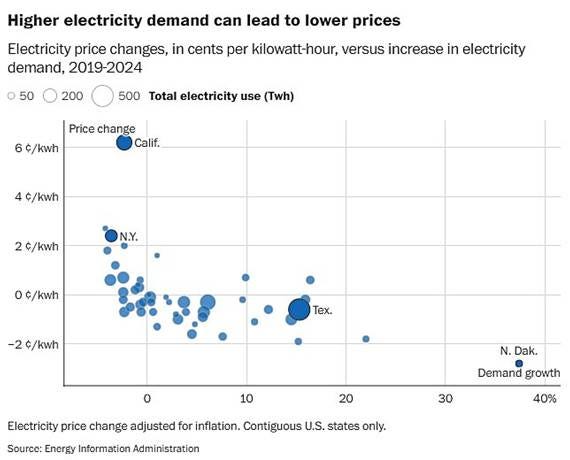
Alternatively, the states where people are paying more for power than they were in 2019 are the states like New York and California, where regulation has made it too expensive to add even clean energy to the grid, not because of new data centers. Supply matters far more than demand, and Texas is currently only behind China (yes, the country of over a billion people) in adding new power supply according to the Texas Tribune, with most of what we have added in recent years in fact being renewable energy.
It's Not About the Buildings
So, if water and power aren’t as good-faith of concerns as social media has made it seem, what is the resistance actually about? Some of it, obviously, is a bigger argument about AI. Beyond that, fears in general about Big Tech, and who owns or controls these large AI companies. The worry is not really about buildings. It is about the work happening on the machines inside them, and who profits from what those machines can do.
We are facing a future where a few very large companies owned or controlled by some of the world’s richest people are building AI systems that will, depending on whom you ask, replace a noticeable share of the work done by humans. The returns from that replacement will not linearly flow to the workers, if they flow to workers at all. I do not think this is a crazy thing to be upset about. I do not think I am not upset about it myself. It is without a doubt the most consequential economic question my generation and the next ones will face, and I have virtually no confidence we are going to answer it well.
It is also, for the purposes of this essay, completely beside the point.
Zoning does not have a tool for deciding whether AI is good for the economy, or for workers, or whether Elon Musk and Jeff Bezos are good people. A city council can write rules about what a building does to its neighbors. It has no jurisdiction over whether the computers inside the building are good for the labor market. Those are questions for Congress, or for the courts, or for the ballot box, and maybe even for philosophy departments. Pretending Dallas on its own can tip the scales of AI progress here is vanity, if not self-sabotage.
The Math
According to data from JLL, data center construction runs around $10 to $12 million per megawatt at current industry benchmarks. So, the new 245-megawatt Crow campus on Stemmons would cost north of $2.5 billion, maybe even $3.0 billion, and that’s all real property added to the City’s tax rolls. That’s before you haul in a single computer chip, and the chips are taxable too as business personal property (BPP), which Texas taxes at the same rate as land and improvements.
At Dallas’s property rate, $3 billion in new taxable value corresponds to roughly $20 million a year of new City property tax revenue. For illustration, this single project, before the computer chips are brought in, would fund almost half of our city’s library budget or nearly a fifth of the park department.
You do not have to take the illustration on faith. Facebook’s (technically, Meta’s) Fort Worth data center campus, owned under the modestly named “Winner, LLC,” sits on the Tarrant County appraisal roll at $2.4 billion of total appraised value, and $1.7 billion of it just the computer chips. It is the single largest taxpayer in its school district. That one data center campus is appraised at more than four times the value of everything Walmart owns in Tarrant County: every Walmart, Sam’s Club, and distribution center combined.
We do not have to guess at what data centers are already worth to Dallas, either. The Infomart, 1950 Stemmons, is appraised at just over $1 billion when you count the building and the roughly 500 businesses that claim BPP inside it. That is just one seven-story building next to a busy interstate. Downtown, the two carrier hotels in old office buildings at 2323 Bryan and 400 S. Akard, the old Federal Reserve Bank, each contribute about $110 million in appraised value to the City’s tax rolls. Both are valued higher than notable, actual-Downtown office buildings, like Comerica Bank Tower, and they each sit just behind Dallas’s tallest building, the 72-story-tall Bank of America Plaza, in appraised value.
Last year, all new construction within the entire city limits of Dallas only added up to around $3.9 billion, according to the 2026-2027 budget book. A single data center campus plus its computer chips could clear that easily.
The Billionaires Will Be Fine
We are in a budget season where the City just cut over 300 staff positions, and long-standing obligations to things like the Police and Fire pension are finally coming home to roost. At the same time, we have a new category of buildings that offers almost comically high property tax value compared to its demand for City services. Data centers don’t send kids to school. They don’t wear out residential streets. God willing, they don’t generate 911 calls.
Pushing these projects outside of Dallas does not “own” the billionaires. The billionaires will be fine. It will only mean less money here for parks, police, or potholes, pick whichever one you care most about.
Dallas should write new rules for data centers, if nothing else to acknowledge they exist. But watch what the new rules say when they are written. If the code says a data center can only be built by SUP, we didn’t write rules for building a data center, we gave ourselves an excuse to veto every one that comes up.
Further, the Stemmons Corridor is one of the best places to put data centers in the country, and is largely zoned “Mixed Use – 3,” our highest-intensity commercial use. While I grant data centers are more like industrial buildings than what we intended to go into MU-3, the Stemmons area is already so intense with traffic and with existing data centers, I would submit we should allow data centers going forward as a use within at least MU-3. The same standard applies to Downtown, which has its own CA zoning, and where data centers are a possible candidate for converting more old office buildings when they don’t work for residential.
So, let’s write the new rules. Require screening, setbacks, tighten noise limits. But, if we don’t leave a path to build them by-right in the areas where we already allow big industrial boxes, or let the highway corridor that has hosted the internet since 1985 keep doing so, then we haven’t really written rules, we’ve just written a data center ban. We cannot let “data centers deserve their own rules” turn into “data centers should not be built anywhere,” when all that will really mean is “not in Dallas.”
I can promise you the data centers are going to get built. We don’t have to like it. We just have to agree it’s okay if they pay Dallas taxes.
love/hate/other to Kirk P. at onemansdallas@gmail.com

Next you're gonna try and tell us that big transmission line everyone's mad about is also Good Actually™ ;)
Kirk, I agree with this AND I think the timing point matters. My first instinct was that Dallas's code is thorough enough to handle data centers case by case. But as you point out, we're permitting them under a 1990s telecom use that was never written for megawatt-scale buildings. ( I actually learned to build countries play Utopia on Mattel Intellivision -pre SimCity, lol!)
With the memo already on the agenda, doing nothing isn't neutral, I suppose... it just leaves the pen with the "if" crowd. The better move is a narrow update: create the use, allow it by-right in MU-3, CA, and industrial districts, and fill only the real gaps like cooling, fuel, and batteries. Rules, not a veto.