
There are many great books written about Dallas. We have a knack for mythologizing this place. I am about to commit that sin myself at length. (If you only come here for the news, come back next week.)
In those great books, Dallas is not a setting but a character: the main character even. Dallas does things in those stories; it bends reality around it. It is a sentient being whose desires are acted upon the unwitting residents of this North Texas floodplain.
This is of course, nonsense. Dallas does not do anything, the same way the bank does not foreclose on your house, and the hospital does not discharge you. People do those things. Dallas is just a place. It has borders. Anything beyond that is a narrative, a story we tell ourselves. Individuals act, and narratives like “Dallas” coordinate those individuals. They give us an excuse or a pre-text to act, and perhaps permission to do what we wanted to do anyways.
Beyond those great books, there is a single sentence that more succinctly describes Dallas than any other I have come across.
“Dallas is the city with everything that money can buy, and nothing that it cannot.”
Everything that money can buy. Nothing that it can’t.
I first stumbled upon it last year on Dallas’s Reddit page, buried in the comment section of a post titled, “What do other cities have that Dallas doesn’t have?” It has stuck with me ever since. I will give credit to the user who posted it, DiracFourier (apparently not a real name, though, who am I to judge?)
I have been thinking about this sentence every day for a year. It captures so succinctly the soul of a city seemingly locked in a constant audition to be the Cathedral of Capitalism. A city which is more comfortable being measured by its Fortune 500 headquarters than by its soul, its beauty, its art.
Of course, this too is a narrative. Again, Dallas does not do anything. Dallas is a story we are told we tell ourselves about this place in which we live, and the important part is that it becomes true in our believing it.
The great books about Dallas knew this too. They have a word for the myth. Their key to understanding the Dallasness of this place they called “Boosterism.”
The Boosters
Dallas is a city that should not exist, we are told we should tell ourselves. Jim Schutze, in The Accommodation, cites a campaign flyer from a bond election in the 1980s that lays boosterism out plainly: “There is no real reason for a place called DALLAS. No harbor drew people here, no oceans, no mountains, no great natural beauty. Yet, on a vast expanse of prairie, people made out of Dallas what it is today: the shining city of the Sunbelt, a city of opportunity, a great place in which to live and work.”
A great place to live and work. Living and working in this sentence, given the same moral weight. That is not a typo, it is an admission.
In this founding myth, Dallas was brought to bear solely through the work of great men and their steely Protestant determination. The Boosters. The city is here because it damn well pleased them. When they die, we bestow upon them the highest known honor in our culture. We name highways after them.
The myth did not merely flatter the business class. It licensed it. If Dallas existed because they built it, then Dallas was theirs to govern. Boosterism was control, and control was boosterism. For most of the city's history, that governance meant a white business oligarchy where control over what got built and the maintenance of the racial status quo were one and the same.
The Dallas myth is a lie. Schutze knew it. Harvey Graff, in The Dallas Myth, documented it. There is, in fact, a reason for a place called DALLAS. The forks of the Trinity River were a natural place for a settlement. The land was surrounded by cotton, cattle, and wheat. Downtown Dallas is one of the narrowest points at which to cross the Trinity. It was therefore the cheapest place to build a bridge, which eventually hosted a railroad. The path of that railroad, the Texas & Pacific Rail, still exists Downtown today as Pacific Avenue, parallel to Main Street. There were perfectly practical reasons to build a city here, and those reasons had nothing to do with the vision, or skill, of the bankers or the business class.
For as many books as have been written about boosterism, there are perhaps now as many books dispelling the idea. That does not make it any less true, in the sense that people believe it. People believe that Dallas was built by sheer force of will because it lets them imagine they could be the next great builder. That one day, a highway will be named after them too.
The cost of this myth is not that it is false. Writers proved it false decades ago and the myth survived the debunking. The cost is that it works. The booster story does not merely describe Dallas. It produces the Dallas it describes. A city whose founding story is about great men building great things will measure itself only by what it builds, only fund what it can measure or profit from, and gradually lose the language for everything else. What we will be left with is only that which looked good in a rendering, or that which replaced what came before it when that had ceased to be great. We will be left with only what money can buy.
A City of Man
We are not the first city to try out this myth. I would submit the greatest book about Dallas is not about Dallas. It is not The Accommodation, or White Metropolis, or any book currently on your nightstand. The word Dallas never appears in it. It was written 1,600 years ago by a man living on the edges of a failing empire in its last century.
In 410 AD, the Visigoths sacked Rome. The eternal city, the city that had conquered the known world, was suddenly mortal. Its citizens wanted to know why. Augustine of Hippo (Saint Augustine to some) spent thirteen years writing his answer.
His book, The City of God, runs over a thousand pages, and its subject is not the military failure of a city but the spiritual condition that made the failure inevitable. Augustine was not interested in which barbarian broke which gate. He wanted to know what the city loved, and whether what it loved was worth the loving.
Augustine writes, “Two loves have made the two cities. Love of self, even to the point of contempt for God, made the earthly city; and love of God, even to the point of contempt for self, made the heavenly city. The former, in a word, glories in itself.” A city built on the love of self, glorying in itself, which is still love, but a love wrongly ordered.
The earthly city is not a dystopia. That is the whole point. The earthly city builds roads and aqueducts and stadiums and writes laws and governs. Its spectacles are thrilling. Its commerce is vast. Its citizens take genuine pride in the republic. Its statesmen serve it with real sacrifice. If you had lived in the earthly city, you would have been proud to live there. You would have told your friends it was the city that had everything.
Nothing in the earthly city is loved for its own sake. Things are loved for what they produce. The citizens compare themselves constantly. A library that does not increase property values is a failed library. A park that does not attract jobs or talent is a waste of land. The sports and games are magnificent, but they are not an escape from the earthly city. They are its purest expression. The earthly city entertains its citizens so well they never have to ask what any of it is for.
Augustine didn’t find fault with what the earthly city could build. He says it is all true, and it is all built on the wrong foundation. The earthly city, he wrote, “though it be mistress of the nations, is itself ruled by its lust of rule.” Ruled by its own lust of rule.
That lust of rule to Augustine was called libido dominandi. It is the desire to rule the world by shaping it, mistaking glory for virtue, or control for order. In this lust, controlling others and building things becomes a way to project the self outward, until what looks like a city is a collection of wills made physical. The need to see the city as yours because you willed it into being. It is the same myth the boosters told. It is what the flyer told us when it said there was no reason for a place called Dallas except for the ambitions of the men who made it.
Augustine's city had a founding myth too. The poet Virgil wrote its most famous version down in the Aeneid, five hundred years after the founding of the Republic. "But you, Roman, remember: rule with all your power the peoples of the earth — these will be your arts: to put your stamp on the works and ways of peace, to spare the defeated, break the proud in war." It was permission to conquer and rule, as if to rule was the entire point. This was the story Rome told itself about Rome. It was the pre-text, the excuse for the existence of a city which had already by then conquered the known world.
Dallas had our campaign poster. The earthly city had Virgil. Both myths worked backwards, dignifying what the powerful had already done by making it look like destiny or virtue. Augustine’s subject is a city that told itself it conquered for the sake of peace, civilization, and order, and he diagnosed the ability to believe those claims as the disease itself, libido dominandi. Dallas, on the other hand, only needs its founding myths inasmuch as the boosters need them to justify boosterism. The myth transformed our desire to control and dominate the world around us into something good, into civic virtue, into even our very reason for existence.
What Dallas Cannot Answer
The Dallas Myth, the idea we are here thanks to the work of a few good men, was our attempt whitewash into virtue what Augustine would have known as vice. Even our most splendid vices, building, shaping, leading Dallas, self-sacrificial though they may appear, were wrongly ordered towards love of self, towards a desire for control. We turned that desire for control and domination into civic virtue, perhaps our chief one.
Boosterism is not civic virtue. It is socially acceptable libido dominandi in a blazer, which we let into the country club.
I fear we have the wrong foundation. The reason that the love of self is the wrong foundation is not simply that self-interest is immoral. It is that a city organized entirely around itself has no way to answer the question: what is all of this for?
That question requires a reference or a standard outside the system, other than the system itself. Without that standard, there is no terminal point, no arrival, no moment where the building becomes something other than more building. The system does not know how to stop. Stop is not a word in its vocabulary.
Augustine diagnosed this 1,600 years before anyone thought to make Dallas their next real estate project. Dallas is Augustine’s earthly city. You can hear it every time the city is asked to explain itself. Ask Dallas what it is for and it will tell you what it has. Ask Dallas what it values and it will tell you how many corporations are headquartered here. Ask Dallas what comes next and it will show you a rendering larger and more expensive than what came before.
Hell, our mayor rang the opening bell of the New York Stock Exchange yesterday, as if our city was a company going public or announcing a great quarter to shareholders.
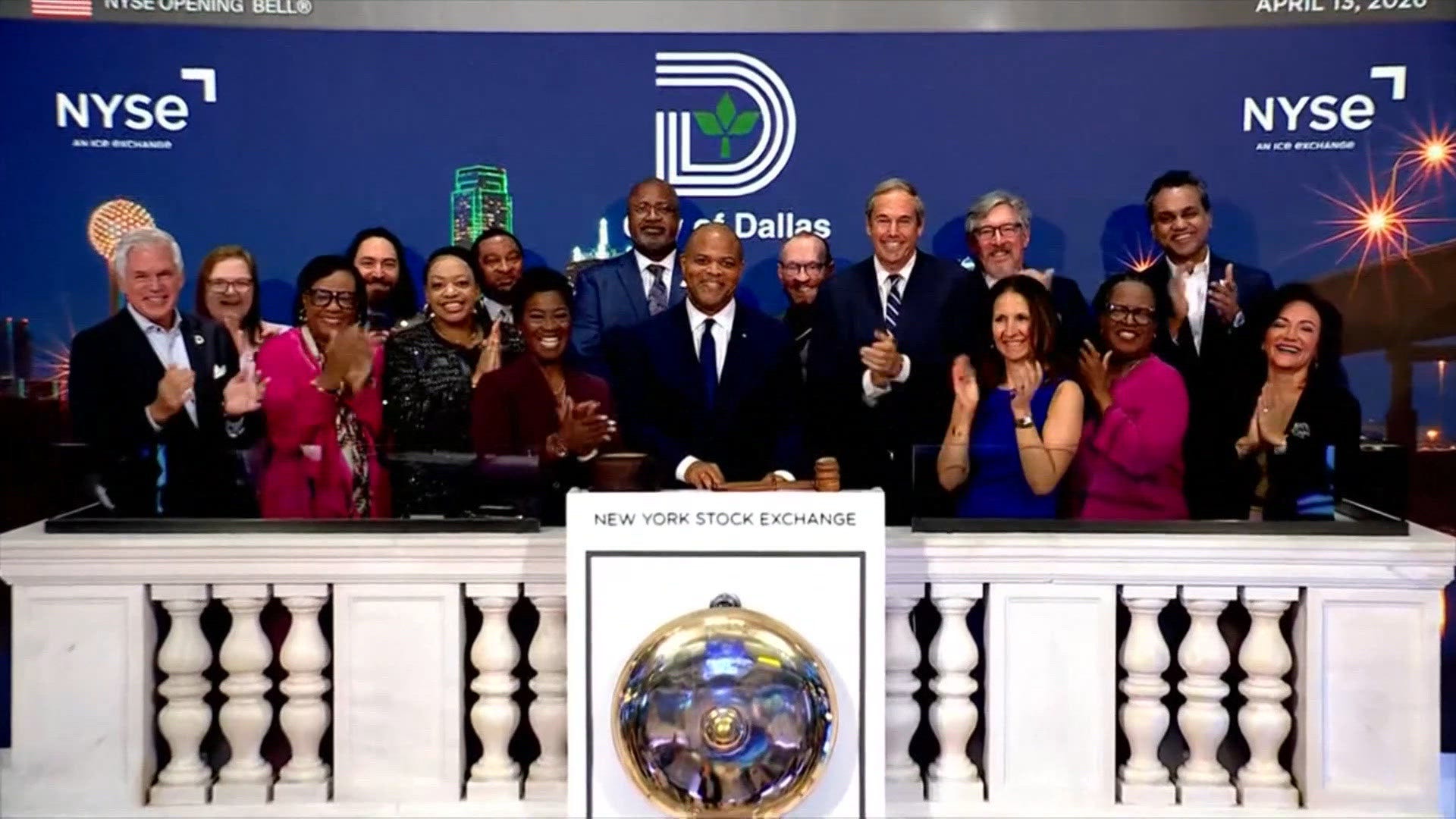
The city has no language for itself that is not a sales pitch. The purpose of Dallas, according to Dallas, is more Dallas.
Growth
The boosters built Dallas from the love of self. But, if it was worth building once, why ever stop? Each round of investment depends on the next round to justify it. Other than power, this perhaps is what the boosters were always most interested in. The toll road needs the subdivision. The subdivision needs the families. The families need their home values to rise, which requires more families to arrive after them. The next families live further up the toll road in the next subdivision, where they can afford it.
There is a word for a system in which each round of participants depends on the next to make the previous round whole.
The Ponzi-like quality of this arrangement is not that any of it is fake. The toll roads are there, and so are the subdivisions. Prosper got an H-E-B before we did. The Ponzi is that the growth requires more growth to justify itself, and the justification for growth is therefore more growth. The boosters are selling growth because it is the only thing that monetizes the investment they made in the growth that preceded it.
The Ponzi does not stop at the city limits. It runs concentrically. Each new ring grows around the trunk centered on a railroad bridge across the Trinity River. Each is the next wave of the boosters, come to spread one more highway, one more master-planned community, that all will require someone else to move there after them. Celina grew 314 percent in a decade. Prosper grew 81 percent.
These are not organic cities with their own reasons for being. They are the next ring of the tree. We have ceased to call these places Dallas after they left our borders, but we know why they are there. They aren't there because Celina had a better Neiman Marcus. They are there because "Dallas" continued to be an excellent sales pitch, long after we ran out of Dallas to sell to them.
What Money Can Buy
The Dallas Arts District describes itself, on its own website, as an organization that “unifies culture and commerce into a dynamic destination for locals and tourists alike.” The largest arts district in the United States wrote as its own self-description, a sentence in which “culture” and “commerce” are morally equivalent. That is not a failure of copywriting. Again, it is an admission.
We did not build the Arts District because we love art. We built it because a great city is supposed to have one, and we could afford it.
That is the meaning of the sentence I cannot stop thinking about. Dallas is the city with everything that money can buy, and nothing that it cannot. We have every Pritzker Prize-winning architect on the shelf. We have so many I. M. Pei-designed buildings that many people, myself included, have called to tear one down. We have the largest arts district, the most-centrally located airport, the tallest something-or-other. Yet, something else is missing, and it was never on the menu.
Dallas doesn't have anything that money cannot buy, because it doesn't want anything that money cannot buy. We never taught it to.
What we cannot buy is the thing that makes a city worth living in rather than worth moving to. We cannot buy the sense that the city belongs to the people who ride the bus, not only the people who build the convention center. We cannot buy a civic identity that is not also a sales pitch. We cannot buy the willingness to spend money on a park, a library, or a transit system that will run whether or not it turns a profit or convinces an investment bank to relocate here.
We cannot buy the knowledge that we, all of us, present company included, are going to die, and that when we do, the gross domestic product of the Dallas-Fort Worth metropolitan statistical area will not have thanked us for our having lived and worked here.
Dallas is not a city without a soul. It has churches, temples, mosques, parades, arts, and neighborhood organizations that owe nothing to the booster class. That life is real. The booster myth simply has no room for it. It cannot measure how many corporate relocations a quinceañera will bring.
On Sunday, the Dallas Morning News editorial board recommended the voters approve a $6.2 billion bond package for DISD by writing that “a city as prosperous as Dallas should not educate children in tin boxes.” They did not write that failing to spend money educating our children is a moral failure that reflects poorly on all of us. They wrote that it is inconsistent with our prosperity. They continued: “a great city has great schools to match its wealth.”
We should have great schools so that everyone will know how much money we have.
Even our newspaper lacks the vocabulary for paying for anything that does not reflect how rich, how powerful, how great our city is or its business people are.
I promised you the Dallas Myth had a cost. This is the cost. It is why I am writing this article and it is why I cannot stop thinking about the sentence, that we have only what money can buy, and nothing that it can’t.
What Will We Have?
I live here. I was not born here. I chose this city. I plan on raising children in it. That is what makes this a confession, not an argument. It costs me nothing to diagnose the machine from inside the machine. I can call it a Ponzi-scheme and still pay my mortgage, on a house which appreciates because someone else will move here after me. I am writing about libido dominandi on a laptop I bought at NorthPark.
Even writing this essay is an act of the love of self. I have some desire to perform cleverness in front of strangers, and that is the same instinct I have spent three thousand words diagnosing. Yet, none of it costs me anything.
What costs me something is the question I cannot answer at the dinner table: what do I want my kids to love about this place? What will I tell them this place is for?
If the answer is that the airport is centrally-located in the middle of the country, then the best part of Dallas is buying a plane ticket to go somewhere else. If the answer becomes the safety or the schools, that is a service that we purchased. If the answer is the restaurants, the trails, the job market, the economic opportunities, that is purchased, all of it. Every reason I reach for when I try to explain why I live here is a thing that money can buy. I have not yet found the one it cannot.
Maybe that is enough. Perhaps all we can ask of where we live is that it is a decent enough place to live and to work.
But, I do not want my kids to grow up in the city built on love of self. I want them to grow up in a place that loves something beyond its own reflection, something that is not for sale and cannot be put on a poster. I do not know if Dallas is capable of becoming that place. I know that the question is worth asking, and that answering it is the one thing the earthly city is allergic to.
Augustine’s earthly city was not a failed experiment. It was a spectacular city. It built everything worth building and could not stop building it. Its residents lived well. The aqueducts are still there two thousand years later. Its boosters believed they had earned what they had. Augustine’s ultimate verdict on the citizens of the earthly city was one borrowed from the gospels: “they have received their reward.” They had everything that the love of self could offer them, and nothing that it couldn’t.
What will Dallas have?
love/hate/other to: onemansdallas@gmail.com
Great article. I enjoyed reading it. As I thought about the issue of whether Dallas can aspire to being something other than a place that knows the price of everything and the value of nothing, I wondered what city do I know of that has better aspirations? I can only go with cities I know. I thought of the place of my birth and the Hill Country around it I grew up in, along with a whole clan who came before me there.
Austin is now extremely self-regarding. It used to be just a backwater college town and place where the legislators cavorted and engaged in unsavory extra-curriculars. It developed a unique redneck/hippie fusion culture in the seventies. And its been riding what was an authentic identity in the 60's and 70's ever since. Except now that culture is a caricature. Its been corporatized and commoditized and utterly destroyed. It reminds me of when developers mow down five hundred year old oak trees, build a subdivision and call it "Stately Oaks". They always seem to commemorate the good and desirable features of the land they destroy. Austin is "Austin" now, not Austin.
So, is this any better than Dallas' self-regarding boosterism? It's just different. Austin isn't a sentient being either. It just reflects the people who live there at a given moment. A city in Texas I think has a durable, stand-alone identity is San Antonio.
Since its founding in the early 1700's, it has been remarkably consistent as a Hispanic/German/Anglo amalgam which absorbs the new arrivals and integrates them instead of vice-versa. San Antonio seems very secure in itself, unlike Dallas and Austin.
I wonder what you think about Fort Worth?
Keep on rocking in the free world, Dallas.
https://www.dallasobserver.com/opinion/dallas-hotel-st-germain-demolition-high-rise-40662529/