
For three years running, Dallas has proposed closing libraries in our annual budget. Before that, the fight each year was over hours. We cut the hours that libraries are open eight times over the past fifteen years, while at the same time still building more of them. The ritual does not change. A closure list is published. Petitions are signed. Town halls are packed. A councilmember finds a few hundred thousand dollars to save a branch. The next year, it starts again.
The Skillman Southwestern branch was proposed for closure in 2024. Councilmember Paula Blackmon found $485,000 in one-time money to keep it open three days a week. A library open three days a week is a library in name only. The city spent $485,000 to delay a decision it had already made. One year later, eight councilmembers and the mayor voted to shut it down. The building was auctioned in February 2026. Within weeks of that, four more branches had landed on the chopping block in this year’s budget.
The total annual savings from closing those four libraries: $2.6 million. Our annual general fund: $1.97 billion.
Dallas is fighting, yet again, over 0.13% of its operating budget. That is less than one-sixth of one percent. A city fighting over that number is not under austerity. It is putting on a performance of austerity. The amount saved is negligible. This is fiscal theatre, not fiscal discipline.
Line items in a $2 billion budget do not earn protection simply because they look small as a percentage. You will not hear me make that argument, here or ever. The question isn't whether to close libraries. Rather, what I want to submit is the annual library fight is not really about libraries at all. It is the one visible skirmish where Dallas residents are allowed to see the deeper problem: the city keeps building new things and cutting taxes, all while the load-bearing decisions that actually shape the city’s finances happen without us ever being honest about them.
Libraries
There are good reasons to close a library. There can be, at least. The city built the new Vickery Park library a mile away from the Skillman branch, opened it seven days a week, and staffed it properly. Keeping both open was likely redundant. When a better facility replaces an older one, closing the older one is called planning, not failure.
If you measure computer lab sessions or the books checked out, some of our less-popular library branches are used ten times less than the popular ones, according to a February staff report. Skyline and Arcadia Park, two of the libraries currently slated for closure and near the bottom in usage, each had only 20,000 books checked out last year. Top-performers Fretz Park and Lakewood both had over 170,000 books checked out.
The City is not closing four libraries, however, due to how often people are using them. The City is closing four libraries because the budget adopted by council in September 2025 directed Library Director Manya Shorr to find $2.6 million to cut out of her budget. That budget passed our city council by a vote of 11-3, with the three dissenting votes coming from councilmembers vocal that the City had not cut enough from the year’s budget.
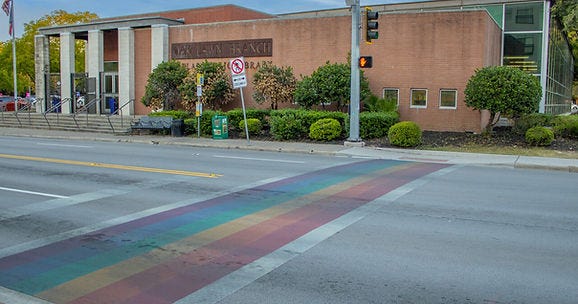
Anyone who followed the Skillman branch saga could tell you: that magnitude of a library budget cut only comes from closing branches, and likely four or five of them. There are not enough operating hours left to cut when our libraries are only open after 5 p.m. two times a week. Shorr’s staff analyzed usage, need, and geographic coverage, and in January 2026 recommended Arcadia Park, Skyline, Renner Frankford, and Oak Lawn.
Councilmembers reacted as though ambushed. Adam Bazaldua called it “a half-assed plan.” Cara Mendelsohn said the plan “was developed without input from communities.” However, this council voted for the same budget that created the directive. Some branches had to close. Those branches were going to be in someone’s district and someone’s neighborhood. The spectacle of elected officials demanding savings in September and attacking the consequences in January is its own form of theater.
The closures may be legitimate. A better library system may revolve around fewer libraries open longer, including the proposed model of five “regional flagships.” I trust people who run libraries to answer that question. That said, the politics around the closures are not being described honestly. The council made a revenue choice and then treated the consequences as though they were someone else’s decision. They cut the library budget and cried foul when that meant any libraries would close.
The Math
The 2026 budget is the largest in city history: $5.2 billion total and $1.97 billion in the general fund. The “general fund” strips out items like Dallas Water Utilities, Love Field Airport, and debt service, and is close to, but not exactly, the City’s “discretionary spending.” Police and fire consume $1.2 billion of that general fund, roughly 62 percent. Last year, the police and fire line alone went up by $63 million.
The entire Dallas Public Library system operates on $43 million. Per a January staff presentation, among peer cities of a million people, the median library system spends $38.74 per resident. Dallas spends less at $32.77. Austin spends $75.50. Our twenty-nine branches clock below San Antonio’s at thirty, and Houston at forty-five. Our spending per branch is 27 percent less than the peer group. In inflation-adjusted terms, the library budget has shrunk roughly 20 percent since its peak in 2008, despite us adding several new branches. By almost any measure, our libraries do not have a spending problem. (Apparently, however, our spending has a libraries problem.)
The cost of operating every single one of Dallas’s libraries, combined, is less than how much the police and fire budget goes up in a single year. Closing every library wouldn’t cover the increase. The single-year $63 million police and fire increase was twenty-four times larger than the savings from closing these four branches.
At the same time, the city has reduced its property tax rate every year for ten consecutive years, from 78.25 cents per $100 of assessed value in 2016 to 69.88 cents today. That is a reduction of more than 10 percent. These reductions are optional. However, constantly rising property values have kept the total revenue the City collects growing, even at a lower rate, as there is more property value to tax. The city has not lost money or shrunk its budget. It has voluntarily lowered the rate at which it collects revenue while telling departments to find savings.
The city’s total taxable property base is $226 billion. Keeping all four library branches open would require a rate increase of roughly 0.12 cents per $100 of assessed value. For the median Dallas household, that is something like $4 per year. The city could have funded every branch set to be closed this year and still lowered the tax rate. The median household would have gotten a $12 tax cut instead of a $16 cut. For most homeowners, the difference would have been trivial. For four neighborhoods, it would have meant keeping a library.
The city chose the $4 cut over the libraries. That is a legitimate choice. I promised I wouldn’t dismiss cuts because they are small. It is not, however, a choice I am seeing the city describe honestly. The tax cut is announced as relief for working families. The library closures are decried as an outrageous, half-assed decision by the library director, as if the two things happened independently, to different people, for different reasons.
Cut the Ribbon, Forget the Bill
In April 2024, the council unanimously adopted a twenty-year library facilities plan that recommended expanding or replacing eleven library branches. It recommended closing none. The future of Dallas involves having well-equipped modern libraries: at least according to that 15-0 vote of the city council. The Dallas Observer reported at the time that the plan devoted only three paragraphs to funding strategy. That strategy amounted to requesting more bond money.
The following month, Dallas voters approved a $1.25 billion bond package.
The bond program allocated $43.5 million to replace and renovate existing libraries. The majority of the money goes to three branches that will be completely replaced or renovated, at a total of around $10 million per library. Of the total, $2.09 million would also go to ADA compliance upgrades at eight library branches. Three of those branches (Skyline, Renner Frankford, and Oak Lawn) are among the four the city proposed closing in January 2026. Yes, you read that right. Voters approved money to upgrade these buildings in May 2024. Twenty months later, the City has proposed shuttering them.
Outside of libraries, Proposition B allocated $345 million for new parkland acquisition and development, the bond program’s second-largest share. Prior to getting these new parks, department staff had already told the council they had close to $400 million in existing unfunded maintenance needs. Bond funds, by rule, cannot be used for routine maintenance and operations. The same general fund that cannot find $2.6 million for four libraries will soon be asked to staff and maintain $345 million in new and improved parks. The city has still not said where that money will come from.
The park and library bond programs were both approved by voters, voters who were being told the City would build and improve our public spaces. Over 80 percent of voters approved the library bond. Those ribbon cuttings will be popular. Councilmembers who fought for those projects will be at them, grinning ear to ear. Our vote was clear direction to the council that we should keep building libraries at a cost of $10 million a pop. However, those same voters who approved spending $43 million for building new libraries also elected a council that thinks $2.6 million more a year to run them is just too much to ask.
In the two years since the bond, the City has only put $100 million to work out of $500 million in bond projects planned through 2026, per the City’s dashboard. It is no accident that less than 20 percent of the approved bond funding has been spent to date. Even the City is realizing there are no operating funds for all the projects voters were promised.
What We Are Not Talking About
I do not know whether Dallas should spend 62 percent of its general fund on police and fire. Crime is real. The pension liability is real. Proposition U binds our hands here somewhat. However, the same people who (narrowly) voted for Prop U in November 2024 also voted for the library bond six months earlier. They were not voting for a city without libraries. They were voting, in two separate elections, for two things that cannot both be fully funded under the budget structure that results.
That is the conversation Dallas refuses to have. Not whether four libraries stay open, but whether the city is willing to raise revenue, or stop building things it will not maintain, or make much deeper cuts than closing four libraries (including to police and fire — sorry). Each of those is harder than closing a library. Any of them would actually make a difference.
Dallas has cut its tax rate ten years running. Every penny of rate on the Dallas tax roll generates roughly $23 million in annual revenue. Restoring two cents of the 8.37-cent reduction since 2016 would generate $46 million a year. That is more than the entire library operating budget. It is more than enough to keep libraries open after 5 p.m. or keep them open seven days a week. The council has not seriously discussed raising the rate, or even pausing tax cuts. A tax cut is the one thing every councilmember wants on a campaign mailer.
Dallas approved $2 billion in bond packages in the past seven years without a plan for paying for what we build. The parks bond alone will generate hundreds of millions in new maintenance costs. Nobody has proposed pausing the bond cycle until the city can demonstrate we will fund what we already approved. Bonds are popular. Ribbon cuttings are popular. Maintenance is invisible until things fall apart. In fact, the Kleberg-Rylie library branch closed itself indefinitely last month after a pipe burst. The building made the decision for us.
If the city cannot find $2.6 million in a $2 billion annual budget without closing things people clearly care about, the question is not about libraries. It is about the other $1.99 billion. What else is in there that nobody is willing to cut? Why are we cutting libraries which people clearly care about, and worse, why do we already keep the twenty-nine libraries we already paid to build open only two nights a week after work?
We should stop calling this austerity. A city that cuts its tax rate every year, passes billion-dollar bond packages, and increases its public safety budget by $63 million is not a city living under austerity. It is a city that has chosen its priorities and lacks the honesty to say so. The library closures are not the hard choice. They are the easy choice, the one that saves a fraction of a percent while generating enough controversy to make everyone feel like something difficult happened.
What You Can Do About It
The 2027 budget process is going on right now. The annual resident survey launched February 18 and is still open. The City’s Quality of Life Committee will hear an update today from the library director. I suspect the closures will come up. Budget town halls, hosted by councilmembers in every district, run this week from March 23 through March 26. The District 12 town hall on March 26 is being held at Renner Frankford Branch Library. Yes, one of the four branches proposed for closure. The city manager will present a revised proposed budget this summer. A second round of town halls follows in August. Council votes in September. The fiscal year starts October 1.
The budget is not an act of God. It is a document written by people who work for you, revised by people you elected, and adopted on an annual schedule you can find at dallascityhall.com. Show up to your Spring Town Hall. Send the email to the council person. They are the ones who made these choices. Not the library director.
I said at the jump there could be good reasons to close a library. There are also bad ones. One of them was providentially gifted to me yesterday by the editorial board of the Morning News in a piece titled, “Is Dallas prepared to make tough budget choices?”
“Dallas City Council members need to be prepared for hard choices during the budget cycle this year. When the time comes to trim back services, there will be abundant pushback from some residents. Council members must think about the long-term fiscal health of Dallas.”
“We need to close four libraries” is not an argument that logically follows from “we need to make hard choices.” Making choices that do not reflect the will of the voters does not retroactively make those choices good in their having been difficult. We cannot difficulty-launder all of our bad decisions. Trading Luka becomes a good idea when this is your grading system.
Being a fiscal conservative is not thinking the City should never spend money on anything. The right amount of money for the City of Dallas to spend on libraries is not zero. Being a fake fiscal conservative is thinking the City shouldn’t spend money on things you don’t like, or need, or use. I fear we have too many people who want to don the cape of being fiscal hawks, without remembering that the City still has a job to do in providing services that make people’s lives better, libraries being among them.
This was a week off from four consecutive pieces about City Hall. (I was sick of it too.) However, if you have been following closely — the same cycles of tradeoffs, incentives, and decisions that led us to having (at least) a nine-figure tab on 1500 Marilla are all at work here. They are symptoms of the same problem, not the disease itself. As I said in week one, “There are no good options. There are only honest ones and dishonest ones.” We can raise taxes (or cut elsewhere) and have libraries open at times when people might actually want to use them. We can cut taxes and have fewer libraries. There is no world where we get to eat our cake and have it too.
The harder choices are not closing libraries. Sorry DMN. They’re telling your council person you don’t want a tax cut this year, or to stop future bond programs. They’re looking for ways to trim public safety spending, including further reforms to the police and fire pensions. They would be either funding what we built, or telling voters the truth: we will cut ribbons on buildings we have no intention of keeping open.
love/hate/other to: onemansdallas@gmail.com
I know the article doesn't get into the voter approval tax rate(a huge driver in municipal decisions!). The city is kinda bound by it but even then they chose to lower the rates below the voter approval rate. That difference is about $6.5 million for the fiscal year and only $15 dollars per property in Dallas.
Also when we look at inflation the majority of departments in the general budget are being cut not just Library's and arts.
Wrt prop U I haven't been able to find an answer to my main point. Is the current 7% budget increase to the police above what is needed for prop U compliance. I really do wonder if they are effectively cutting these departments to pump more money into policing compared with what is required.