
In December 2025, Lieutenant Governor Dan Patrick hosted a press conference in the Texas Capitol and announced a plan he called Operation Double Nickel. At the end of March, he added it to the Legislature’s “interim charges”, signaling it is his top priority when the legislature next meets in 2027. The pitch: change the existing freeze on the school district portion of your property tax bill to start at age 55 (from 65), raise the homestead exemption from $140,000 to $180,000 for everyone, and from $200,000 to $240,000 for seniors, a group which, he said it, not me, now apparently starts at age 55. These homeowners, Patrick said, would “never again have to worry about rising appraisals for school taxes.”
It is a remarkable promise, and he means it. Patrick intends to bring the plan to the 2027 legislative session as a constitutional amendment. If it reaches the ballot, it will pass. Homestead exemption measures have been approved by Texas voters with 78, 79, 83, and 86 percent of the vote in recent years. The exemptions keep growing. Nobody is going to vote against cheaper property taxes for themselves.
Outflanking him to his right, Governor Abbott has entered the fray with his own five-point tax plan. Forget a freeze at age 55. Abbott’s plan would end school district taxes for homeowners entirely. Stumping for it last week in Houston, he claimed that “everyone’s property tax bill is going to be more than cut in half.” Everyone, apparently meaning, people who own a home. The roughly forty percent of Texans who rent did not make the cut.
These two competing plans suggest major property tax reforms are coming in 2027. Whatever passes may ultimately be less radical than the two plans on the table today. Regardless, they will call them tax cuts. For at least ten million Texans, they will not be.
In Texas, we boast that we do not have an income tax. We say that as if it makes us free. What we have instead, is a property tax system that is bad and getting worse. When voters approve plans like Operation Double Nickel or Abbott’s Five-Points, they are not cutting any government budget line item, any expense, or any spending anywhere in the state. They are only cutting homeowners’ taxes. That only leaves local governments and school districts who depend on property taxes with two options. Cut spending, or let the tax burden shift onto someone else.
Who Pays
Consider three people living in (or near) the same $350,000 house, around the median home value in Dallas, per the most recent census data. We’re going to pick on a block of Carroll Ave. from Central Expressway to Capitol (which also most famously includes the empty field that once hosted the Leaning Tower of Dallas).
The Renter is 31, earns $45,000, and she pays $1,550 a month for a one-bedroom apartment at the large complex overlooking the highway that you have no doubt driven past, called Cityplace Heights. (Disclosure: I lived in this building too once upon a time. If that’s how disclosures work.) To ground her income, this is roughly equal to the City of Dallas’s published living wage, the minimum pay all city employees and contractors receive. Her complex pays property taxes to five local taxing entities at a combined rate of roughly $2.24 per $100 of assessed value. The building is assessed at $81 million dollars. Spread across 396 units, it’s as if each home were taxed at $204,000. The total bill is $1.8 million this year. Per home in that complex, that’s $4,554 per unit in annual property taxes. It is roughly equal to her January, February, and March rent.
No homestead exemption. No school exemption. Apartments do not qualify. Yes, her landlord “pays” the tax bill, but not out of the goodness of his heart. This expense was baked into the cost of the building when it was first built and when the landlord bought it, and it is still included in the rent today. Her imputed share of property taxes is roughly $4,500 per year, or 10 percent of her annual income. If the building could claim a homestead exemption per apartment unit, its tax bill would be 41 percent lower.
Add the 8.25 percent sales tax she pays at the Kroger or Target at City Place. According to ITEP, which publishes the annual “Who Pays?” study of tax policy, the lowest-income Texas households pay an effective sales tax rate of about 6.5 percent across all their spending. Her combined state and local rate from the property and sales tax: 16.7 percent.
The Homeowner is 42, earns $90,000, and owns the median-value home, down the street from the apartment complex where we started. I won’t name a random house like I did the apartment complex, but clicking around on DCAD, I found 5 homes on this block around the $350,000 figure that the Census cites as our median home value.
After the existing $140,000 school tax homestead exemption and 20 percent city and county exemptions, her bill is about $5,000. She can deduct this from her federal income taxes against her 22% tax rate under the new $40,000 SALT cap, so she ends up paying close to $1,000 dollars less in income tax thanks to these local taxes. She pays sales taxes too, but on a lower overall share of her income, given she can afford each month to put a little bit in savings. The net effective state and local rate: about 8.3 percent.
Now the Homeowner is 72, earns the same $90,000, and lives in the same $350,000 house. She gets $200,000 exempt from school taxes, which was the largest chunk of the bill. Further, her school taxes are frozen at whatever they were the year she turned 65, which was 7 years ago before home prices went bonkers after COVID. Effective state and local rate: roughly 7.4 percent and falling every year, because the freeze does not adjust and inflation does the rest.
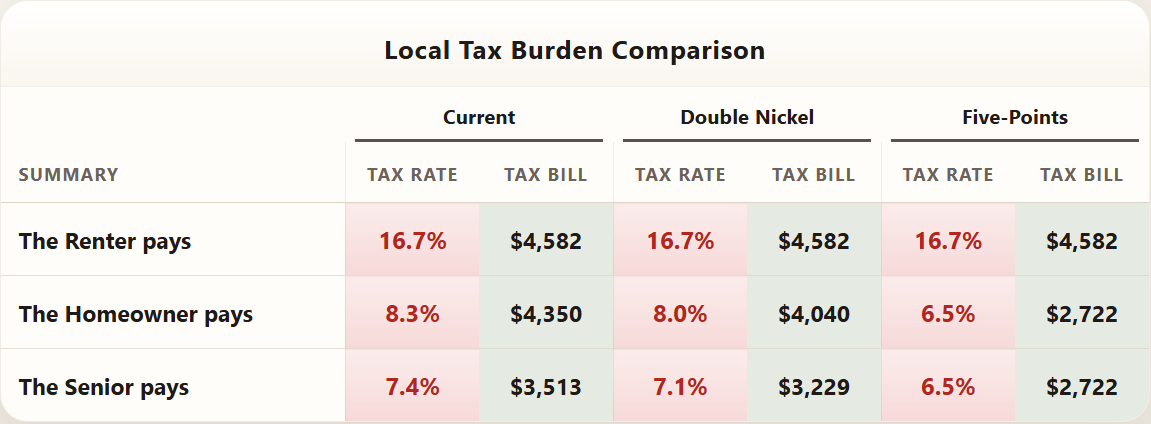
The tax brackets these Texans fall in. 16.7. 8.3. 7.4 percent and falling. If I showed you those numbers without labels and told you they were income tax brackets, you would assume the highest rate applied to the highest earner. The opposite is true.
Most egregiously of all, these are just the tax rates I am drawing your attention to. Look at the amount of taxes themselves. The Renter actually pays the most per year of anyone, not just as a percentage on her income, but in the total check she writes.
This is before Operation Double Nickel or Abbott’s plan goes into effect. This is the system already on the books today. By November 2027, the odds would tell you it gets worse.
Back-Asswards
According to the same ITEP “Who Pays” report, Texas has the 7th most regressive tax rates, where poorer people pay more, out of all 50 states. There is something deeply wrong with this. Government provides things we cannot provide for ourselves. That costs money. It is a fee we pay for civilization, and there is something inherently wrong with a society that sends the largest bill to the people with the least.
A tax system ought to ask the most of the people who have the most. This topic alone could be the essay. While I may not do this point justice today, what I want to impress is that this is not a left-wing position or a right-wing position. It is the first principle of taxation, and you do not need an economics degree to see it.
For those of you that do have an economics degree, Adam Smith, whose 1776 book The Wealth of Nations underpins much of free market capitalism, opens his taxation section with this simple claim: “The subjects of every state ought to contribute towards the support of the government, as nearly as possible, in proportion to their respective abilities.” This is not about taking from the rich to give to the poor. It is about not taking from the poor to give to the rich.
The Texas Comptroller’s office is required by state law to produce a biennial report on who actually pays Texas taxes. The January 2025 edition, signed by Comptroller Glenn Hegar, uses a statistical measure called the “Suits Index” to assess the fairness of every major state and local tax. A score of zero would indicate a “proportional tax,” that everyone pays exactly according to our income. Scores higher than zero indicate a progressive tax, and negative ones indicate a regressive tax.
Every single tax in Texas scores below zero. Property Tax. Sales Tax. Motor Vehicle Tax. Even the Gasoline Tax. Every tax we charge is regressive.
The report goes further. The bottom fifth of Texas households pay over 14 percent of their income in state and local taxes. The top fifth pay less than 4 percent.
This is not some think tank’s estimate. It is the state of Texas’s own math, measuring our tax system and finding it upside down.
Exempted Away
I should be fair to the existing structure of homestead exemptions before I break it apart. The school district homestead exemption, as designed, is genuinely progressive. A flat $140,000 exemption on a $200,000 house eliminates 70 percent of the taxable value. On a $700,000 house, it only eliminates 20 percent. On a $2 million dollar house, it barely makes a dent. It helps the family in Pleasant Grove more than the family in Preston Hollow. Among homeowners, this is the right structure.
Two problems.
First: the renter still gets zero. A flat-dollar exemption is progressive between homeowners, but still highly regressive to renters, because well, zero is zero. Every dollar exempted from the school tax base is a dollar the school district still needs. It collects that dollar from every property that did not get the exemption, i.e. the renters and businesses or customers who use them. There is no exemption fairy. Every dollar forgiven is a dollar moved.
Second: the school exemption is not the only one. The City of Dallas and Dallas County offer percentage-based homestead exemptions at 20 percent of appraised value, the maximum allowed under state law. Twenty percent of a $200,000 house is $40,000. Twenty percent of a $2 million house in Lakewood is $400,000. The richer you are, the bigger the tax break. This is proportional in theory, if you do not factor in that wealthier people spend less on housing than middle-class homeowners.
This system we have asks the most of those with the least, and every two years in Austin, our legislature digs the hole deeper. The Weatherford-based think-tank Texas Policy Research said it plainly with the last round of homestead increase amendments in 2025: “this measure shifts the tax burden onto younger and non-exempt Texans, expands state spending commitments without reform, and erodes tax equity.” Take my word for it, these guys are not bleeding-heart libs.
This is not a side effect. I fear it is the point. It is at best, democratically speaking, a runaway train that we are going to keep voting for until homeowners perhaps pay no taxes at all.
Faction
You hear the same argument at every town hall or every Thanksgiving dinner table. “I paid off my house ten years ago. Why do I still have to pay property taxes just to live in a home I own?”
I have heard this from smart people. I have heard it from my own family. It sounds like common sense. It is also the most expensive idea in Texas tax policy, and one of the worst ones I could imagine. It is exactly the sentiment that Greg Abbott’s or Dan Patrick’s plans play into.
You still pay property taxes for the same reason you still pay for electricity: because you are still using the service. It is a consumption tax on the services you are consuming by owning a property in this city. The fire department does not stop protecting your house when you turn 65 (or 55.) The roads do not maintain themselves. Parkland still treats you if you have a heart attack. Dallas ISD still educates the children in your zip code, including the grandchildren that you moved to be near.
Property taxes are not a mortgage. They are the annual cost of living in a place that works. The question as we pass deeper senior or homeowner tax exemptions is not “why do I still pay.” The question is “who pays instead of me.”
In the 2022 midterms, 58 percent of homeowners voted and 37 percent of renters did. Stanford researchers, studying 18 million voter records in Ohio and North Carolina, found that buying a home causes a roughly 20 percent increase in the propensity to vote in local elections, an effect that nearly doubles when zoning or property tax issues are on the ballot. That is what it looks like when one group is large enough, organized enough, and reliable enough at the ballot box to vote itself a tax cut every two years and send the bill to people who do not show up. The people who absorb the cost are not absent because they do not care. They are at work, or they moved, or probably nobody told them they were paying 16 percent. Heck, they may have even voted for it too in hopes of owning a home one day.
Cutting taxes is the same thing as cutting revenue. The revenue shortfall temporarily gets backfilled by the state surplus, which sounds free until the surplus runs out. Then it gets backfilled by whatever is left of the tax base: renters, businesses (and their customers and employees), or younger homeowners who have not yet aged into the freeze. When that is not enough, we will have to start cutting things we fund with property taxes. Yes, that will mean schools.
Don’t California My Texas
We have seen this movie. Texas would not be the first state to try and freeze its property taxes due to a populist push-back about rising bills.
There is a bumper sticker or a billboard you might have seen. “Don’t California My Texas.” It is a warning to the exodus of Californians coming to the Lone Star state that they should leave behind the policies and politics that made them seek greener pastures in the first place. California’s top income tax bracket is 13.3 percent, for people earning over a million dollars a year. Texas has no income tax. We are supposed to be opposites.
In 1978, California passed Proposition 13. Among other things, Prop 13 got rid of tax re-assessments, locking in the price you paid for the home as your assessed value. Only a 2 percent annual increase is allowed.
It hasn’t gone well.
A paper published by the National Bureau of Economic Research found that in the decades after Prop 13, California homeowners stayed in their homes 10 percent longer and worse, renter tenure increased 19 percent. Fewer homes went on the market. Property tax bills were locked in. Renters were stuck renting longer. Texas's over-65 freeze is the same basic deal with a different name, and it produces the same lock-in. A 72-year-old empty nester in Old East Dallas, with a frozen tax bill that declines in inflation-adjusted terms every year, has zero financial reason to downsize. She is responding rationally. That is the problem. The four-bedroom house stays off the market. Supply tightens. Everyone else's taxes go up. The renter's rent goes up. Calls for rent relief, city spending on affordable housing, and more out-migration to cheaper suburbs will surely follow.
Worse still is what Prop 13 did to actual tax revenue. It devastated school district budgets across the state. California’s per-pupil spending in its public schools fell 15 percent in the twenty years after Prop 13, indexed to the rest of the country. It fell from fifth in the country in education spending per student to forty-seventh. Operation Double Nickel does not advertise the cuts to budgets that will follow freezing and cutting taxes for millions of people. They want you to focus on a property tax cut. They do not want you to think about what that money might have gone towards.
It is not insanity to think we are on a slippery slope to passing our own version of Prop 13 and having the same disasters. What we will likely pass this year is not all that far off. Further, these things become very hard to undo. Prop 13 is now the untouchable “third rail” of California politics. Imagine the Texas governor who runs on a platform of reinstating taxes on homeowners.
We may very well California our Texas. It will not be the California emigrants’ fault. We are doing this to ourselves.
The Right Villain
Nationally, 78.6 percent of Americans over 65 own their homes. Among those under 35, the figure is 36.4 percent and falling. If you think this is only a generational conflict, the number of DFW renters 65 and over has surged 66.5 percent in the last decade too. The freeze does not help them either. It largely tracks wealth, not just age.
The senior homeowner in the empty house with the frozen tax bill is not the villain of this story. I want to avoid this becoming a young versus old issue. Worse, I cannot fault someone for voting in their own interests.
I can however fault the politicians who give you the opportunity. Our representative form of government was built to handle issues like this, where one faction uses its voting power adversely to the interests of another group. It is why we do not have a simple direct democracy and instead elect senators and representatives to make our laws. (It is also why you don’t let your toddler vote on their bedtime.)
We can let Dan Patrick or Greg Abbott be the villain today and leave it at that.
Texas’s property tax system already asks too much of the people who have the least to give. We are actively making it worse in that regard, not better.
Further, it is starting to ask the most of the young, and the least of the old. The family that has three kids and could use the four-bedroom house is still waiting for the big-enough house to come on the market, or moving to Celina where it was just built. They are paying property taxes on their rental house at a tax rate that covers both their portion of the bill and recoups the frozen taxes from their neighbors across the street.
Last week, I wrote that one of the reasons I write is that I believe this city is our inheritance. To be honest, I actually believe something much stronger and more specific than that. I believe our society is a generational partnership between the dead, the living, and the yet-to-be-born. There is a contract between the generations, and we fail to uphold our end of it when we cut taxes today and let someone else pay for it tomorrow. We received public schools, public roads, and public safety for the decades we were raising our families. We owe the same to the people who come after us.
Police, roads, and schools are not going to go away. The question is whether we will make the family in the rental house pay both their share and everyone else’s at the same time.
Dan Patrick and Greg Abbott have an answer to that question. It is on its way to the ballot. Some version of it will pass. The 31-year-old at Cityplace Heights, paying double the share of taxes as her neighbor, will never know why.
love/hate/other to: onemansdallas@gmail.com

Photo by Pete Alexopoulos on Unsplash
The previous article and this one pair well together. State and local leaders don’t present the pros and cons of choices, leading people to believe that that reducing their property taxes is a unilateral good.
The high % rate that the amendments have passed likely means a good chunk of the people voting for the exemptions are also the same people upset that schools are losing funding. Would they make a different choice if they knew the tradeoff? I’m not sure, but regardless, good elections require that to be well known