
It’s budgeting season in Dallas, and thus far it has been framed as one of the tightest budget cycles in decades. The projected hole in the budget is thought to be as high as $50 million, driven by a combination of expenses that came in over projections (often cited are employee benefit costs and police overtime) and tax revenue (sales tax, mainly) that came in under. To stop the bleeding, the City has been under a hiring and travel freeze since April, and a few weeks ago, the City Manager required all non-public safety employees to take three furlough days (for all intents and purposes, a one-time staff pay cut) in order to save an estimated $4.2 million.
The kinds of budget cuts we have practiced in Dallas in recent memory, closing four or five libraries to save a couple million dollars, are not going to close a fifty-million-dollar gap. Even if we closed every city library tomorrow, we don’t pick up $50 million: the entire library system’s operating budget is only about $43 million. Neither can this be fixed by a few more unpaid days of leave for city staff.
We are firmly in the “drastic action” territory, and the city will have to look hard at every nickel it spends. Given there is almost no such thing as a popular budget cut, protests will be raised in the coming months by nearly every interest group affected. So, expect to hear from every organization with “Friends of the” in their name before this is all over. (Nor is this going to be the last time you read something about the budget from me.)
We have a budget paradox in Dallas. The City Council has voted to cut the property tax rate, the amount of tax collected per $100 of assessed property value, every year for the last ten years. Also, every single one of those ten years, the City’s spending was higher than it was the year before. The paradox is supported by the simple fact that property values have skyrocketed. You don’t need to collect as much per dollar of property, when there are more dollars of property. This is not some weird trick. It’s just algebra.
We cut your taxes. We collected more taxes. The tough thing is, both of those statements are true.
I think that’s the problem.
My working theory is that homeowner displeasure with skyrocketing property tax bills has made most Dallas budget conversations over the last ten years about revenue, not expenses. The people we sent to the horseshoe have all been able to look their voters in the eye and say, “I cut your taxes.”
They are half-right. After all, they voted ten times to cut the tax rate.
Over those ten years, however, the City’s General Fund spending grew by roughly 71 percent. Inflation, primarily during the post-pandemic period, eroded the value of a dollar by about 36 percent over that decade. So, that explains roughly half the increase. However, the other half represents genuinely higher real spending: services that became more expensive faster than the rate of inflation, or programs, positions, and obligations Dallas did not pay for a decade ago.
This is by no means to say that anything we spend more money on today than we did ten years ago is automatically a waste. What it does mean is we have allowed the size of the city government, measured by its spending, to grow by almost a third in real terms. We need to be honest about what, if anything, that money is buying us.
Proposals are rightly coming in from every direction on how to get Dallas to spend within its means. Here’s mine. Consider this my modest, slightly outside of the Overton window proposal on how to fix a part of Dallas’s budget woes, from the revenue side.
We should start actually using all of the property taxes we collect.
Yep. That’s it. That’s my big idea.
That sounds less radical before you realize Dallas currently doesn’t do this. The city diverts about $134 million a year of City property tax revenue into tax increment financing districts or “TIFs.”
To put this in perspective, the City of Dallas collects about $1.55 billion per year in property taxes. We take one of every twelve dollars we collect in property taxes, and instead of putting them in the general fund or using them to service the city’s debt, we leave them captive in the budget of a TIF district. That is larger than the operating budget of the entire park system, and more than the budgets of libraries, code compliance, and animal services combined.
What is a TIF?
I would take for granted that most of the people who read my newsletter know what a TIF district is. In fact, I might have the opposite problem. My average reader is probably someone who has been on a TIF board or asked a TIF for money. I am in hostile territory already here.
For the uninitiated, a Tax Increment Finance District is a mechanism under state law for a city to set aside newly-collected property taxes in a given area and reinvest them in that same area. They do this by freezing the taxable value of properties in the district on the day it is created. As values rise, taxes on the growth above that frozen base (the “increment”) are allocated to the TIF district’s own account rather than the General Fund. The TIF can pay for sidewalks, streets, affordable housing, parks, environmental remediation, development incentives and nearly anything else a city can lawfully spend money on.
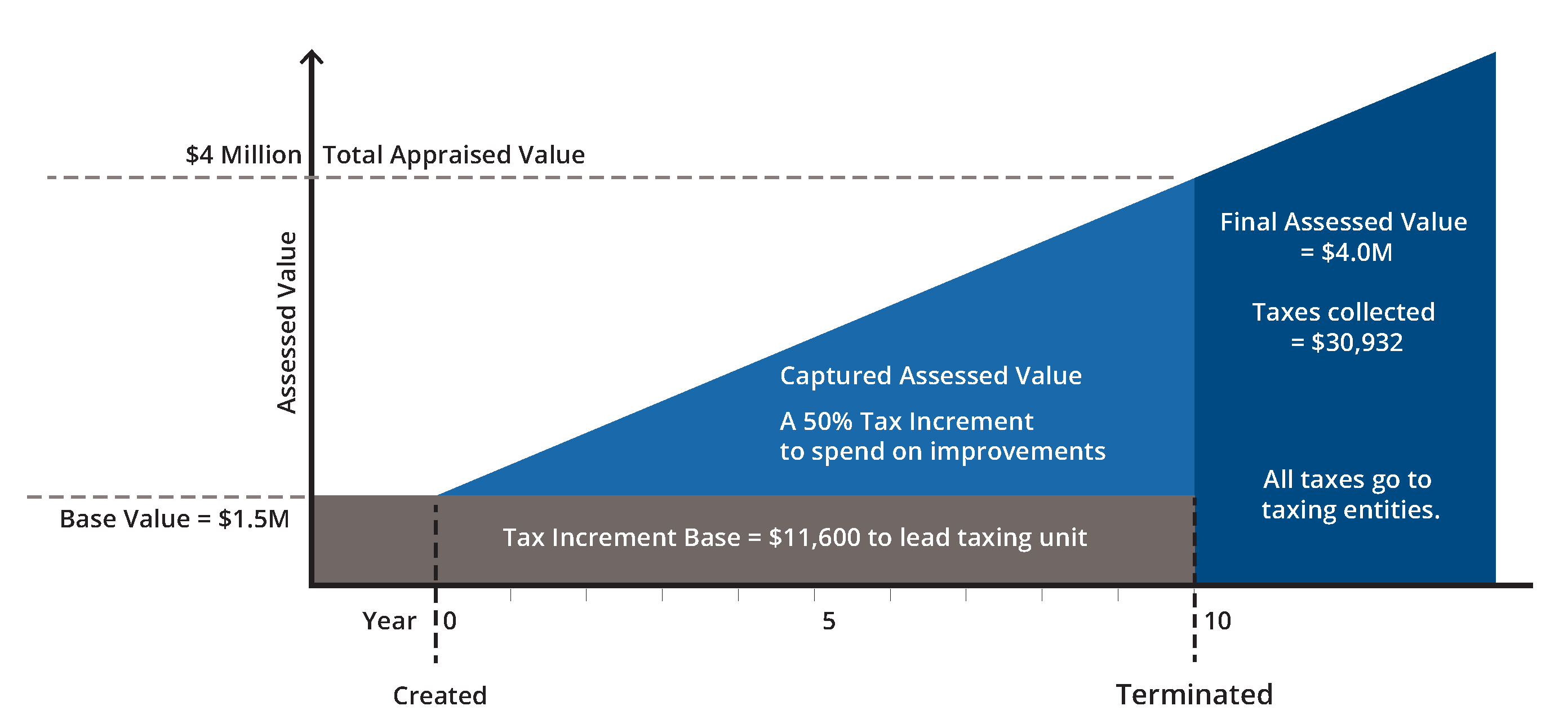
The city sets a “participation rate” that determines how much of the increment is kept by the city or sent to the TIF. Dallas participates in most of its TIF districts at 85 to 90 percent of the increment, meaning the TIF is keeping almost all the money.
We have a lot of active TIFs. Eighteen of them by my count. They cover many of the most important commercial areas of the city, including Downtown and Uptown, Farmers Market, Deep Ellum, Victory & American Airlines Center (“Sports Arena” technically), and Design District. In many of these areas TIFs have collected and paid out hundreds of millions of dollars since their creation, and several of them have been in existence for over thirty years, collecting increment off a base that has been frozen since the Clinton administration.
The theory behind a TIF is straightforward. A neglected or underdeveloped area may need expensive infrastructure or public assistance before private development would occur without subsidy. Once that development gets started, the TIF works like a flywheel, reinvesting growth back into growth.
The idea goes, the money that goes into the TIF is all revenue that would not exist without it. They aren’t soaking up all the taxes, just the amount created after the TIF was set up, growth which can be attributed to the TIF’s magnanimity.
The Control Group
The formula does not estimate what property values would have been without the TIF. It treats any and all value above the baseline as increment, and calculates the taxes diverted away accordingly. It does not subtract inflation, separate out the appreciation of old buildings from new construction, or estimate how much development would have occurred simply because Dallas is a large, growing Sun Belt city.
To try and do that myself, I pulled together a “same-store” sample of the six TIF districts that existed throughout the entire ten year period from 2015-2025 and whose boundaries were reasonably stable the whole time: Sports Arena, Design District, Vickery Meadow, Davis Garden, TOD, and Maple-Mockingbird.
The six districts grew from about $2.68 billion in taxable property value in 2015 to $7.32 billion in 2025, an increase of approximately 174 percent.
The entire rest of Dallas, the parts that have a TIF over them or don’t, saw their property tax base grow by about 132 percent.
Here lies the first problem. These six districts only beat the greater Dallas property value growth by around $1.1 billion. The tax increment that is collected is calculated against the entire $4.65 billion increase, without adjusting for inflation, general increases in property tax values, or controlling at all for what could actually be attributed to “good economic development” by the city.
You could rightly say: well, Kirk, 174% is more than 132%. You just proved that TIFs are working. Sure, and you won’t hear me argue that TIFs don’t work. Economic development being a good thing is not a justification to fund TIFs based on a formula that gives them full credit for growth they only partially produced.
Further, consider what areas many TIF districts cover. Downtown Connection includes much of Downtown and parts of Uptown up until about the Crescent. Sports Arena includes Victory Park and all the land surrounding the AAC as well as Trinity Groves. Deep Ellum has, uh, Deep Ellum.
These six districts were not made TIFs randomly. They contain rail stations, sports arenas, and major mixed-use projects that were planned before the TIF was created. They are among the best-located real estate in Dallas, and, importantly, they have some of Dallas’s most permissive zoning rules. The fact that they only produced an incremental 40% more taxable value than the rest of the city, when most other areas of the city are single-family homes with homestead exemptions and appraisal caps is perhaps its own indictment.
The PID Alternative
There is a better tool on the shelf for many mature areas, and funny enough, we already use it often. Dallas operates fifteen Public Improvement Districts, or PIDs, which fund supplemental services such as extra security, landscaping, street cleaning, lighting and marketing.
The critical distinction with a TIF is who pays. A PID levies an additional assessment (more taxes) on property owners inside the district. A TIF carves away a share of the ordinary City property taxes generated within the district and makes those revenues unavailable for unrestricted citywide use.
A PID asks a neighborhood to pay extra for something extra. A TIF allows a neighborhood to retain taxes assessed at a rate that the rest of the city is expected to pay for the ordinary cost of city government. The mechanics of the TIF accounting make it seem like the TIF district pays for things, when in fact it’s every other taxpayer in the city left footing the bill for the cops and roads that TIF-routed taxes aren’t paying for.
Funny enough, some areas in Dallas have both a PID and a TIF operating with mostly overlapping footprints. Downtown and Deep Ellum are two prominent examples. If a district’s property owners are stable enough to assess themselves extra for supplemental services, we should seriously evaluate why the City would continue diverting ordinary property taxes into the same geography.
Uptown here is our example. The State-Thomas TIF expired in 2008 and the Cityplace Area TIF expired in 2012. The Uptown PID, managed by Uptown Dallas, Inc., collected around $4.06 million last year from Uptown property owners and spent it on things that help make Uptown exceptional: the M-Line trolley, public safety, and other street and sidewalk improvements. There are many areas across the city where we should thank the TIF for a job well done, and ask neighborhoods that want above-and-beyond amenities to pay for them with a PID.
Don’t Let The Sun Go Down on Me
At its creation, a TIF plan is given an expiration date and an estimated project budget, an amount of money it is authorized to collect over its lifetime. The district is supposed to terminate when either the term ends or the authorized amount is collected. Both should serve to stop a TIF from becoming a permanent subsidy for certain parts of the City.
However, Dallas has fallen into a pattern of repeatedly amending both caps, the time and dollar horizon, across nearly all of its TIF districts. We have extended the maturity of seven TIF districts and only ever let three expire. One in North Oak Cliff that was formed in 1992 when Steve Bartlett was mayor, we have now extended until 2052.
Downtown Connection is the cleanest example. The district was created in 2005. By 2022, City staff reported that “explosive growth” in Uptown had caused it to collect increment sooner than expected. Staff projected the district would hit its original $231.6 million cap in 2026, nine years before its scheduled 2035 termination date.
There was a not-insignificant complication worth acknowledging here: Downtown Connection TIF had outstanding tax-increment revenue bonds extending beyond 2026. Allowing the TIF district to terminate when it hit the cap would have left the TIF expiring before it could retire that debt.
However, the Council did much more than make a narrow adjustment for existing debt. It increased the original subdistrict’s budget from approximately $454 million to more than $1.06 billion. Separately, it created the new Newpark subdistrict within the TIF to further expand the boundaries, with a fresh $90.3 million collection budget and a 2052 sunset.
For the few TIFs we do allow to expire, Dallas has created a retirement home of sorts for their tax increments. It is called the Infrastructure Investment Fund, or IIF.
When a TIF expires, the properties simply return to the ordinary tax rolls, with the district going away like it never existed. However, since 2023, the City has adopted a policy that for the first ten years after a TIF expires, the City will take the amount that TIF would have collected in its final year, and instead will transfer that amount to the new IIF account.
The Council must still appropriate the transfer from the general fund to the IIF annually, and also like a TIF, approve each of the projects. However, the policy commits the same original sin, by creating a presumption about where the money belongs before the rest of the budgeting competition with police, parks, and potholes begins.
The current annual payment to the IIF is modest, around $6 million per year, as only two TIFs have expired since the IIF was created. The concern, however, is what the IIF policy could balloon to if larger districts expire.
The entire premise of a TIF is that a temporary diversion catalyzes growth for a defined period, after which the revenue returns to the government. The premise of the IIF is that even after the geographic TIF expires, an amount equal to its last annual payment should remain dedicated to the economic development game for another decade. IIF or TIF projects can all individually sound like things the City should support. However, that is not an excuse to evaluate those projects in a vacuum away from everything else the city needs to spend money on.
The Trick
The central trick of tax increment financing is to make ordinary tax revenue look like a separate pot of money. It is not. No accounting fiction can make the money that goes into a TIF district anything other than a collection of property tax. My objection goes further than that, because our budget is rife with accounting fictions. The problems begin when we start acting as if we believe them.
Dallas starts each fiscal year with nearly 9 percent of our property tax revenue already designated for specific geographies, based on a formula that looks at values that in some cases are more than thirty years old. We begin each budget with well over a hundred million in taxpayer dollars that are not available for police benefits, to fix a pothole, keep a library open, or even to offer property tax relief. We are letting twenty or thirty years of appraisal growth in Dallas decide, on the city’s behalf, what the right amount to spend on economic development and real estate projects is, and worse, where they need to go, to the exclusion of the rest of the city.
This is silly. The city should absolutely spend money on economic development, and fund many of the projects that TIFs currently are used for. I’m not here either to pick a fight about the really great project in your neighborhood that got TIF funding. However, the flawed math of a TIF district is a terrible way to decide how much money we spend as a city as a whole on projects like this, and where. Add to that, the TIF program is becoming a larger and larger drain on the rest of the budget, mostly due to growth the TIF district itself didn’t plausibly cause.
When inflation makes police, roads, and parks more expensive to hire or maintain, the general fund and every other taxpayer paying into it have to eat that cost. When inflation makes land in a TIF worth more money, the TIF district gets the benefit. This is just bad policy design.
Spend All the Money We Collect
I think we mostly got here by accident. All of these TIF districts were created before anyone could have anticipated a decade in which Dallas property values would more than double. The formulas behind each TIF were just not designed to absorb growth on this scale. The math doesn’t contemplate it. What began as a limited economic development tool gradually became a claim on nearly one out of every twelve property tax dollars the City collects.
But, hey, now we know.
I have a few recommendations to operationalize this advice. None of this can happen overnight. TIFs have adopted plans, outstanding contracts and, in some cases, debt. Some of the TIFs cover areas that are legitimately still good candidates for prioritized, outsized public investment. Some today are not.
Going forward, Dallas should stop reflexively extending TIFs, expanding their boundaries and increasing their budgets whenever they approach the limits originally approved by the Council. We should begin winding mature districts down by first voting to decrease participation rates early, allow successful districts to declare victory and expire, and return their property tax growth to the ordinary City budget.
Also, a sunset should mean a sunset. That means ending the presumption that the last year of a TIF’s revenue should automatically become ten more years of IIF spending. If a project deserves City money, bring it forward. Put it beside every other street, drainage project, park, library, fire station and public facility Dallas needs. We have a very robust process to prioritize projects through the bond task forces. Let the Council and the public decide where it belongs in line with all our other priorities, in a budget. Otherwise, sometimes when you set aside money, the money finds a way to get spent. It becomes an answer in search of a problem.
Dallas is preparing to make painful decisions about basic services. Before we close libraries, reduce park maintenance, or tell residents that the City cannot afford the government they already pay for, we should at least begin every budget with a full view of all the money we collect.
It’s time to start making decisions as though all of Dallas’s property taxes belong to all of Dallas. I said it was a modest proposal.
love/hate/other to Kirk P. at onemansdallas@gmail.com
Insightful takes, thanks for sharing. Isn’t the real issue a lack of revenue, though?
great piece, something that isn't talked about. I ran businesses in both PIDs and TIFs.