
Our ongoing replacement of the Kay Bailey Hutchison Convention Center has got trouble with a capital T, which rhymes with B, which stands for Bridges.
The new convention center had its design altered last year to save the project around $600 million, namely by lowering the building out of the air by two stories. The building must be cantilevered in the air regardless; there are Union Pacific rail lines as well as DART tracks that run beneath it. However, the original design had it raised up so high that the existing Jefferson Boulevard viaduct, which is one of the bridges connecting Oak Cliff to Downtown over the Trinity River, could pass uninterrupted underneath.
Doing that ain’t cheap. The proposed lowering of the building would save money (hundreds of millions, but who’s counting) but make that vertical stacking impossible, making a perfectly good bridge dead-end into the back of the new convention center.
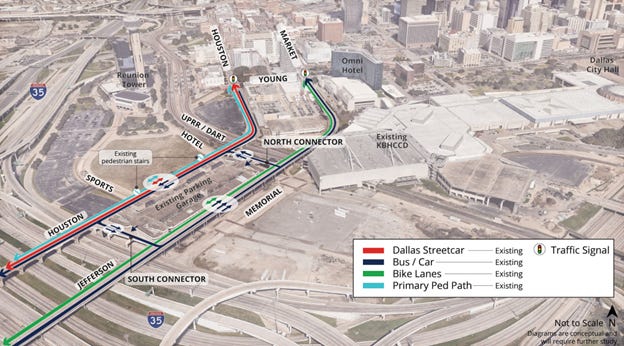
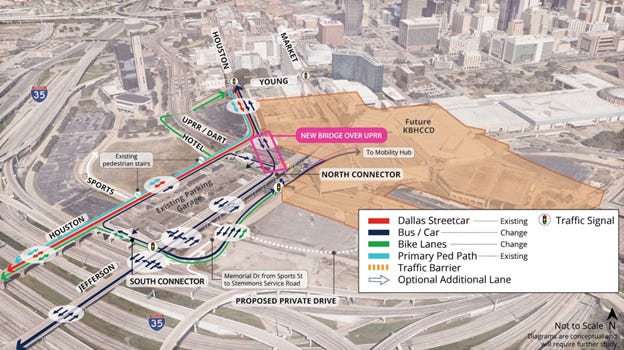
While the convention center is under construction, there would be a re-routing of Jefferson Street first on to the parallel Houston Street Bridge, which would temporarily become one lane each way. Eventually, a new ramp off of Jefferson would be built around the convention center, making the bridge dump out before it dead-ends into a time-wasting loop-de-loop past Reunion Tower. Still open, but annoying.
Traffic engineers hired by the city estimated the greatest impact would be during construction when traffic both ways drops from five total lanes to two, creating a ten-minute delay for commuters from Oak Cliff entering Downtown this way at peak morning rush hour. This delay drops to a permanent two-minute increase after construction is done.
That future two-minute trip relies on a new permanent solution to be built, when the city would build a new bridge over the railroads to make the old Jefferson bridge, well, a bridge again. That is, if said new bridge ever gets built. It’s a $100 million proposition on its own, assuming we get Union Pacific and DART to agree on letting us build over their railroad. Also, we haven’t identified a funding source or even a design for it. Small details, really.
People in Oak Cliff pushed back. It was the thing to talk about in Dallas, and especially in Oak Cliff, for about two weeks in mid-June. Proposals were made to return to the original, more expensive convention center design to avoid disrupting the bridges.
In its final meeting before summer break on June 24th, the full city council voted 9-6 to reject that recommendation and instead keep the lower and cheaper convention center design, and in turn, permanently change the alignment of Jefferson as it enters Downtown. We’ll talk about why that was the right decision, but that’s not actually the story here.
I didn’t write about the Oak Cliff viaduct fight before the vote. I didn’t think the policy question was important enough to merit a position from someone who doesn’t live nearby, or that there even was a policy question buried here in the first place. I still don’t. In our fifteen-minute-news-cycle world of 2026, some of you are probably already wondering, is this guy still talking about the bridges?
So, I am breaking my own personal rule (yes, this place has rules) and I am writing about an issue that’s already been voted on. Here’s why. I would submit the Oak Cliff viaducts fight is perhaps the richest text we’ve gotten in a while for understanding how politics in Dallas actually works right now. The fight, the public rhetoric, the way information moved and mutated, the city’s own role, the 9-6 split, and the coalition on council that formed all make this issue one of the most informative microcosms of this moment’s politics.
Dallas has thankfully given us a month to think about anything else while the city council is in summer recess. When we come back in August, we will have the same old politics, the same old fights, and the same old problems to deal with. It’s been a terrible start to the year. I can’t imagine anyone would disagree. I don’t think the second half is going to get much better, as it necessarily will feature a fight over the annual budget, when cuts to, uh, everything (which in Dallas means everything except Police & Fire) seem to be on the table.
This is a case study, and the month off from council meetings now gives us a chance to chew on it and read it like one.
The General Observation
None of this needed to happen. That is the plainest and most honest way I can describe this entire situation, being downstream of a convention center project that was so wildly ambitious that there was even $600 million from a budget to cut in the first place. The convention center team, which includes departments of city staff as well as private developers, contractors, and architects, designed no fewer than sixteen potential layouts of the convention center over four years. They settled on Option #15 in part because it was one of only two layouts (Slide 15) that were rated “excellent” for the evaluation criteria of “Connectivity” and “I-30/UPRR Constraints,” referring to the interstate highway and railroads that surround the building. The plan would have preserved the Jefferson viaduct as-is.
That was, of course, before the building had to be dropped out of the air and right into the middle of the Jefferson viaduct. When Option #15 ceased to be the best option because it wasn’t really Option #15 anymore, they should have gone back to evaluate the dozen other alternatives instead of pretending the cheaper, worse version of the best idea was still the best idea.
Then, when the convention center team realized they would cut off the bridge, the right time to start talking about it was immediately. Staff presentations to the council as recently as January 2026 (Slide 25) still show renderings with Jefferson Street passing beneath the convention center, well after the re-design. Presentations that same month to the Transportation Committee show maps of road closures and clearly label some of them as permanent. Jefferson Street is not one of them, marked only as being closed from 2026 to 2029, but there is no mention of the fact that a section of it, the section that actually makes it a bridge to somewhere, would be permanently removed.
It is honestly hard to distinguish whether they only recently stumbled upon the fact they designed a building in the middle of a bridge, or if they decided to sit on it for as long as possible until the manufactured urgency of cost overruns and delays would force the council’s hand. During the June 24 meeting, Councilmember Chad West pressed staff on this exact issue after they claimed council should have known about the closure for over a year, bringing out the actual presentations and catching staff completely flat footed. Between incompetence and dishonesty, I’m not sure which one I prefer as an explanation here.
Other People’s Money
The city has limited funds with which to build the convention center, namely, future collections of hotel and related tourism taxes. While hotel taxes are usually pitched as “other people’s money,” (in fact, in 2022 Mayor Johnson campaigned for a tax increase related to the convention center by saying it would “be funded entirely by visitors”), it is still possible to run out of other people’s money. That seems to be the case at the convention center, where projected future collections of hotel taxes support us borrowing convention center debt (plus cash on hand) of a little under $3 billion, while the project has a total cost that has been reported as high as $3.8 billion.
If the math isn’t math-ing to you, don’t worry, we have a plan to sell the convention center naming rights to close this nearly billion-dollar budget gap. That sounds silly because it is. Fort Worth is in negotiations to sell the naming rights to its convention center for as much as $500,000 annually. Financed over the life of the project, that would support around $5 million in debt.
As funny as the Southwest Airlines Kay Bailey Hutchison Convention Center could be, we would need to sell the naming rights to this building more than one-hundred-times-over to close the projected budget gap. The math flies in the face of a recent claim from the Assistant City Manager over Convention & Event Services, Robin Bentley, that a “large percentage” of how we would fill the gap was to come from selling the name, per the Morning News’s Devyani Chhetri.
Add it to your vocabularies, everyone: “a large percentage” in Dallas now apparently includes “less than one percent.” I can already foresee getting good mileage out of this one. I plan on telling my wife I have remembered to take out the trash or unload the dishwasher “a large percentage of the time.” I digress.
The Plan Before the Plan Before the Amendments To The Plan
This is a minor point, but there is a detail of the story that belongs right next to the other regrettable and unnecessary decisions by the city convention center team that led to any of this happening. The City and North Central Texas Council of Governments (NCTCOG, or “the Cog” to the cool kids) have already paid for and conducted a long-range traffic planning study on Houston and Jefferson Viaducts. No fewer than five community meetings were held in 2024 and 2025 with Oak Cliff residents about a future plan for these bridges, which feature a streetcar, walking paths, bike lanes, and two directions of travel.
The study recommends converting Jefferson into a bridge for two-way car travel, while converting the three-lane Houston into a pedestrian, bike, and streetcar bridge only. The city would also realign the Zang, Colorado and Jefferson around the site of the former Oak Farms Dairy with the goal of increasing connectivity to Downtown and taking up less space as public right-of-way. It’s a plan that serious people spent serious time, treasure, and talents on, and the community was briefed on it for several years.
The City’s new alignment of the convention center essentially makes this plan impossible. We cannot go forcing all vehicular traffic onto the bridge that isn’t a bridge any more. This whole Oak Farms mobility plan goes back to the drawing board until the City can figure out how to replace the section of Jefferson that it removes when it builds the convention center, if you recall, that unfunded, undesigned $100 million bridge over railroad tracks we don’t own or control.
We had a plan for these bridges that people at the City and the community worked on together for years. The convention center needed to be shorter and that all went out the window. This was another unnecessary “own goal” by the City, if we are still allowed to use soccer metaphors. (I do miss the World Cup already.)
What’s Actually Happening to the Bridges
This whole story got muddled badly, and some of the muddling was organic and some was strategic. During construction, the northern stretch of Jefferson will be closed for construction work where the bridge comes within 30 feet of the convention center. That closure was happening regardless of how the council voted. Throughout construction, each bridge will continue to exist, albeit in a new alignment that pushes traffic headed into Downtown onto one shared bridge at first, and later down a ramp and around Reunion in what will be one of Dallas’s most confusing detours.
However, you can still drive on these bridges. The bridges will still be there.
As complicated as the plan is, and the fact that the route will change three times between now and 2029, a few things are undeniably true. The bridges are not closing. They are not being demolished.
If you went online and read about this story, you would never know this.
The plan is complicated, so it is understandable why people gravitated to the worst and wrong version of the facts. The problem is that the worst and wrong version was also the version some people chose to amplify. The rallies were called “Save the Bridge.” Flyers handed out by activists on the bridges to cars passing by read, in all caps, “the bridges would be closed or cut off in just days.” A YouTube video posted by one activist last week is titled, “Bye Bye Jefferson Bridge.” Some public speakers at the June 24 council meeting very clearly genuinely believed the bridges were being torn down.
When you know that they aren’t and you don’t correct it because the panic is useful, we’ve crossed a line from honest confusion into weaponizing misinformation. Or, more simply, lying. If lying is too strong a word for this, how about: “not telling the truth.” The rhetoric on one side of the bridge debate very clearly took advantage of a perception, or even amplified one, that something much worse was happening to these bridges than an annoying re-alignment that represents an addition of roughly ten or two minutes to people’s commutes in one direction.
There is ultimately a broader philosophical point here, one of the reasons I do this blog, and one of the reasons I think our local politics is worse off than it has any reason to be. People are far too comfortable these days lying or stretching the truth in the pursuit of political goals.
Please don’t hear this as a tsk-tsk. I am also a “citizen journalist” (if that isn’t an oxymoron) doing much of the same work as people keeping their neighbors informed on Facebook, email chains, and Nextdoor posts. The temptation in politics however is always to win, and ends are often made to justify means.
That’s not the city any of us should want to live in, the one where the side that’s willing to lie the most always wins. Lying to get your way just makes you a liar. When we get too comfortable letting this genie out of the bottle, it is eventually going to come back to bite you in the ass when you are on the side against the ‘convenient lies’ in the next fight.
The Double Standard
We hold bridge disruptions to a completely different standard than roads. We close roads all the time in this city for construction. It is annoying, but it never generates a yard sign.
The plausible difference is that a bridge is as much a metaphor as it is infrastructure. When someone says a bridge is being taken away, it sounds like real separation. Oak Cliff has plausible historical reasons to hear it that way. The push for the construction of the Houston Viaduct came after the Flood of 1908 where the Trinity River briefly became two miles wide, and Oak Cliff could only be reached by boat.
But, there are some numbers here worth keeping in perspective, from TxDOT’s Statewide Traffic Count Map. About 4,600 vehicles per day use one viaduct (into Oak Cliff on Houston) and 7,200 use the more-affected bridge (into Downtown on Jefferson). In comparison, over 175,000 cars cross the Trinity to Downtown on I-30 daily. Another 110,000 cross the river the same direction on I-35. The West Commerce Street Bridge a mile to the north sees 12,000 cars per day, while the Margaret Hunt Hill sees 36,000. A mile to the south, the Corinth Street bridge sees 9,700 cars. In other words, there are seven bridges from North Oak Cliff and West Dallas to Downtown, and Houston and Jefferson are the sixth and seventh most popular ones.
If the claim is that redirecting a bridge will “cut off” our communities, the existence of five other, more popular bridges would beg to differ.
We, for a moment, with the support of six members of the city council, considered spending $600 million in order to help keep the commutes of roughly 7,000 people a little shorter, when there are five other ways to cross the Trinity within a mile of the Jefferson viaduct. If we assume this would have saved every commuter going into Downtown on Jefferson the full 10 minutes five days a week for three years, we would have spent over $100 per morning commute.
We do not treat any other road project in this city with that kind of deference, especially with that small a number of affected commuters and very especially not at this proposed cost. If we started to, it just might be time to let Fort Worth annex us.
The Coalition That Doesn’t Make Sense
The vote to keep the cheaper, lower convention center design was 9-6. If that sounds familiar, it’s the same vote count for and against nearly every measure related to leaving City Hall that has been voted on in 2026. The six who voted to preserve the viaducts were Councilmembers Mendelsohn, Roth, Ridley, Bazaldua, Cadena, and West. The City Hall six is Councilmembers Mendelsohn, Roth, Ridley, Bazaldua, Cadena, and Blackmon. You’ll count two flips. Chad West and Paula Blackmon switch places. Everyone else stayed locked in formation.
This doesn’t make any sense to me. There is absolutely nothing on its face that makes the Oak Cliff bridges vote even a little bit like the “Leave City Hall” votes.
Let’s take the two votes that most prove this point in my eyes. Councilmembers Roth and Mendelsohn represent parts of far north Dallas. Their constituents do not use these bridges and these councilmembers are often vocal about fiscal responsibility. The facially fiscally conservative position here was straightforward: don’t add half a billion dollars and more delay to a project already costing north of $3 billion. Inconvenience a few people in Oak Cliff by adding two minutes to their commute that don’t vote for you anyways.
Here’s why I bring this all up. We need an explanation for why the two most fiscally conservative members of council voted to spend half a billion dollars to help the commutes of one-half of one percent of the city’s population. The only explanation that can square this for me is that this is more of a Kim Tolbert referendum than a bridge vote.
If this is a proxy vote on whether you trust the city manager’s judgment, then maybe it’s also the same vote the council has been taking all year, over and over again on City Hall.
That should completely reshape how we talk about and even how I understand the City Hall fight. In my head, the City Hall relocation came from some combination of the Mayor, a few key leaders on the council, maybe a few key private sector voices who were in their ears, all fighting to keep a Mavericks Arena project alive in Downtown. The bridges vote gives me reason to update that prior belief.
This is the step that the “greedy developers have paid off our council” narrative around City Hall skips over. This is not the Mayor’s great idea or even something the nine members arrived at after having an envelope full of cash slid to them. The city manager thinks relocating is a good idea, and the nine votes follow from there, rather than the other way around.
Two people flipped from their recent votes. At a surface level, Chad West is the more tempting one to write about, but he is actually the least interesting of all fifteen votes. A council member who represents North Oak Cliff voted to protect North Oak Cliff’s connection to downtown. Color me shocked.
What makes his vote more interesting is the op-ed that he published in the Dallas Morning News on June 24, the same day as the viaduct vote. His primary criticism was that “staff” has produced no transparent plan for what happens to the City Hall site if the city vacates. He even connected the two issues explicitly, citing the viaduct rerouting as an example of the same short-sighted planning by “staff” now hurting his district.
The word “staff” appears seven times throughout that piece. Staff has no plan. Staff is rushing the decision. Staff’s recommended convention center alignment would cut off Oak Cliff’s connectivity. In Dallas city government, “staff” sometimes means the people who work for the city. But sometimes it just means the City Manager herself.
What the Vote Tells Us
Three things at least are true here at the same time.
First, the council got it right on June 24. I’ve already spent more words than I meant to on the arithmetic, so I won’t relitigate it. You do not spend $600 million to protect ten minutes of somebody’s morning when there are five other ways to cross the Trinity less than a mile away.
Second, the council should have never had to vote on it. Somewhere in a parallel universe there was a version of the last four years in which the convention center team, upon discovering that the cheaper building would land in the middle of a bridge, figured that out and said so, last year, in a public meeting, before the project broke ground.
Third, by the time the vote happened, there wasn’t a vote about bridges happening at all. It was a 9-6 vote, the same vote we’ve been having all year. Whatever was printed on the agenda that day, the thing actually being voted on was whether you will take the city manager’s word for anything.
A city runs on the assumption that when the government tells you what it’s doing, that’s what it’s doing. Every part of local politics that works or doesn’t is downstream of that. Public hearings, agenda items, the people who show up to speak for three minutes, all of it presumes we’re arguing about the same set of facts. When the facts stop being reliable, we don’t stop arguing. We just start arguing about people instead. Can we trust them? Are they corrupt? Are they listening to us? That’s cheaper and faster and it feels really great, and it produces exactly the politics we have.
That’s how you get a flyer in all caps saying the bridges are closing in just a few days. Not because people in Oak Cliff are gullible, but because the alternative is that you believe the City’s version of the story, which wasn’t the truth either. The lie worked as well as it did because the truth was never in the room with us in the first place.
I said earlier, the city where the side that’s willing to lie always wins is the city none of us should want to live in. That standard has to start and end with our own city government, its staff and manager.
I opened this piece with a Music Man joke, and I have deleted several others from an already lengthy piece. In the musical, the trouble with a capital T that Harold Hill sold River City on wasn’t real either, and the joke of the show is that a con-man leaves town better off than he found it.
I guess we ended up there too. We saved $600 million, the convention center doesn’t get more delayed, and Jefferson can still be a bridge to somewhere again as soon as the Wells Fargo wagon brings us $100 million to pay for it. Fine.
It took a lot of lying to get there. Nobody should want to run a city this way, where the right answer arrives by accident at the end of an argument neither side was having in good faith.
We spent June pretending to argue about a bridge. We’re going to spend the rest of the year pretending to argue about a budget, when we’re all just really fighting over whether we trust the City Manager. It would save everyone a lot of time if we all just said that’s what this was really about, and maybe, could all start telling the truth.
Love/hate/other to Kirk at onemansdallas@gmail.com
EDIT: an earlier version of this post stated that Councilmembers Roth and Mendelsohn flipped their votes on convention center redesign following earlier discussions in the transportation committee. They voted ‘YES’ in committee to send the issue to council, and ‘NO’ at council against a “motion to deny” the item. However, both of those votes had the same effect, to save the bridges. Apologies to both.
Oh you sweet summer child. Our budget arguments have actually been about "whether we trust the City Manager" since at least Mary Suhm and AC 3000.
I'd also argue that when someone like Councilman West repeatedly incants the word "staff," it's not just "the people who work for the city" OR "the City Manager herself" but the whole idea of an unelected bureaucracy making consequential decisions, which is why the City Hall debate has led directly to us once agin litigating our council-manager form of governance.
(Judging by her recent D article, I'm guessing former Mayor Miller would argue this all goes back to John Ware [whom she very pointedly was sure to mention hired Tolbert way back when] but I wasn't around for that regime.)
But that's okay because it was all worth it for this banger line: "The lie worked as well as it did because the truth was never in the room with us in the first place."
Now next time please drop all of your intended Music Man references, those of us who made it through all X,000 words have earned as much.
Nice piece, agree it was well muddled all around. One thing that was interesting and continues to be is Hunt Consolidated's position that those areas are theirs and they can refuse the plans. I think bc hunt owns all the land around reunion, all of it. It goes back to an old agreement when they did reunion. There was a press statement and then nothing after that.